Le siège de Corinthe

Le siège de Corinthe is a 1826 reworking, for Opéra de Paris, of Rossini’s earlier Maometto II so besides, of course, being in French it is restructured as a three act tragédie lyrique with a substantial ballet in Act 2.  The plot is straightforward enough.  It’s the mid fifteenth century.  Mahomet II is besieging Corinth but unknown to him the king, Cléomène’s, daughter Palmyra is the girl he fell in love with during an incognito trip to Athens.  Cléone has promised Palmyra to his top warrior Néoclès.  After Corinth falls Mahomet promises clemency to the Greeks as long as Palmyra marries him.  She agrees and is cursed as a traitor by her father.  The marriage doesn’t happen for various reasons and Palmyra flees to the camp of the once again revolting Greeks.  When they are defeated for a second time she commits suicide rather than submitting to Mahomet.

1.bottles

Continue reading

An unusual lunchtime recital

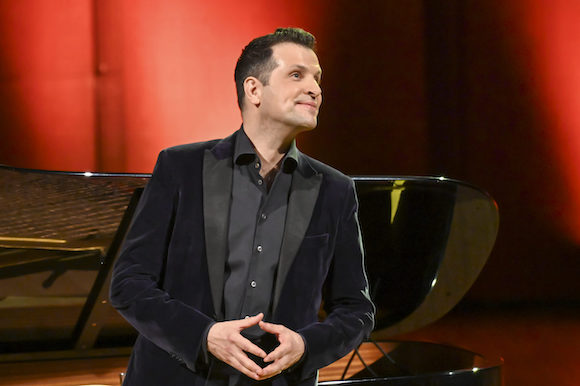
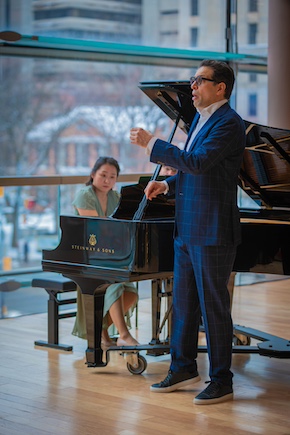
Luca Pisaroni, currently singing in the COC’s The Marriage of Figaro, and pianist Timothy Cheung performed in the RBA at Tuesday lunchtime.  It was unusual and what was unusual was the choice of repertoire; rarely heard 19th century songs by composers who are much better known for opera.  In fact I’m not sure I had heard any of the programme before.

lucapisaroni Continue reading

February 2023

february2023Here’s what I’m looking forward to in February plus a few gigs I can’t make:

  • February 1st and 2nd the Chicago Symphony and Riccardo Muti are performing at Koerner Hall.  It’s a rare opportunity to hear a top orchestra in the wonderful Koerner acoustic but it’s probably sold out already.
  • On February 3rd the COC opens a run of Richard Strauss’ Salome with Ambur Braid in the title role and a stellar supporting cast.  Hard core Braid fans (and that includes me) know that this is a role she was born to sing.  It’s an Atom Egoyan production and he’ll likely tweak it but here’s a link to my review of the 2013 run.
  • February 6th sees the return of the Quilico Awards; a competition for the singers of the Ensemble Studio.  That’s at 5.30pm in the RBA and it’s free.

Continue reading

Hoffmann in Hamburg

The 2021 recording of Offenbach’s Les contes d’Hoffmann from the Staatsoper Hamburg is fairly straightforward but it’s visually interesting and musically excellent.  I don’t think Daniele Finzi Pascas’ production has a “concept” as such.  It’s still about three imaginary women who make up Hoffmann’s dream woman and he still ultimately rejects even her in favour of Art.  Each of the five acts is given as different and distinctive look and feel though the use of mirrors and aerial doubles is a recurrent theme.  It’s worth noting up front that Olga Peretyatko sings all four ladies.

1.kleinzach

Continue reading

A brace of baritones

Last night Thomas Hampson, his son in law Luca Pisaroni and pianist Vlad Intifca appeared at Koerner Hall.  It was a curious program.  The first half was made up of opera arias and excerpts.  There was a sequence of Conte/Figaro and Leporello/Don G numbers.  They were, of course, very well sung.  Both singers are noted exponents of these roles but I really didn’t see the point.  They were pieces I’m sure pretty much every audience member has seen with orchestra, on stage, multiple times.  With piano accompaniment it all seemed a bit pointless.  There followed two longish scenes; the Riccardo/Giorgio confrontation from I Puritani and the scene from Don Carlo where Posa pleads with the king for a change in policy in the Netherlands.  These worked better; perhaps because they are less familiar but more likely the fact that each featured Pisaroni in a genuine bass role.  This allowed for more variation of timbre and colour than the Mozart pieces.

DSC_5885

Continue reading

April shows

butterfly-square… plus a late March addition…

March 29th and 30th Tapestry are doing the Songbook thing again.  This is the show where an established singer; Jacqueline Woodley this time, works with emerging artists and a pianist (Andrea Grant) plus director Michael Mori to create a show based on Tapestry’s back catalogue.  There are three shows at the Ernest Balmer Studio in the Distillery; Friday at 8pm and Saturday at 4pm and again at 8pm.

Continue reading

Hytner’s Così

Nicholas Hytner’s production of Mozart’s Così fan tutte, seen at Glyndebourne in 2006, is about as traditional as it gets.  The story is straightforwardly told and the settings and costumes are 18th century Naples, or at least some operatic approximation of it.  That said, it’s immensely enjoyable and, just occasionally, goes beyond the superficial.  The strength lies in the casting and in the director’s decision to allow his young singers to behave like young people.  Miah Persson as Fiordiligi and Anke Vondung as Dorabella are close to perfect in their exuberant girlishness.  Naturally Vondung gets to be a bit ditzier than the angstier Persson because that’s how the thing is written.  Both of them sing extremely well too and there’s nothing lacking in the big solos or duets.

1.officers

Continue reading

Brisk and attractive Figaro

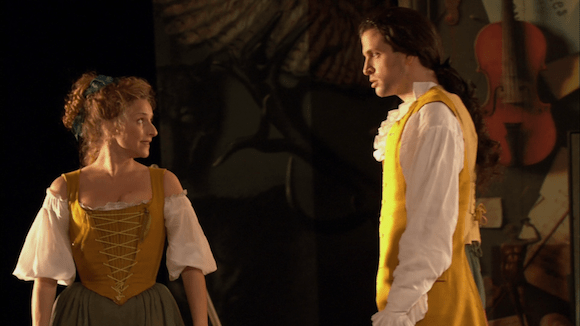
This recording of Mozart’s Le nozze di Figaro was made in 2004 and released on DVD, which won a Grammy.  It’s now been remastered and released on Blu-ray.  It was recorded at the Théâtre des Champs Elysées in Paris and directed by Jean-Louis Martinoty.  The production is visually attractive and well thought out but not concept driven in any way.  The sets are largely made up of 16th century paintings while the costumes are the operatic version of the 17th or maybe 18th century; low necklines, full skirts, breeches etc.  There are a few interesting touches.  Act 3 is set in the count’s curio room with dead reptiles, skulls and so on and it seems somehow to provoke extreme nostalgia in the countess during Dove sono.  For the most part it’s a highly competent, well paced effort though with nothing new or different to say.

1.figarosusanna

Continue reading

Completing the Bechtolf trifecta – Le nozze di Figaro

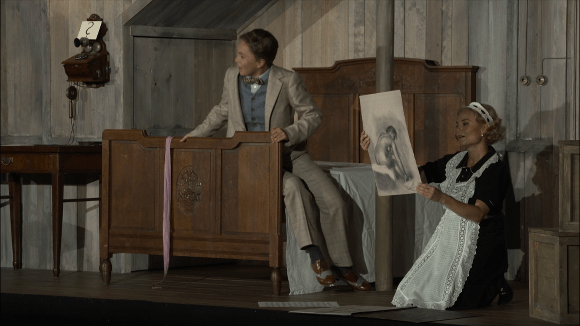
Sven-Eric Bechtolf’s stagings of the Mozart/da Ponte operas in Salzburg concluded in 2015 with Le nozze di Figaro.  I think it’s the most successful of the three.  Bechtolf’s strengths lie in detailed direction of the action rather than bold conceptual statements and Nozze is probably the least in need of, and the least amenable to, the big Konzept.  There aren’t any real dramaturgical problems to solve.  It just works as written.  I don’t think that’s so true for Don Giovanni or Così.

1.sketch

Continue reading

Bechtolf Round Two – Don Giovanni

Sven-Eric Bechtolf’s second Mozart/daPonte for Salzburg was Don Giovanni which premiered in 2014.  There are some similarities with his Così fan tutte.  He uses a symmetrical unit set again and shows a fondness for creating symmetrical tableaux vivants but there the similarities pretty much end.  I could find a consistent, believable set of humans in Così but not so much in Don Giovanni.  The problem is really the man himself.  Bechtolf, in his notes, seems to be arguing that Don Giovanni can make no sense in an age of pervasive accessibility and exposure to all things sexual.  Da Ponte’s Don requires a climate of sexual repression for his essence; to Bechtolf a kind of Dionysian force (he cites Kierkegaard), to make any sense as a human.  I think I get that but then, I think, the challenge becomes to create a Don Giovanni who does make sense to a 21st century audience as, in their different ways, do Guth and Tcherniakov.  Bechtolf seems to treat the character not so much as a human rather than as a kind of energy focus who exists by igniting aspects of the other characters; whether that’s lust or jealousy or hatred.  He caps off this idea at the end by having Don Giovanni reappear during the final ensemble as a kind of mischievous presence still chasing anything in a skirt, even if it’s, perhaps, from another world.  It’s an idea that I could not really buy into.

1.stab

Continue reading