Completing the Bechtolf trifecta – Le nozze di Figaro

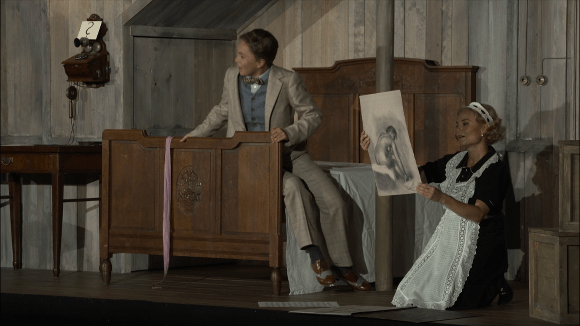
Sven-Eric Bechtolf’s stagings of the Mozart/da Ponte operas in Salzburg concluded in 2015 with Le nozze di Figaro.  I think it’s the most successful of the three.  Bechtolf’s strengths lie in detailed direction of the action rather than bold conceptual statements and Nozze is probably the least in need of, and the least amenable to, the big Konzept.  There aren’t any real dramaturgical problems to solve.  It just works as written.  I don’t think that’s so true for Don Giovanni or Così.

1.sketch

Continue reading

A new Salzburg da Ponte cycle – Così fan tutte

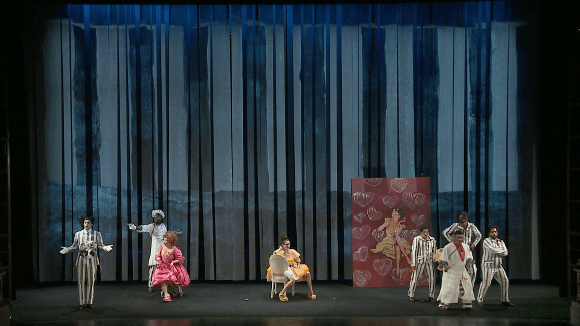
Every few years the Salzburg Festival replaces the productions of the three Mozart/da Ponte collaborations with new productions.  At least in recent years they have entrusted all three to the same director but the “refresh” happens in different years and not always in the same order.  I reviewed Claus Guth’s offerings here (Le nozze di Figaro, 2006; Don Giovanni, 2008; Così fan tutte, 2009) and noted the way that certain linking elements developed over the course of the “cycle”.  I was interested to see whether the same thing held for the newest iteration by Sven-Eric Bechtolf.  All three have now been released on Blu-ray (though due to availability issues I have the Così on DVD) so I thought I should watch them in the order they appeared at the festival and see what transpires.  So here we go with Così fan tutte recorded in 2013 in the Haus für Mozart.

1-guys

Continue reading

La fuga in maschera

I find it interesting the way some opera composers become canonical to the point where their most unsuccessful (often deservedly so) works still get produced while others, equally famous in their day, disappear pretty much entirely.  One of the latter group is Gaspare Spontini who had a long career stretching from the the late 18th into the middle of the 19th centuries during which he was active in Italy, Paris, Vienna and Germany.  There was a revival of his La Vestale at La Scala with Visconti directing and Callas in the title role but otherwise the 20th century pretty much ignored him.  So obscure had he become that the Wikipedia entry for his operas describes his La fuga in maschera as “genre unknown”.  Perhaps that’s not so surprising as the work was last performed in 1800 and the score was thought to be lost until it turned up in an English bookshop in 2007.  Subsequently it was performed in 2012 at the Teatro GB Pergolesi in Jesi as part of the Festival Pergolesi Spontini.

1-portrait

Continue reading

Guillaume Tell

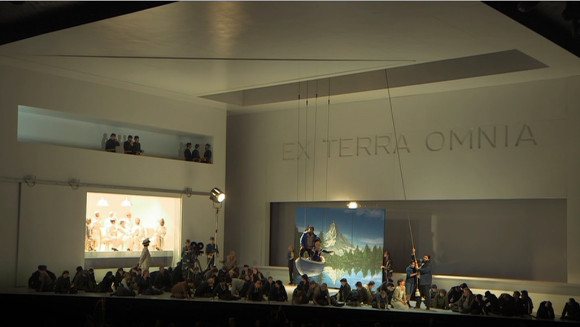
Rossini’s last opera, Guillaume Tell, was written for Paris and is an extremely ambitious piece of great musical sophistication.  It’s also very long.  Performed uncut, a rarity, it runs something like four hours including ballets.  It’s also hard to cast with the role of Arnold Melcthal in particular making unusual demands.  It’s a high tenor role combining the flexibility needs of a typical Rossini role with something much more heroic.  The soprano role of Mathilde has some of the same issues; signature Rossini coloratura is combined with the sort of dramatic heft one might more associate with early Wagner.

1.boat

Continue reading

Eine Frau von Heute

I don’t usually associate Arnold Schoenberg with comedy but he did write a one act comic opera Von Heute auf Morgen which premiered in 1929.  It was an attempt to cash in on the vogue for satirical operas on modern themes characterised by Brecht and Weill and , if a bit slight and lacking Brechtian punch, it works well enough.  A bourgeios husband and wife have returned from an evening out where they have met an iold friend of the wife who has become something of a femme fatale.  There’s also a singer, inevitably a tenor, involved.  The husband is rabbiting on rather gormlessly about the charms of the “other woman” so his wife decides to teach him a lesson.  She apes the manners of a “modern woman”, neglects their child, plans assignations etc.  There’s a long phone conversation inwhich the “friend” and the singer invite them back to the bar.  By now the husband is beginning to realise what he stands to lose.  The wife realises she has won.  The other couple show up and there’s a “modern” vs. “traditional” quartet after which the “moderns” leave in disgust and the husband and wife revort to bourgeois domesticity.

1.couch Continue reading

Bard of sex and Eros kinky

The sudden death of Italian opera has always intrigued me.  Works, by Italians or to Italian libretti, dominated opera houses, at least in the English speaking world, for centuries.  The Metropolitan Opera even commissioned new work in Italian (Puccini’s La Fanciulla del West, 1910).  But after Turandot (1924) new works in Italian pretty much dried up.  I can’t think of a single one that could be considered a repertory staple and even more recherché pieces like Pizzetti’s Assassinio nella Cattedrale are few and far between.  Indeed, since WW2 at least, the dominant language for new operas has been English with German some way behind and the odd work in French or something more obscure.  So, I was intrigued to get my hands on a recording of Luca Mosca’s 2007 work Signor Goldoni; a commission for Venice’s La Fenice inspired by the 18th century Venetian playwright and librettist Carlo Osvaldo Goldoni.  What’s really surprising is that the libretto (perhaps we should say “book”) by Italian writer Gianluigi Melaga, is in English!  Apparently librettist and composer consider that English is better adapted to the kind of word play they were aiming for than Italian.

1.rafael Continue reading

Adelaide di Borgogna

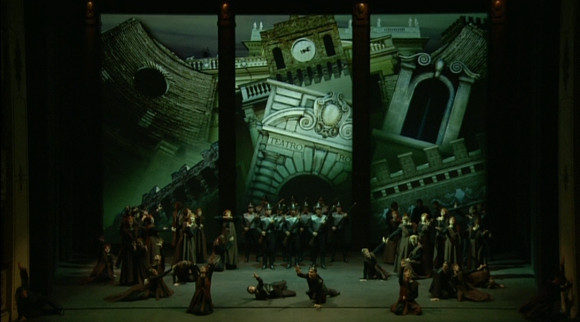
Adelaide di Borgogna is one of those rather odd “serious” Rossini works where bel canto collides with opera seria.  The plot is fairly accurately based on an episode from 10th century history and is most definitely not a comedy.  The form has progressed well beyond a succession of da capo arias with multiple ensemble numbers and quite a few choruses.  But there’s a throwback to an earlier tradition in the use of high voices for heroic male roles though it seems that by 1817 castrati were rather rare and the crucial role of Ottone, the German emperor, was from the beginning sung by a female contralto.

1.teatro Continue reading

Born to the anvil, not the hammer

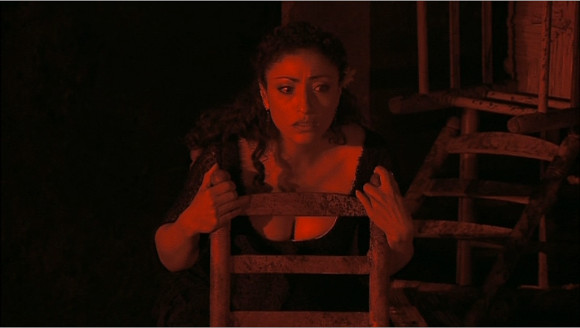
Manuel de Falla’s La Vida Breve is often credited with being the first true Spanish opera.  It’s certainly one of very few works in that language one might encounter in an opera house.  It’s hard to see why it’s not performed more often.  It’s a dramatic story about the tragic love affair of a gtpsy girl and a wealthy young man and the music is a blend of verismo and flamenco.  The orchestration is quite exciting and the Spanish influenced vocal lines are very easy on the ear.  It really ought to have a rather wide appeal.

1.salud Continue reading

Chen Kaige does Turandot

Zubin Mehta seems to be making a habit of teaming up with Chinese film directors to stage Turandot.  This time the director is Chen Kaige (Farewell My Concubine) and he chose Liu King and Chen Tong Xun to do the sets and costumes.  The production in question took place at Valencia’s I Festival del Mediterrani in 2008.  It’s actually in an opera house rather than on location in the Forbidden City but this production ends up having a rather similar look and feel to Zhang Yimou’s earlier one.

1.moon Continue reading

Assassinio nella Cattedrale

I’ve often wondered what happened to Italian opera after Puccini because nothing much has ever come my way.  That is until today when I got my hands on a DVD of Pizzetti’s 1958 piece, Assassinio nella Cattedrale which is closely based on the Eliot play.  Murder in the Cathedral is, when one thinks about it and how Eliot uses the chorus, a really good basis for an opera libretto.  The libretto sticks pretty close to the play and Pizzetti provides a tense, dramatic score which brings out the underlying fear and tension in the Eliot.  Just occasionally, and very effectively, he becomes more openly lyrical, as in Becket’s acceptance of his impending martyrdom, but mostly it’s pretty high energy.  That said, Pizzetti seems to be quite a conservative composer and the music is essentially tonal and easy to grasp.  One curiosity I noted is that in the lead up to Becket’s death he interweaves the men’s chorus singing the Dies Irae with the forebodings of the women’s chorus and the setting of the Dies Irae he uses is the same as in Bergman’s Seventh Seal which came out the year before.

Continue reading