Surprisingly perhaps I started out liking this 1986 recording of Lohengrin from the Metropolitan Opera quite a lot. It’s a very traditional, literal and 70s/80s dark production but the orchestra and chorus are great, the P-regie seems pretty well thought out and the singing in the opening scenes is great. Unfortunately it really rather goes downhill once Elsa, Lohengrin and Ortrud make their appearances.
A series of blog posts discussing time, perceptions of time and historically informed performance (HIP) plus seeing Opera Atelier’s Der Freischütz got me thinking along some curiously convergent lines and arriving at the conclusion that HIP isn’t and can’t be what it is often purported to be; a fairly faithful attempt to reproduce a work as it would have been seen by its first viewers or “as the composer intended” or something like that. Not, of course, that even if it was, we would see and hear it as the original audience did but that perhaps is a topic for another day.
The 1982 Metropolitan Opera recording of Mozart’s Idomeneo will likely please those who like their Mozart on the well done side. The story telling is straightforward (though there are some design quirks), the orchestra is big, the tempi are not too sprightly and the vocal talent is starry if not especially Mozartian. To reinforce this James Levine has made a number of cuts and interpolations from different early performances to structure things a bit more like a grand opera and less like a tragédie lyrique. Continue reading →
I grew up with the Solti Ring and Nilsson’s Immolation Scene still makes the hair on my neck bristle. The 1980 video recording of her performance in the title role of Strauss’ Elektra at the Metropolitan Opera really doesn’t have the same effect. The voice is accurate enough, there’s still a lot of power and the vocal acting is good but somehow the voice seems to have hollowed out and to lack resonance. Admittedly she’s not helped by the recording which seems to favour the orchestra over the voices fairly consistently. The other sopranos suffer from the acoustic/recording too but come off better and if Leonie Rysanek really had a high fever it’s not obvious. Mignon Dunn’s Clytemnestra is also well sung. The orchestra plays wonderfully for James Levine and gets much better treatment from the sound engineers. Continue reading →
The 2000 Metropolitan Opera recording of Mozart’s Don Giovanni is based on Zeffirelli’s 1990 production somewhat modified by director Stephen Lawless. It’s an entirely traditional “breeches and boobs” affair with baroque painted flats, tricorne hats etc. Blocking is mostly very basic with a lot of “park and bark” just livened up with a bit of prop twiddling. It works because it has a superb cast who sing and act (within the limits of the production) extremely well.
At the core is Bryn Terfel in the title role. You get what you expect; a big voice that can be scaled back to quite beautiful, menace, physical presence and a touch of humour when required. If you have seen his more recent Scarpia or Mephistopheles you know what to expect. He’s backed up Ferruccio Furlanetto in a rather broadly comic take on Leporello which, though I find it unsubtle, isn’t inappropriate in this production. The Terfel/Furlanetto relationship is very much master/servant. No ambiguity about two sides of one character here! Continue reading →
In this next episode of our wallow in Met nostalgia we are looking at the 1988 production of Richard Strauss’ Ariadne auf Naxos. It’s a starry affair with James Levine conducting, Jessye Norman in the title role, James King as Bacchus, Kathleen Battle as Zerbinetta and Tatiana Troyanos as the Komponist. There’s even a bit of luxury casting in the minor roles with Barbara Bonney and Dawn Upshaw among the nymphs. It’s also as old fashioned as one could possibly imagine, being a revival of a production that premiered in 1962. Continue reading →
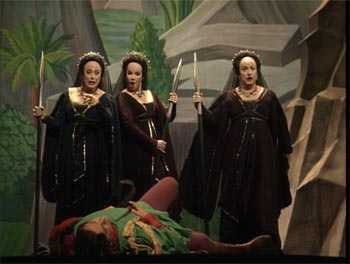
It seems to be “looking back at older Metropolitan Opera productions” week here in the blogosphere. Over at The Earworm there’s a series of posts on a 1980 production of Don Carlos. Our subject will be the 1991 Die Zauberflöte.
The production was designed by David Hockney and the look varies from the whimsical; the opening scene, to the grandiose; the final scene, with bits of Egyptiana in between. It’s very handsome. The direction is described as “original direction” by John Cox and “direction” by Guus Mostart. I’m not entirely sure what this means as there doesn’t really seem to be a production concept and the Personeregie is pretty basic. Basically it looks like acting is considered to be an optional extra. Some of the singers are good actors and some don’t even try. There’s no consistency. The impression is that the “production” is just a backdrop for the singers to do their thing. Continue reading →
Apparently the 2000 production of Beethoven’s Fidelio at the Met was controversial. It’s very hard to see why. Although Jürgen Flimm has moved the setting to the mid 20th century and some unspecified country that looks vaguely Germanic the storyline is followed to the letter, bar a few changes to dialogue, and there is no risk at all of any dangerous ideas surfacing. It’s actually a very good example of what the Met does when it’s on form; assemble an all star cast, stick them in an inoffensive production and let the music do its thing. Here we have an enviable cast. Leonora/Fidelio is sung by Karita Matila who looks and sounds spectacular (although maybe the fact that she’s the only “male” among the principals with no facial hair should have triggered a little cluefulness). Vocally she is most assured and never seems under any strain at all. She acts well too. Ben Heppner, as Florestan, is also vocally solid and even quite lyrical in the big trio “Euch werde Lohn in besseren Welten”. The acting though is best passed over in discrete silence. René Pape is fascinating as Rocco, the gaoler. I’m used to seeing Pape playing magisterial roles like Boris Gudonov or Sarastro. Here, the big voice is coupled with almost bumbling acting as he plays a morally weak character. It’s most interesting. A young Matthew Polenzani, one of my favourite tenors, sings Jacquino and he sings quite beautifully. Marzellini is Jennifer Welch-Babidge who I had never heard before but was sufficiently impressed to go look her up. It seems she’s busy with four kids in Utah and doesn’t spend much time at all in opera houses these days. It’s rather a pity. Falk Struckmann’s Don Pizarro is appropriately villainish and musically solid like everyone else. James Levine conducts and right from the overture launches us into a very intense, muscular reading of the score backed up by a very high standard orchestra. Musically and dramatically this is very satisfying albeit in a thoroughly conservative way.
The production was recorded for TV broadcast and it shows. The sets are already pretty claustrophobic but Brian Large’s video direction amplifies that. One gets the feeling that this is being directed for a 27 inch screen and it looks a bit lost on anything much larger. That said, the picture is more than decent and the DTS 5.1 soundtrack is top notch (Dolby 5.1 and LPCM stereo are also offered). The English subtitles are a bit odd. For some reason “Gouverneur” is translated as “Colonel” and “König” as “President”. I didn’t check the French, German, Spanish or Chinese subs for similar oddness. Bonus material is minimal but the documentation is fairly decent. All in all it’s a typical Deutsche Grammophon release of its period.
This excerpt from Act 1 (Gut, Söhnchen, gut) is pretty typical.
Once in a while an opera performance really blows you away and it becomes quite hard to write about, especially when the work is as long and dense as Die Walküre because even with a great performance one is in overload by the end. Yesterday’s broadcast from the Met was one of those experiences. Here’s what I think I saw!

 Surprisingly perhaps I started out liking this 1986 recording of Lohengrin from the Metropolitan Opera quite a lot. It’s a very traditional, literal and 70s/80s dark production but the orchestra and chorus are great, the P-regie seems pretty well thought out and the singing in the opening scenes is great. Unfortunately it really rather goes downhill once Elsa, Lohengrin and Ortrud make their appearances.


 operaramblings