ARC Ensemble

c-t“Culture Days” is a weekend long festival in Toronto where various arts organisations put on free events.  This year it included a concert in Koerner Hall by the ARC Ensemble with guests Baritone Peter Barrett and cellist Se-Doo Park.  The main draw for me was Respighi’s Il tramonto; a setting for baritone and string quartet of an Italian translation of Shelley’s The Sunset.  This was indeed very well executed but was far from the most interesting part of the afternoon.

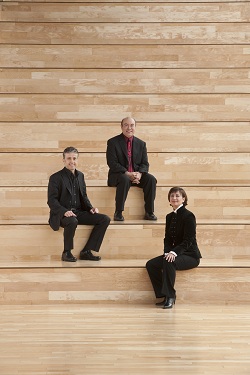
It was actually the final piece that was the revelation; Castelnuevo-Tedesco’s Piano Quintet No. 1.  It’s a really fun piece in high romantic style with tons of melodic ideas and lots of colour.  It was given a truly virtuoso performance by Erika Raum, Benjamin Bowman, Steven Dann, Se-Doo Park and Dianne Werner.  I think I’ll be looking for more examples of Castelnuevo-Terdesco’s work.

Gryphon Trio with Robert Pomakov

Gryphon_085v1(1)Back to Koerner Hall last night for a concert of chamber music and art song.  Anchoring the show were the Gryphon Trio.  They kicked off with the Debussy Piano Trio in G Major.  This was an enjoyable and compact piece with a very playful second movement.  Then came what was, for me, the main reason for going, Mussorgsky’s Songs and Dances of Death.  For this the Gryphons were joined by Toronto bass Robert Pomakov.  He was excellent.  Obviously completely at home singing in Russian he produced a nuanced reading of text and music.  His acting with the voice was exemplary and no extraneous physical acting was required.  His control of dynamics was exemplary.  He has a really big voice which he deployed as appropriate but he was also capable of floating a lovely pianissimo.  Accompaniment from the Gryphons was also well up to par.  There are some interesting instrumental lines including making the cello go about as low as a cello can to match the bass voice.  Continue reading

Toronto Summer Music Festival kicks off

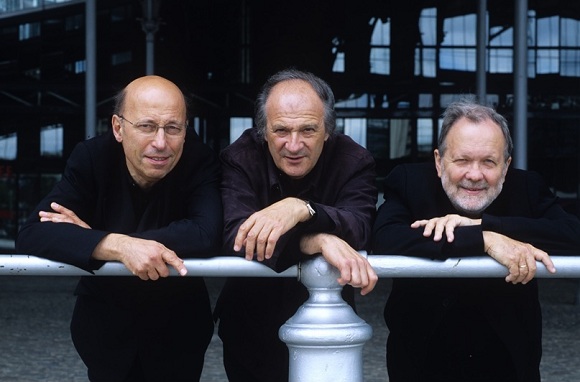
Last night saw the first concert of the Toronto Summer Music festival which runs at a variety of venues until August 3rd.  The theme for the festival is Paris La Belle Époque and this was reflected in last night’s opening concert being given by the distinguished French trio Trio Pennetier Pasquier Pidoux.  One might question though to what extent works written in 1914 and 1923 can be said to belong to the themed era.  It didn’t seem to bother a packed Koerner Hall.  The reception to all three pieces given was raucous.

Trio Pennetier Pasquier Pidoux (From left to right:  Roland Pidoux, cello; Régis Pasquier, violin; and Jean-Claude Photo credit: Guy Vivien

Trio Pennetier Pasquier Pidoux (From left to right:
Roland Pidoux, cello; Régis Pasquier, violin; and Jean-Claude
Photo credit: Guy Vivien

Continue reading

Smart and sexy Don Giovanni

Last night saw the first of two performances of Don Giovanni by the students of the Glenn Gould School at Koerner Hall.  Koerner Hall isn’t the easiest venue to do fully staged opera since it is basically a concert hall with very limited lighting and stage facilities.  Ashlie Corcoran and Camellia Coo pulled off perhaps the most inventive staging I have seen there by using a giant staircase to link the part of the gallery that wraps around the stage to the stage itself.  Within this basic configuration they deployed a few bits and pieces of furniture, mostly couches. It made a very serviceable unit set for the various scenes.  The production was set in the 1960s and seemed to revolve around the basic idea of Don Giovanni as a “chick magnet”.  All the usual suspects are clearly attracted to him.  There’s no hint of coercion in the opening scene with Donna Anna and Zerlina is a very willing seductee.  The idea is reinforced in “Deh vieni” when, as Don Giovanni is serenading Donna Elvira’s maid, five or six women make their way to the staircase and down to the man himself.

Continue reading

Don Giovanni at Koerner Hall

Last night I saw the Glenn Gould School’s production of Don Giovanni at Koerner Hall.  I’ll do a proper review later but for now let’s just say that the staging is the best use of the Koerner Hall space I’ve seen and that the production is witty, sexy and well sung.  There’s only one more performance, on Friday night.  Well worth seeing if you are in the Toronto area.

Le Docteur Miracle and L’Heure Espagnole

Last night lemur_catta and I braved the blizzard to see students from the Glenn Gould School and the Royal Conservatory Orchestra perform at Koerner Hall. The bill was two French one act comic operas; Bizet’s Le docteur Miracle and Ravel’s L’heure espagnole. Both have extremely silly plots but rather lovely music.

The Bizet piece concerns an officer who is in love with the mayor’s daughter (or maybe his wife, or maybe both. This is French opera) and wins her hand by disguising himself as “Docteur Miracle” and “curing” the mayor who thinks he has been poisoned by an omelette. The omelette gets a lot of air time. In last night’s version heavy use is made of three ballet dancers with omelette making headgear. I have no idea if this idea is original or in the libretto but it was very funny. It’s a pretty conventional early classical piece musically; arias for the soprano, tenor and baritone leads and a lot of ensemble numbers. The dialogue is spoken. It was generally well sung with the stand out being the daughter, a coloratura soprano part, played by Jennifer Taverner. The ensembles worked well except that the very young looking tenor, Zachary Finkelstein, was somewhat underpowered and tended to disappear. Solo, his voice was pleasant enough, if light. Pretty decent performances from baritone Maciej Bujnowicz and mezzo Danielle MacMillan as the mayor and his wife. Excellent work from the orchestra and conductor Uri Mayer.

After the interval we had the much more modern sounding L’heure espagnole by Ravel. In this piece the clockmaker’s wife takes advantage of her husband’s day out fixing the municipal clocks to find a lover. This is complicated by the arrival of a muleteer who needs his watch mending. She gets him out of the way by having him haul clock cases from the shop to her bedroom and back. At various points her two would be lovers; a dull grandee and a verbose poet are concealed in the clock cases and a lot of singing takes place through windows in the front of the clocks. Finally she decides that someone who can tirelessly haul loaded clock cases up and down stairs may have more of what she is after than the other two and takes the muleteer off to bed, sans clock. The work concludes with a quintet confirming that it is, indeed, the muleteer’s day. The work is heavier in tone; through sung and fewer set piece numbers. Bujnowica and Finkelstein appeared again as the lovers but the stars were the bluff, strong baritone of Todd Delaney as the muleteer and Leigh_Anne Martin’s strong soprano as Concepcion. It’s the sort of role that one could easily imagine Anna Netrebko singing and Martin managed the same sense of sly, sexy fun that Trebs brings to roles like Norina. Tenor Andrew Byerlay played the clockmaker. This is a much more musically complex work than the Bizet and uses a pretty large orchestra. I didn’t think the orchestral work was as crisp as in the Bizet but it was fine really.

Koerner Hall is a visually lovely venue with acoustics that help everyone. It’s really pleasant to hear and watch opera in a venue that size, 1100 seats, where every seat, pretty much, is a good one and the sound is excellent. All in all, a fun evening. I’m more and more convinced that I would rather see young artists having fun and really trying to put on a show than watch rather bored experienced professionals do their 200th performance of a work in a routine production in a big opera house. There’s another show on Friday night and decent seats are only $30 so think about it!

The COC crowd were out in force and I spotted Alexander Neef, Simone Osborne and Ambur Braid among others in the audience. One has to give credit to Mr. Neef. He spends a lot of time talent spotting young singers. I guess, given his background in casting in Paris, it’s not so surprising.