An engaging Semele from the COC’s Ensemble Studio

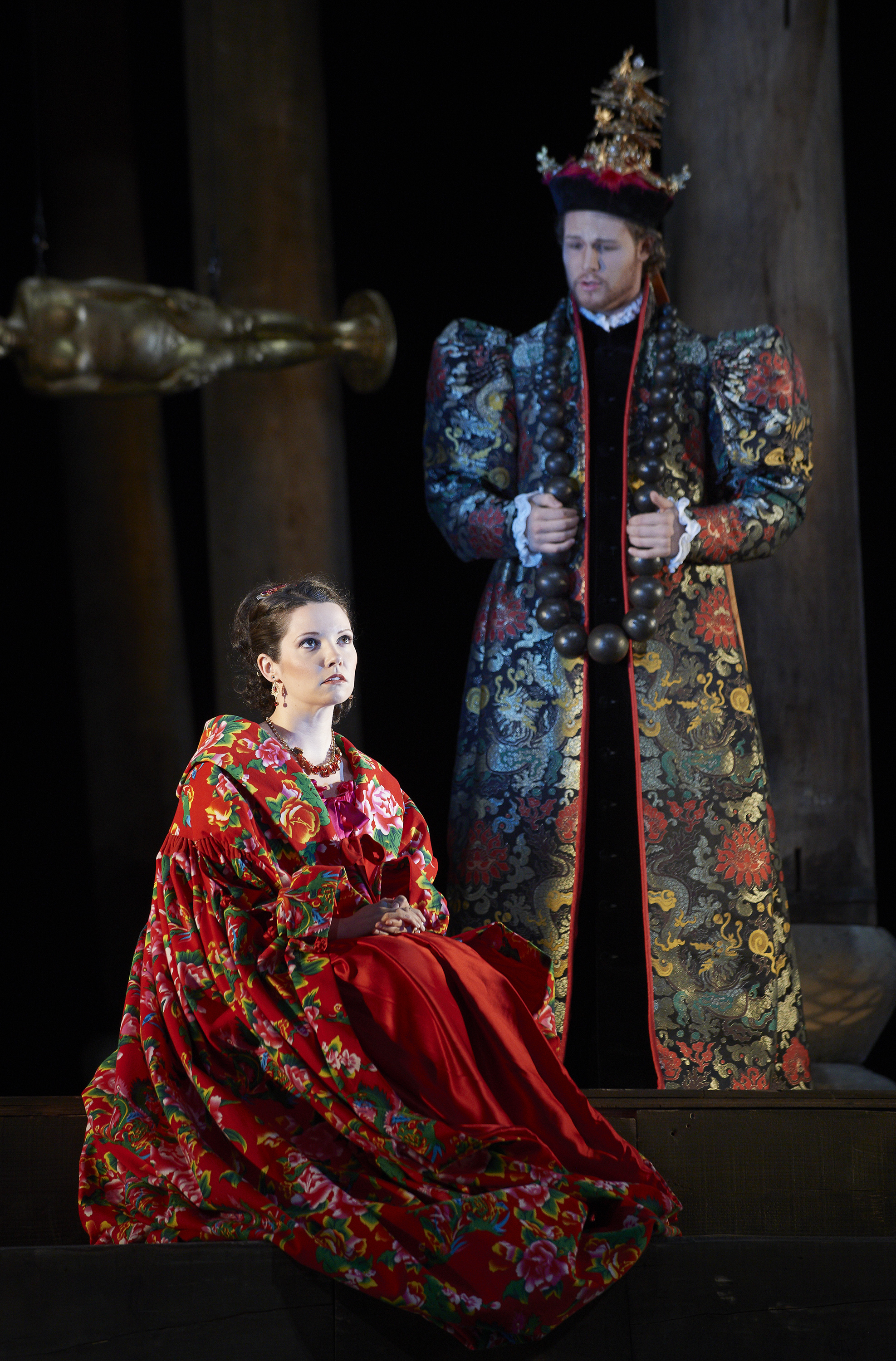
Mireille Asselin and Phillipe Sly

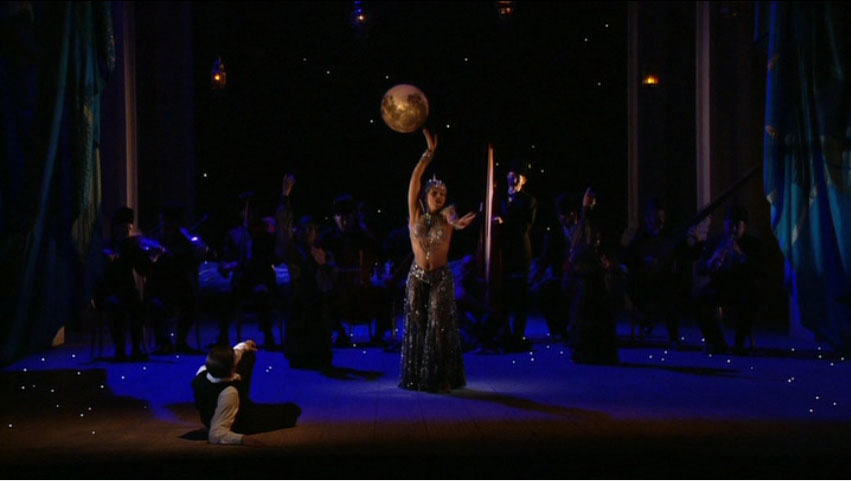
Last night saw the annual main stage performance by the COC’s young artist programme, the Ensemble Studio.  This year it was Handel’s Semele in the production which I saw a couple of weeks ago.  The main roles were cast from the Ensemble Studio with the the exception of the countertenor role of Athamas which was played by Ryan Belongie, an Adler Fellow.  The title role was split with Mireille Asselin singing the first two acts and Ambur Braid coming in for the third act.  This seemed like a sensible solution given the size of the role and the two singers’ strengths. Continue reading

Ariodante in Spoleto

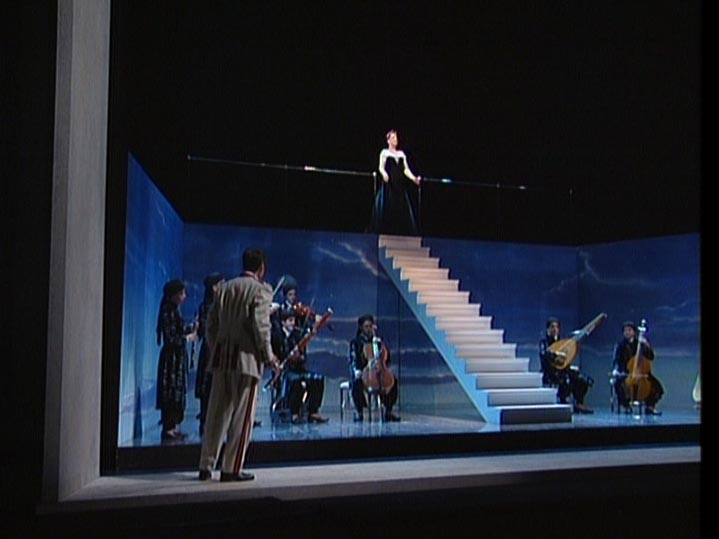
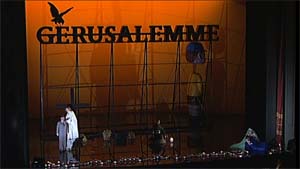
Musically, the 2007 Spoleto Festival recording of Handel’s Ariodate is very good indeed.  Unfortunately the production, at least as rendered on DVD, is a bit of a snooze.  Director John Pascoe has chosen to set the piece in 1957 to celebrate the 50th anniversary of the festival.  The court of the king of Scotland is supposed to evoke the “glamour” of the court of the young Elizabeth II.  There is also a partially twisted mirror that is supposed to remind us of the deception and self-deception intrinsic to the plot.  I only know this because of the bonus interview with Pascoe as  video director Matteo Ricchetti completely ignores it.  There’s also a recurrent appearance of an image of Ginevra (Handel having fortuitously stumbled upon le nom juste for a character supposed to remind us of Margaret Windsor) framed by the garter ribbon and motto.  Subtle. Continue reading

Deconstructing Semele

When a director’s note in an opera programme contains in its first paragraph the following one has, I think, cause for concern.

there are very few people who understand opera, and even fewer artists who understand it.  I too do not understand opera, but I like doing things out of the ordinary.

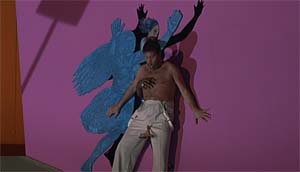
Zhang Huan’s production of Handel’s Semele for the Canadian Opera Company, first seen at the Théâtre Royale de la Monnaie in 2009, is certainly “out of the ordinary” but it doesn’t show much understanding of opera. Continue reading

Normal service will be resumed shortly

On a bit of a hiatus here caused in part by bad luck with some library DVDs; a couple of which turned out to be pretty much unwatchable and certainly not worth a full blown review.  For the record:

Shannon Mercer - Extremely Silly

Le Nozze di Figaro; Glyndebourne 1973.  Dates from the era before acting or stage direction made it into opera.  eg: Susanna “this is the hat that I made”. Stops, grins, points to hat…

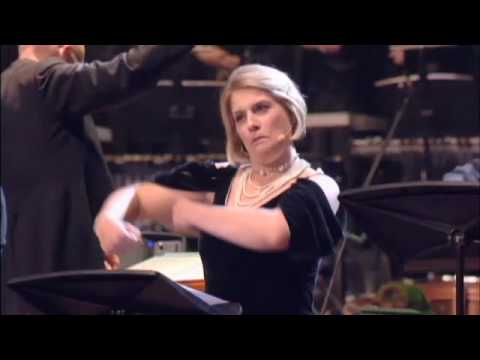
Not the Messiah (He’s a Very Naughty Boy); RAH 2009.  I was searching the library catalogue for Claus Guth’s staged Messiah.  Not a chance of course but I did find this.  How bad could a Monty Python oratorio be I thought?  That bad!  How did the lovely Shannon Mercer and a trouper like Rosalind Plowright get mixed up with this pile of dreck?

Hopefully the “to watch” pile will turn up something better soon.

Dull Tamerlano

Handel’s Tamerlano cries out for a Regie approach because it’s basically boring. The motivation of the characters is so oddly straightforward that the plot(1) seems inevitable right up until the utterly implausible ending and character development is all but impossible. Unfortunately Regie is exactly what we don’t get in the 2001 production of the work from the Halle Handel Festival.  Jonathan Miller directs and attempts to convey the story in an entirely straightforward way with the barest minimum of support.  The very small stage is furnished with a couple of screens and a chair/throne.  The brightly dressed characters (costumes by Judy Levin) basically wander about and sing.  Any drama is entirely dependent on the acting ability of the cast, which varies.  Tom Randle as Bajazet acts rather well throughout and Anna Bonitatibus is a fiery Irene (complete with a riding crop which she shows every sign of being willing to use and thus provides the obligatory Handel opera BDSM reference) but Elizabeth Norberg-Schulz as Asteria, although very easy on the eye, seems capable of no more than stock gestures from the Dummies Guide to Baroque Acting.  Graham Pushee is a bit better as Andronico but his simpering acting coupled with being a fairly “thin” counter-tenor does come off as a bit effeminate.  Maybe the worst acting of the lot comes from Monica Bacelli in the title role.  She is a sort of low energy Snidely Whiplash (with Snidely like moustache) and manages exactly one emotional register and no hint of menace from beginning to end.  The whole thing feels like a rather dull semi-staged performance.

As to the music, one has to say that the playing and singing are very good.  Everybody can do what’s needed and there are some interesting variations on the normal “voice” one hears in Handel.  Randle and Bonitatibus in particular can sound quite dramatic.  Trevor Pinnock conducts the English Concert so no problems there.  The problem is the music itself.  It’s horribly unvarying.  The first two hours plus go by in a series of reciitatives and da capo arias at what seems to be a constant andante soporifico.  The first lively number comes well after the two hour mark and is so surprising I jumped out of my chair.  It finishes a little stronger with a couple of pleasant duets and the obligatory closing ensemble but this really is not Handel at his best.

Helga Dubnyicsek is the video director.  She really doesn’t have much to work with so, for once, the succession of close ups, angle changes and dissolves seems almost a relief.  The picture is 16:9 and normal DVD quality.  The sound is Dolby 5.1 (LPCM stereo option) and is pretty decent though not as vivid as some more recent releases.  Subtitles are English, French, Spanish and Japanese.  There’s an interesting subtitle option called “Score plus”(2) which projects the score onto a faded out picture of the action.  There a couple of bonus interview features.

There is one other video version of Tamerlano available. It’s from Madrid with Placido Domingo as Bajazet and it’s available on DVD and Blu-ray from Opus Arte.  I think it will be a long time, if ever, though before I sit through this one again.

fn(1) Bajazet, formerly Ottoman emperor has been captured by the Tartar leader Tamerlane.  Bajazet hates Tamerlane unreservedly because (a) he won and (b) he sees him as a lower class usurper.  Bazajet spends most of the opera wishing he was dead but only manages to poison himself right at the end.  Bajazet has a daughter, Asteria, who hates tamerlane because that’s the filial thing to do.  Asteria is betrothed to Andronucus, a Greek client king of Tamerlane.

Tamerlane is betrothed to the Greek princess Irene but decides, for unspecified reasons, that he wants to marry Asteria instead and palm Irene off on Andronicus.  There are multiple misunderstandings as Asteria appears to go along with this while really intending to kill Tamerlane.  She makes two hamfisted attempts to do so which don’t seem to bother Tamerlane as much as attempted murder of a head of state usually does.  Finally Bazajet poisons himself which (why?) causes Tamerlane to repent.  Tamerlane marries Irene, Asteria marries Andronicus and the obligatory triumphal ensemble is sung.

fn2 This is what “Score plus” looks like:

I came, I saw, I picnicked

The DVD of the 2005 Glyndebourne Festival production of Handel’s Giulio Cesare in Egitto is one of the most satisfying that I have ever got my hands on. David McVicar’s production is a delight. The cast is consistently excellent with stand out performances from Sarah Connolly as Caesar and Danni de Niese as Cleopatra. William Christie gets wonderful playing from the Orchestra of the Age of Enlightenment. The production for DVD/Blu-ray is exceptional in every way. There’s even over an hour of worthwhile extras giving a total of over five hours of material.

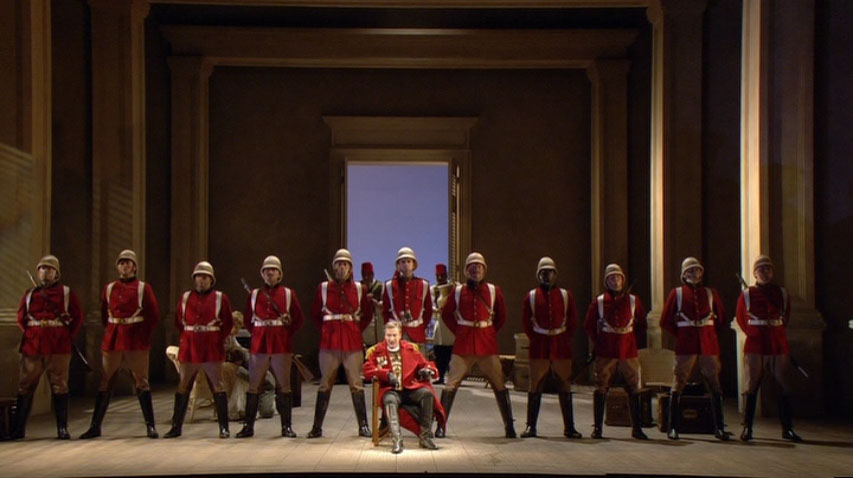
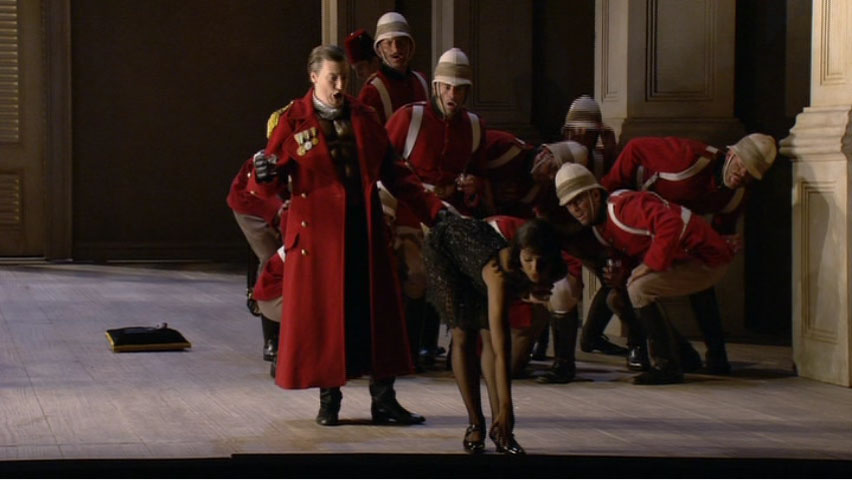
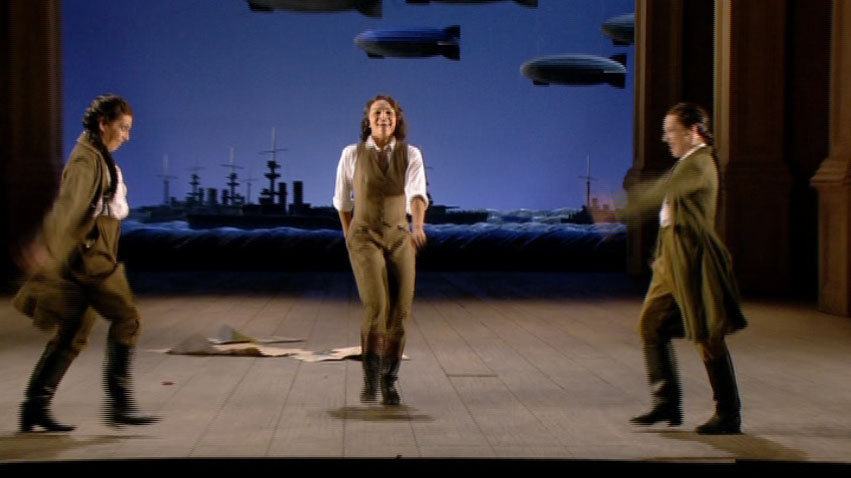
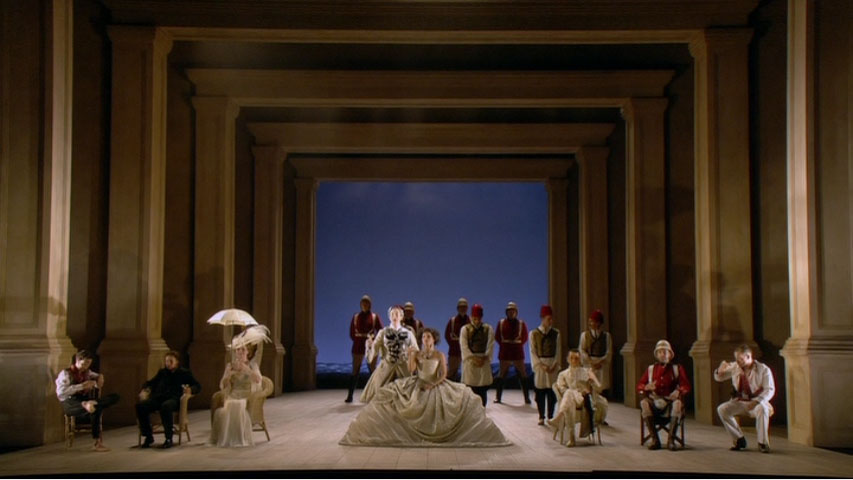
Let’s start with the production. McVicar and his design team have placed the action firmly in Egypt but moved the time period to the late 19th century with the Romans being portrayed in the manner of the British who effectively ruled Egypt at the time. There are a number of elements taken from Bollywood musicals which seems to have led some reviewers to dismiss it as not being “serious” enough to be a proper Handel production. I think this is misguided. The Bollywood elements are well integrated dramatically and musically and serve a dramatic purpose. They point up the cultural rift between the Romans and the Egyptians without getting into a crude and heavy critique of colonialism. There are a few places where Andrew George’s choreography is a bit over the top but mostly it works and, if nothing else, it’s tremendous fun. McVicar has obviously worked really hard on the and all the main characters and their interactions are clearly defined. The gulf between Romans and Egyptians emerges through these relationships though perhaps the rather overwrought Sesto of Angelika Kirchschlager somewhat undermines the chilly memsahib Cornelia of Patricia Bardon. Throughout there are neat little touches like Cleopatra ditching her cigarette in the urn containing Pompey’s ashes or the Roman/British warships sailing into Alexandria harbour with airship cover during Da tempeste il legno infranto. At the very end, Achilla and Tolomeo, blood soaked, (both are dead at this point) reappear and flank the line of seated dignitaries sipping champagne. It’s weird but works. Notably the production team got one of the biggest ovations of the night when they appeared for a curtain call.

The individual performances range from very good indeed to spectacular. Musically the star is Sarah Connolly. She’s utterly brilliant with completely secure coloratura and ornaments that are far more than just decorative.  Right from Empio, dirò, tu sei where she manages to spit out her disgust while maintaining 100% musicality, to the very end she’s note perfect. Her acting is also really good. She covers a wide range of emotions and her physical acting is genuinely masculine. She really does not look or move like a woman in drag. Then there’s Danielle de Niese! Musically there may be subtler or more refined exponents of the art of Handelian singing but I doubt whether there are any who could handle the role Danni is handed here. (Jane Archibald maybe, just maybe). She sings very well in fact. Some of her big numbers are very well done indeed and Piangerò la sorte mia is very fine and she’s very clever vocally in Da tempeste il legno infranto here she works some ornamentation in to accompany miming firing a sub-machine gun. But singing is only a fraction of the work she gets through. She has a lot of physical acting and several major dance numbers. She’s a very good dancer and, of course, she really looks the part. It’s really quite a performance!

Patricia Bardon acts well in a chilly way and sings beautifully. Priva son d’ogni confortois a real tear jerker. Kirchschlager sings very well but is a bit overwrought in the acting department and doesn’t really come across as a young man set on revenge. Rachid Ben Abdeslam is wonderful as Nireno. He gets the basically scaredy cat (and somewhat effeminate) functionary spot on. Chris Maltman is an appropriately brutal and coarse Achilla without letting the coarseness affect his singing. Alexander Ashworth in a kilt, is a solid, if unexciting, Curio but that’s the role. Christophe Dumaux is brilliant as Tolomeo. He looks like Captain Darling from Blackadder Goes Forth and is similarly petty and petulant. He’s also a vicious, spoiled bully and narcissist. Dumaux brings out all these aspects while singing at the highest level. It’s almost up there with de Niese and Connolly. The musical direction and orchestral playing is of the highest order.

Glyndebourne has been really well treated on video in recent years and this Opus Arte release is no exception.  The production for DVD is both excellent and opulent. The DVD version is spread across three disks (the Blu-ray gets two which is remarkable!). The video direction, by Robin Lough, is sympathetic and unobtrusive. The production was filmed in 1080i (which is what one gets on the Blu-ray) and the DVD rendering of the picture is about as good as DVD gets. The audio choices on DVD are LPCM stereo and DTS 5.0 with the latter being superior. In fact it’s superb; maybe the best sound I’ve come across on DVD. The fidelity with which the brass and woodwinds are captured is exceptional. The Sinfonia just before the final scene is thrilling to listen to. I’d really like to hear what the PCM 5.0 track on the Blu-ray sounds like. There are English, French, German, Italian and Spanish subtitles. Besides a synopsis and cast gallery there are two documentaries incluced. There’s a “making of” called, appropriately “Entertainment is not a dirty word” and a feature on “Danielle de Niese and the Glyndebourne experience”. It’s rather touching as Danni gushes over what an amazing place Glyndebourne is and interviews Gus Christie about what it’s like to live there. I’d like to see the follow up with Mrs Gus Christie, chatelaine!

This really should be watched by anyone who thinks baroque opera is difficult and boring and needs to be dumbed down for the average audience. But I don’t suppose he’s listening.

Giulio Cesare in Australia

Opera DVDs from Australia are as rare as Canadian ones and for the same reason. The national broadcaster’s approach to the arts would put the Philistines to shame so opera broadcasts from which DVDs can be produced are passing rare. The one under review here is a 1994 production of Handel’s Giulio Cesare from the Sydney Opera House.

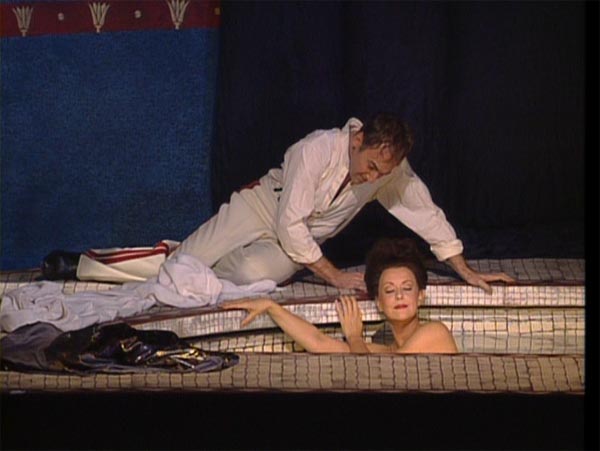
There’s a lot to like about it. The stage production by Francisco Negrin is fairly conventional but attractive to look at and contains some very effective touches. He makes good use of an apron in front of the pit and he uses the rather minor character of Nireno to some effect as a sort of silent chorus on the action. Costumes are sort of 1900ish with odd touches like breastplates and Egyptian dancers and supers in white body and face make up. Sets are mostly simple with typical Egyptian iconography. Cleopatra is naked in her bath when she receives Caesar which would probably be too much for the more staid North American houses today, let alone twenty years ago. The choreography by Gregory Nash makes very effective use of a talented group of dancers. Best if all from the point of view of watching on DVD the video direction by Peter Butler is very respectful of Negrin’s intentions and gives us a real good view of all of the action.

On top of that there is some excellent singing especially by Graham Pushee in the title role. Not everyone likes to see a countertenor in this role but Pushee makes a good case for it. He’s fuller toned than most and has excellent control of his coloratura and ornamentation. He’s also a very good actor. Overall, he may be the best in this role that I have seen. The Tolomeo of Andrew Dalton makes a good foil. He’s a reedy, nasal counter tenor of an older type but that works quite well for the weak and scheming character he portrays. The Achilla of Stephen Bennett is also top notch building to a fine climax in Act 3 with “In tal’ modi si premia”. Rodney Gilchrist as Nireno doesn’t have a lot to do vocally but he’s present and contributing so much of the time that he deserves a special mention. The orchestra under Richard Hickox uses modern instruments but doesn’t go heavy or mushy.

I was initially somewhat ambivalent about Yvonne Kenny’s Cleopatra. I’ve got used to this role being sung by much younger singers than the 44 year old Kenny and it has to be that she looks and sounds very mature for Cleopatra. That said she sings with great gusto and bold coloratura. She acts well too but she does struggle a bit to be the sex kitten who seduces the stuffy Caesar. Despite this by the third act and, especially, her really committed “Da tempeste il legno infranto” I was pretty much won over by her sheer enthusiasm. There’s something of the same problem with Rosemary Gunn’s Cornelia. It’s hard to think of Ms. Gunn as the bombshell who has half of Egypt lusting after her, despite a pretty decent performance overall..

What’s not to like? Not too much really. Elizabeth Campbell’s Sesto is a bit shrill and generally not very convincing dramatically. The biggest negative though is the technical quality of the disk which scarcely does justice to Butler’s efforts. The sound, Dolby 2.0, is OK but the 4:3 picture really isn’t all that great. There’s no way one can fit 207 minutes of opera onto a single DVD9 and have great video quality. 4:3 doesn’t help either as the stage is the sets are wide but not very high (so I guess an extra bonus point for avoiding the close up trap). The subtitles are English only and the documentation is limited to a chapter list. Bottom line, a good effort rather spoiled by el cheapo production for disk(1).

This version does have the merit of being inexpensive but it’s up against strong competition from Copenhagen and Glyndebourne. Both houses offer much more recent productions at much higher technical quality. At a price.

fn1. This performance appears to be available in a different package outside North America. It has Dolby 5.1 and DTS sound tracks and, I suspect, is spread across two disks. Certainly the track numbering n the version I watched and the way it behaves if played with vlc suggests two VIDEO-TS folders crammed onto one disk.

David Alden’s Ariodante

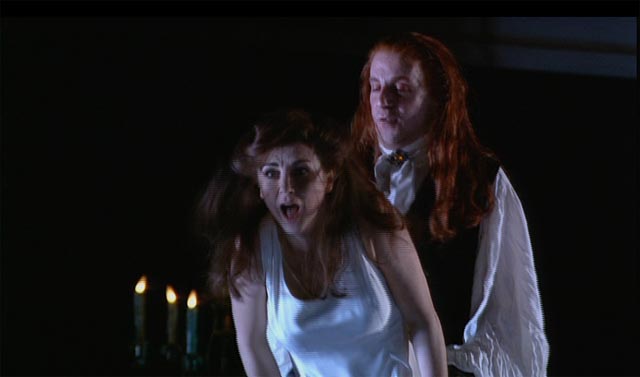
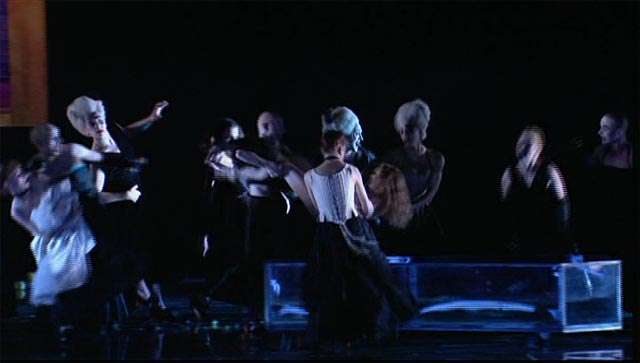
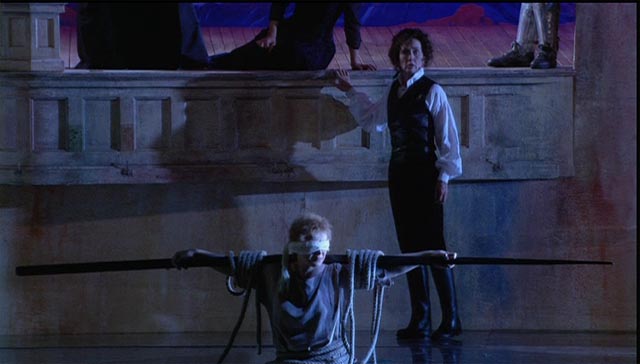
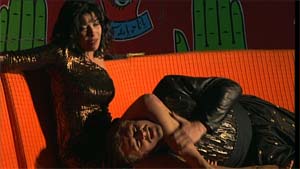
Handel’s Ariodante has, broadly, the same plot as Much Ado About Nothing. The King of Scotland’s daughter is framed as “unfaithful” by the bad guy’s disguised accomplice. Her fiancé goes off the deep end. The bad guy betrays his accomplice. She rats on him. He gets killed. All is revealed. Everybody but the bad guy lives happily ever after. In this 1996 production for English National Opera, David Alden seems to be turning it into a very dark plot with madness, intense and perverse sexual desire, hints of anal rape and a nude drowned in a tank. All in all, a pretty run of the mill Regie approach. Flippancy aside, it actually works quite well. It’s a bit of a slow starter. Act 1 is mostly scene setting and it’s not easy to see what Alden is driving at. Ariodante (Ann Murray) in particular seems to be prey to emotions that have, as yet, no obvious origin. To be honest I was quite puzzled at the end of Act 1 though there appeared to be much that was visually striking going on. At least, that’s what I’m guessing because video director Kriss Rusmanis does his level best to hide most of the stage most of the time.
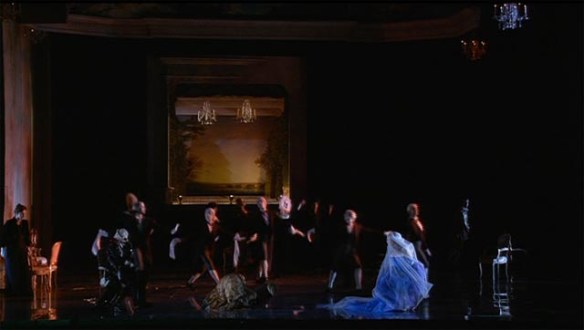
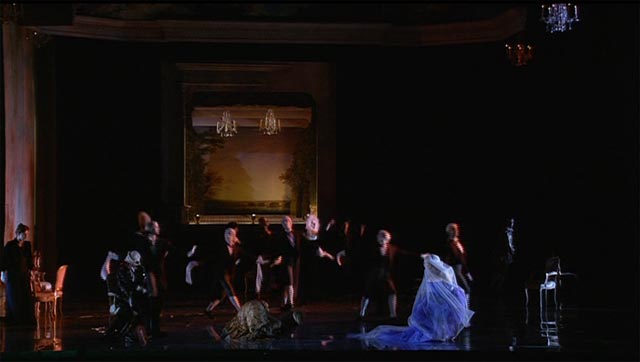
It picks up in Act 2 where we get more extreme emotion but it’s clearer why. In Act 1 Polinesso (Christopher Robson) is obviously the bad guy but his real nastiness emerges in his treatment of his accomplice/lover, Dalinda (Lesley Garrett). Among other indignities, anal rape appears to be suggested before he drags her off to have his henchmen finish her off. To be fair, Dalinda’s attitude to her treatment is quite equivocal so we can add this to a long list of opera productions with sado-masochistic sub texts. Act 3, in which all is revealed is also dramatically strong besides having some of the best music.  All three acts have fairly lengthy ballets. These are strikingly choreographed by Michael Keenan-Dolan. At least the bits we can see on the DVD are. There’s a particularly effective “nightmare” sequence in Act 2 where the princess Ginevra (Joan Rodgers) is trying to make sense of what has happened to her. The sets are quite painterly with effective use of an upstage window which is used to frame subtextual elements while the main action goes on in front. So, all in all, it works pretty well though it would hardly be David Alden if nothing seemed gratuitous!
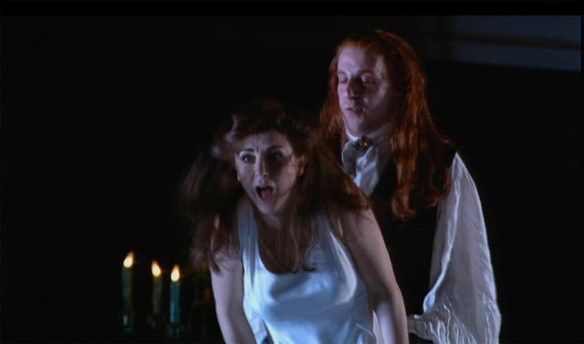
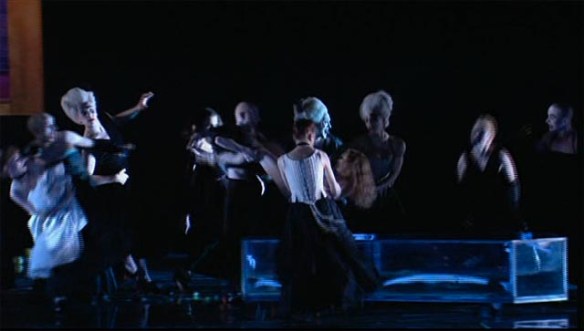
Like the drama, this got better musically as time went on. In Act 1 I was really questioning the decision to cast a mezzo in the alto castrato role and a traditional countertenor in what was originally a breeches mezzo role. It does work out. Ann Murray sings brilliantly and muscularly throughout and makes, in the end, a completely convincing Ariodante. Christopher Robson’s Polinesso doesn’t totally convince me. That voice type just doesn’t make for a particularly convincing villain but it does make more sense as his sheer nastiness comes out in his excellent acting. Joan Rodger’s Ginevra definitely gets better as things progress. I think she sounds strained in her upper register in the first act. The notes are there but it isn’t a very beautiful sound. In Acts 2 and 3 she sounds much more at ease despite having to sing while being put through not far short of torture(1).
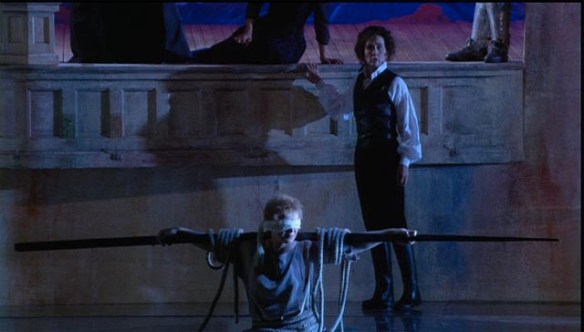
Lesley Garrett’s Dalinda was a pleasure from first to last. The King of Scotland is Gwynn Howell. It’s the sort of bluff, thankless role that Howell seems to play rather often. He sings perfectly well and is bluff. Paul Nilon sings Lurcanio, Ariodante’s brother. he doesn’t have a lot to do but he does have one glorious duet with Dalinda in Act 3. This is closely followed by another lovely duet between Ginevra and Ariodante. I wish there were more duets and ensembles in Handel operas. They happen rarely but when they do they are usually wonderful. Ivor Bolton conducts the ENO orchestra and they sound OK for a modern band (not my first choice for Handel!). Tempi seem on the slow side. The rival DVD version of this opera comes in 20 minutes shorter. Whether that’s due to cuts or tempi though I can’t say. The ENO chorus doesn’t sound great but this may be the recording, see below.

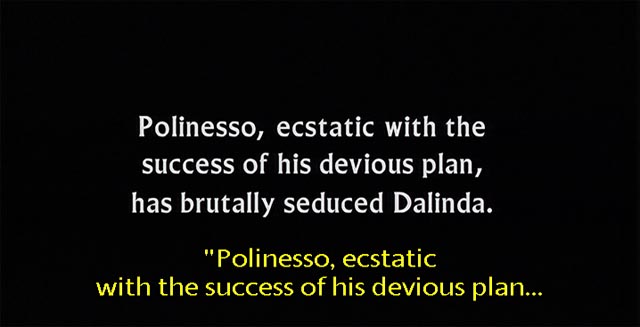
Musically and dramatically I think this is a recommendable performance. Unfortunately, as a DVD, it’s very hard to find good things to say about it. It was recorded for broadcast on the BBC and is given a treatment I’ve not seen before. I assume it’s taken from a live performance but there is no applause and no curtain calls. What we do get are silent film like “story boards” at key points like the beginning of each act.
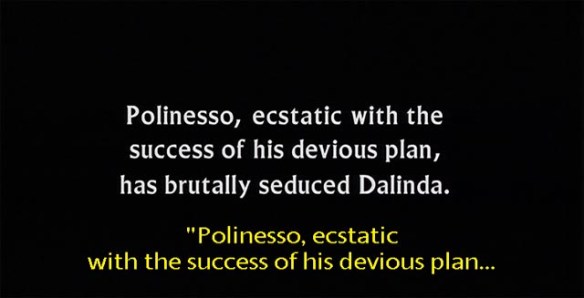
For example “Polinesso takes advantage of Dalinda’s blind devotion to further his ambition”. Weirdly, the subtitles repeat the message. I don’t particularly like this approach but it’s not fatal. What is is the failure to show us enough of the stage to figure out the director’s intentions. I ranted about this yesterday so I won’t labour the point but it pretty much wrecks this disc. Technically it’s not so hot either. The picture is OK 16:9, no more. There are two sound tracks; Dolby 5.1 and Dolby 2.0. The surround sound version is about the worst sound I’ve ever encountered on an opera DVD. It’s mixed so that the subwoofer booms out the bass line in a most unmusical fashion. It’s horrible. The stereo track is OK though it gets a bit odd in parts of Act 3, especially the final chorus. Either that or the ENO Chorus really is having a bad night. The only sub-titles are English and there is no documentation beyond a chapter list. (This is the North American release on Image. It wouldn’t be unprecedented for the European version to have more acceptable sound).

It’s a bit of a shame. I would really like to have a proper look at this production.

Another edition of the Armida and Rinaldo show

I really don’t know how many operas there are more or less based on Tasso’s story of the Christian knight Rinaldo and the Muslim sorceress Armida. Certainly there are versions by Rossini and Lully which I’ve seen. Then there’s Handel’s Rinaldo which I watched in David Alden’s production for the Bayerischer Staatsoper in 2001. Alden at least manages to avoid obvious Monty Python and the Holy Grail references which is more than either the Metropolitan Opera and Opera Atelier managed with the Rossini and the Lully. In fact Alden manages to avoid all the usual cliches of both Handel in general and this piece in particular though at the expense of giving us a version that is quite hard to interpret. The action is moved to maybe the 1950s to judge by the costumes and the Christians are decidedly wimpy and ostentatiously pious (except for the Rinaldo of David Daniels). Crucifixes, surplices and bibles crop up at odd times and in the final scene the Christian army is a line of Jesus statuettes of the kind one can pick up at Honest Ed’s or one’s friendly neighbourhood Catholic tat store. The Muslims are much earthier and in Act 1 Argante (Egilis Silins) seems to terrify the Christian trio of Goffredo (David Walker), Almirena (Deborah York)and Eustazio (Axel Köhler). Also Noëmi Nadelmann’s very sexy Armida is much earthier than Deborah York’s rather etiolated persona. Note that by casting Goffredo as a countertenor we end up with four countertenors which is more than I’ve seen on stage at one time for sure.

Whatever the overall concept, Alden does pretty much what Handel did with the original production; give us a succession of arresting visual images and effects and some very funny moments. There’s probably more flesh on display too than Handel could have got away with in 1711. There is, as the cliche would have it, never a dull moment with giant dolls dropping their pants, an army of aliens, severed limbs and a David Lynch like giant face. It all puts considerable demands on the athletic and acting abilities of the cast and here Nadelmann has the toughest time and does really, really well. Her physical acting and timing are excellent and she’s not at all hard on the eye which helps. Everybody else is pretty good too. David Daniels face, as he gets felt up by both the girls, is a picture.

Musically, the stand out is David Daniels. No surprise really. Here he sings stylishly throughout and delivers a really lovely “cara sposa, amante cara”. Nadelmann gets full marks for being accurate and musical even while acting her head off. She sings “Furie terribili!” with Argante’s head clasped between her thighs! At least for “Lascia ch’io pianga” York is stationary though in quite an awkward pose. I think she sounds a bit over challenged by some of the high passage work in act 1 but she seems to improve as things progress. As the one low voice on show Silins is a good contrast. I’ve heard more agile bass-baritones in Handel but his fairly bluff reading is appropriate to the way the part is portrayed here. Harry Bicket directs the Bavarian State Orchestra and plays continuo. No worries there.

Brian Large directed for the small screen and does his usual thing of giving us lots of close ups which is a shame as there is lots going on that we miss and it’s obvious that Alden and his designer, Paul Steinberg, have put a lot of thought into the overall composition of scenes which is mostly lost on the DVD. The DVD itself is pretty basic. It’s on the Kultur label in North America though it originated as a Euroarts release in Europe. Kultur have stuck the original two DVDs onto a single disc and while they have included the useful documentary essay Handel, the Entertainer it means the only sound option is Dolby 2.0 and the only subtitles are English. The picture (16:9 anamorphic) and sound quality is perfectly OK but not stunning. The only documentation is a chapter listing.

All in all well worth a look

Handel for the Handelians

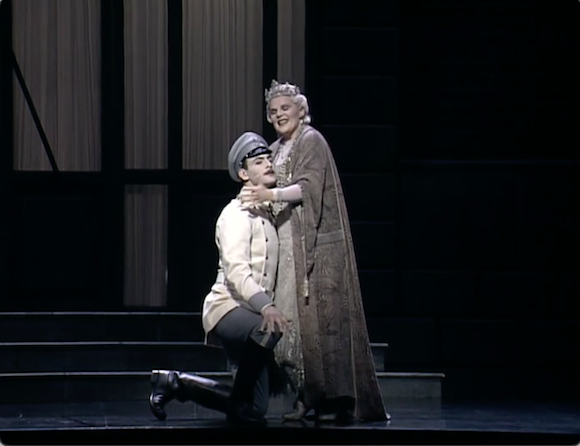
I think maybe Handel’s Rodelinda is one for the hard-core Handelians. It’s got some lovely music but it’s long (200 minutes), not very dramatic (it’s based on Corneille) and, structurally, is a succession of recitative and da capo arias. There is no chorus and I only recall two numbers that weren’t solos; the concluding quintet and a rather lovely duo between Rodelinda and Bertarido at the end of Act 2. Jean-Marie Villégier’s 1998 production for Glyndebourne rather tends to emphasise the leaning to elegance rather than drama. The basic look and feel is “silent movie era”. Sets and costumes are near monochrome and that tends to be emphasised by the lighting. At least when there is a any. Much of this production is very dark, as was fashionable at the time.

r1

Continue reading