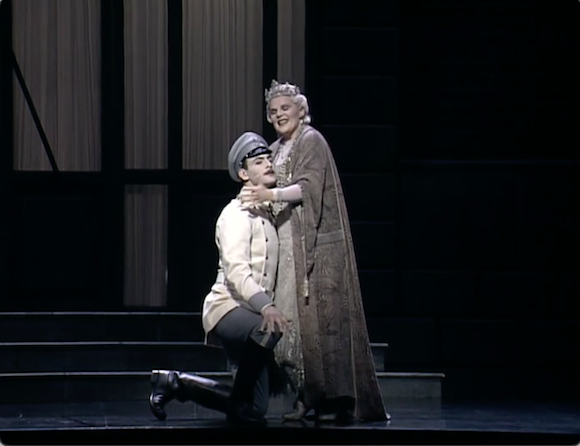
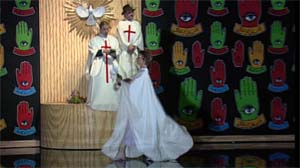
 I really don’t know how many operas there are more or less based on Tasso’s story of the Christian knight Rinaldo and the Muslim sorceress Armida. Certainly there are versions by Rossini and Lully which I’ve seen. Then there’s Handel’s Rinaldo which I watched in David Alden’s production for the Bayerischer Staatsoper in 2001. Alden at least manages to avoid obvious Monty Python and the Holy Grail references which is more than either the Metropolitan Opera and Opera Atelier managed with the Rossini and the Lully. In fact Alden manages to avoid all the usual cliches of both Handel in general and this piece in particular though at the expense of giving us a version that is quite hard to interpret. The action is moved to maybe the 1950s to judge by the costumes and the Christians are decidedly wimpy and ostentatiously pious (except for the Rinaldo of David Daniels). Crucifixes, surplices and bibles crop up at odd times and in the
 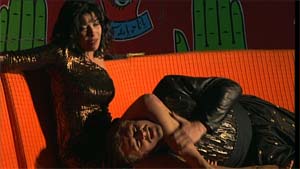 final scene the Christian army is a line of Jesus statuettes of the kind one can pick up at Honest Ed’s or one’s friendly neighbourhood Catholic tat store. The Muslims are much earthier and in Act 1 Argante (Egilis Silins) seems to terrify the Christian trio of Goffredo (David Walker), Almirena (Deborah York)and Eustazio (Axel Köhler). Also Noëmi Nadelmann’s very sexy Armida is much earthier than Deborah York’s rather etiolated persona. Note that by casting Goffredo as a countertenor we end up with four countertenors which is more than I’ve seen on stage at one time for sure.
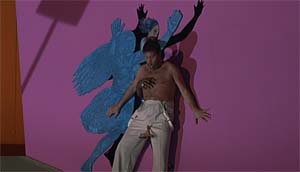 Whatever the overall concept, Alden does pretty much what Handel did with the original production; give us a succession of arresting visual images and effects and some very funny moments. There’s probably more flesh on display too than Handel could have got away with in 1711. There is, as the cliche would have it, never a dull moment with giant dolls dropping their pants, an army of aliens, severed limbs and a David Lynch like giant face. It all puts considerable demands on the athletic and acting abilities of the cast and here Nadelmann has the toughest time and does really, really well. Her physical acting and timing are excellent and she’s not at all hard on the eye which helps. Everybody else is pretty good too. David Daniels face, as he gets felt up by both the girls, is a picture.
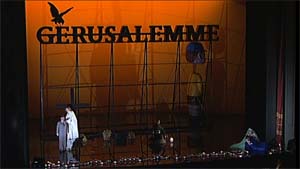 Musically, the stand out is David Daniels. No surprise really. Here he sings stylishly throughout and delivers a really lovely “cara sposa, amante cara”. Nadelmann gets full marks for being accurate and musical even while acting her head off. She sings “Furie terribili!” with Argante’s head clasped between her thighs! At least for “Lascia ch’io pianga” York is stationary though in quite an awkward pose. I think she sounds a bit over challenged by some of the high passage work in act 1 but she seems to improve as things progress. As the one low voice on show Silins is a good contrast. I’ve heard more agile bass-baritones in Handel but his fairly bluff reading is appropriate to the way the part is portrayed here. Harry Bicket directs the Bavarian State Orchestra and plays continuo. No worries there.
Brian Large directed for the small screen and does his usual thing of giving us lots of close ups which is a shame as there is lots going on that we miss and it’s obvious that Alden and his designer, Paul Steinberg, have put a lot of thought into the overall composition of scenes which is mostly lost on the DVD. The DVD itself is pretty basic. It’s on the Kultur label in North America though it originated as a Euroarts release in Europe. Kultur have stuck the original two DVDs onto a single disc and while they have included the useful documentary essay Handel, the Entertainer it means the only sound option is Dolby 2.0 and the only subtitles are English. The picture (16:9 anamorphic) and sound quality is perfectly OK but not stunning. The only documentation is a chapter listing.
All in all well worth a look