Last night was the “event” at which the COC brass and guests, with a bit of help from Brent Bambury, announced the upcoming season to a packed house of subscribers and friends. What struck me was how much news was packed in. It was far more than the usual schedule presentation with announcements of several major new projects. But first the season. Continue reading
Tag Archives: guth
Dense and dramatic Ariadne
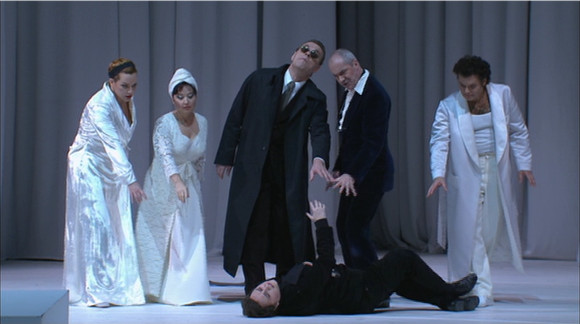
Claus Guth’s 2006 production of Ariadne auf Naxos recorded at the Opernhaus Zürich in 2006 is a compelling piece of theatre. It’s one of those Regietheater pieces that combines a workable concept with compelling Personenregie to create a whole that’s extremely illuminating. The entire Vorspiel is played out, in modern dress, in front of a grey curtain. We get an immediate idea of how Guth is going to explore/exploit metatheatricality as soon as the Haushofmeister appears. He’s played by none other than Zürich Intendant Alexander Pereira. Who is calling the shots? This is reinforced when he drops the bombshell that the opera seria must be combined with Zerbinetta’s farce. This speech is delivered by Pereira from among his guests in the Intendant’s box. It’s very clever. But there’s so much more going on during the Vorspiel. The Komponist is getting seriously deranged; perhaps even more so after he begins his infatuation with Zerbinetta. There’s a moment when it looks like a love triangle is being set up. The diva just gives one look that suggests that she’s got her eyes on the Komponist. It’s a typical moment. A look, a gesture, seems to convey so much. It all concludes with the deranged Komponist shooting himself.
Beyond pale
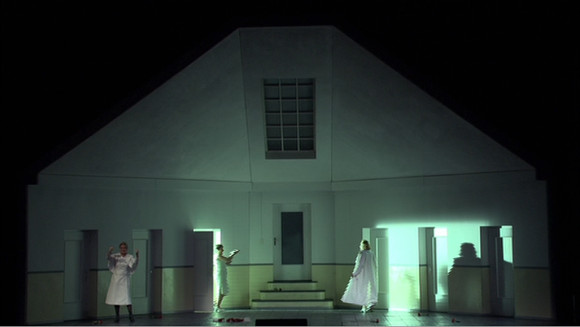
Paul Dukas’ Ariane et Barbe-bleue is a setting of a libretto by the symbolist poet and playwright Maeterlinck. It’s roughly contemporary with both Debussy’s Pelléas et Mélisande and Strauss’ Salome. It shows. It really is a product of a particular fin de siècle world view. Like Debussy’s piece, Ariane is loosely based on a folk tale. In this case it’s the gory story of Duke Bluebeard and his six wives but here it’s curiously etiolated. It’s as if Maeterlinck is reacting to the ultra-realism of, say, Zola, by retreating into a strange inner world. It’s not even the troubled inner world of Freud or Jung either. It’s colourless (and we’ll come back to that). All this is reinforced by Maeterlinck’s style of telling rather than showing. Much of what “action” there is takes place off stage and is narrated by the on stage characters. Both words and music are used to fill in the gaps.
Into the woods
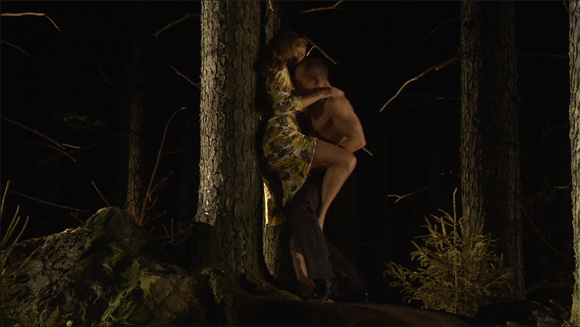
Claus Guth’s 2008 Salzburg production of Don Giovanni divided the critics along entirely predictable lines. It’s a very unusual treatment of Don Giovanni but the concept is stuck to with real consistency and it works to create a compelling piece of music theatre. The treatment on video too is not straightforward and, in a sense, the DVD/Blu-ray version is as much the work of Brian Large as it is of Claus Guth.
Staging Messiah
It’s a rare and valuable experience when a performance makes one reconsider a perhaps overly familiar work. That’s the effect that Claus Guth’s 2009 staging of Handel’s Messiah had on me. I don’t think that there is any piece I’m more familiar with than Messiah. I feel like I’ve known it all my life. I’ve sung it. I own a vocal score (rare indeed for me!). I couldn’t begin to count how many times I’ve heard it. And yet here it came up entirely fresh and had me thinking about it in completely new ways.
It’s the only Iphigénie in town
Claus Guth’s 2001 Zürich production of Gluck’s Iphigénie en Tauride is, rather surprisingly, the only video recording of the work currently available. Fortunately it’s a very decent production much preferable to the Met’s over-stuffed overly literal version but not, I think, to be preferred over Robert Carsen’s stark and elegant version seen in Toronto, Washington and elsewhere. The Zürich performance, led by William Christie, is very good but it’s rather let down by the video direction and the production for DVD.
Claus Guth’s Cosí
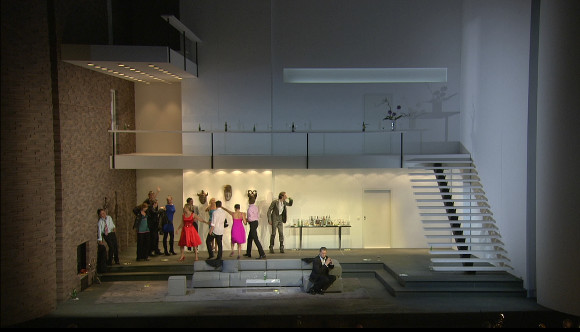
In 2009 Claus Guth wrapped up his Da Ponte cycle for Salzburg with Cosí fan tutte. I really like his Le Nozze di Figaro and after seeing this Così I’ll certainly be seeking out the Don Giovanni too.
This production was staged in the Haus für Mozart and uses a single set. It’s the girls’ apartment; a very expensive looking two level loft with a broad staircase that recalls the Figaro. The setting is contemporary and it opens on the aftermath of what appears to have been a rather good party. The men are preparing to leave when Don Alfonso issues his challenge. It’s the edgiest version of the scene I’ve watched with quite an undertone of violence. This is clearly not going to be a light comedy. By Una bella serenata the characteristic feathers of the Figaro have appeared. The edginess continues throughout the first act with many deft touches, especially a power cut staging of Come Scoglio. When the “Albanians” appear there is only the most perfunctory effort at disguise. No slapstick moustaches here. Continue reading
Happy ever after?
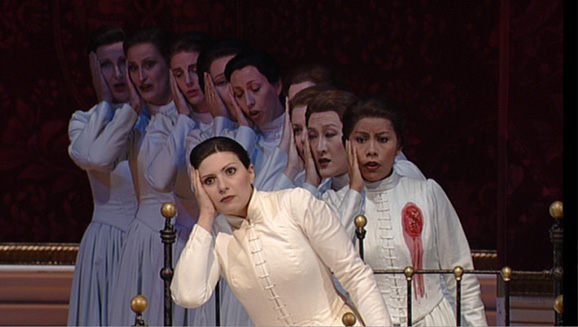
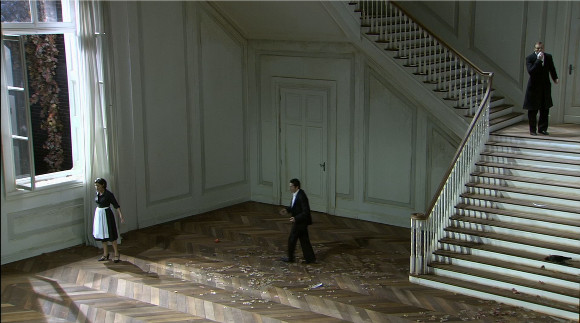
I’ve watched the Blu-ray version of the 2006 Salzburg production of Le Nozze di Figaro a few times now but sitting through it with notepad at the ready made me realise how much I hadn’t seen on the previous viewings. My notes are copious. I usually take a couple of pages or so. This time I covered four pages and it could easily have been more. You have been warned.