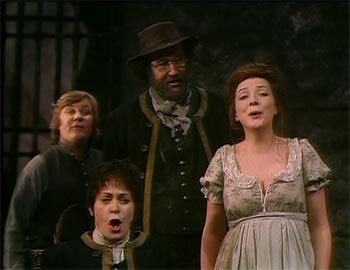
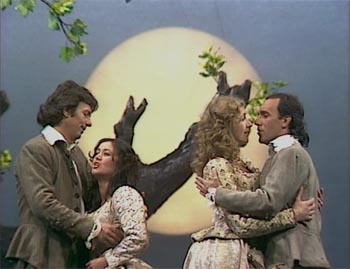
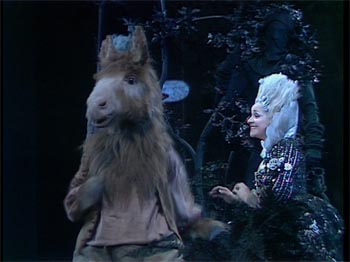
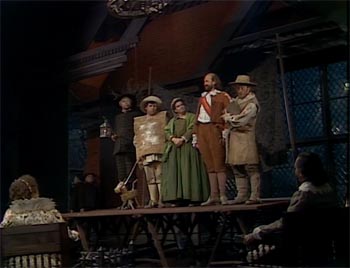
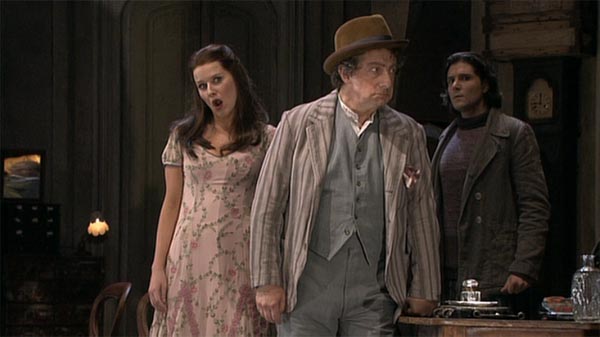
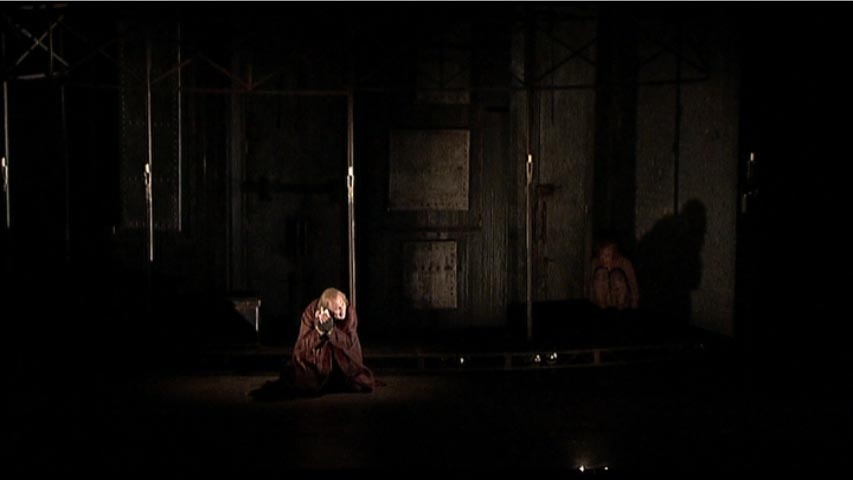
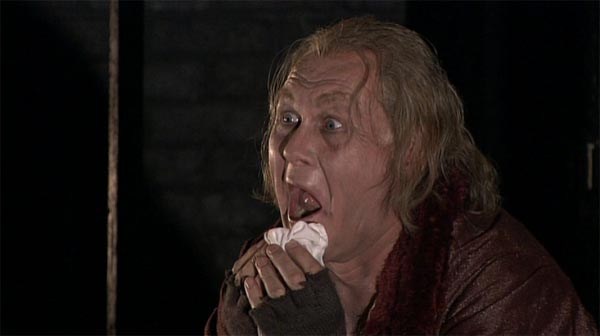
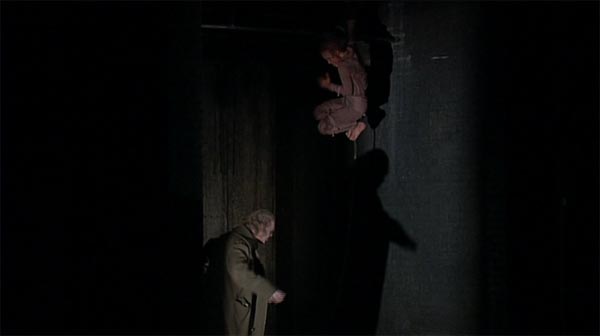
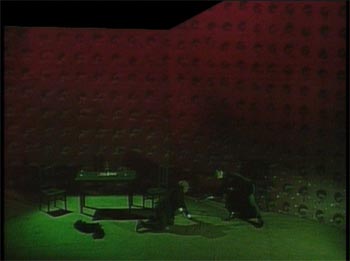
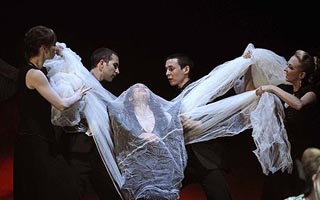
Southern Television’s 1979 Glyndebourne broadcast was Beethoven’s Fidelio. The production by Peter Hall with designs by John Bury is conventional enough though tendencies to exaggerate are clearly creeping in. The chorus of prisoners is almost zombie like and Florestan looks disconcertingly like the legless sea captain from Blackadder II. Apart from that it’s a conventional 1800ish setting where the prison’s a prison, the dungeon’s a dungeon etc. It’s also very literal in that the dungeon is so dark it’s almost impossible to see anything. Continue reading
Tag Archives: glyndebourne
Hockney’s Rake
Having watched quite a few opera recordings from the 70s and 80s recently I can well see why David Hockney’s designs for Stravinsky’s The Rake’s Progress at Glyndebourne were such a big deal back in the day. They look they were designed by an artist rather than being lifted from an expensive department store furniture catalogue. And, of course, they are still in use. Beyond the design issues, this has a kind of transitional feel as a production. Occasionally some acting breaks out and quite imaginative use is made of the chorus but there is a lot of “park and bark”; perhaps somewhat inevitable on the old, small Glyndebourne stage but very noticeable. It’s hard not to feel that director John Cox could have done a lot more with a neat staging and a talented cast. Continue reading
Normal service will be resumed shortly
On a bit of a hiatus here caused in part by bad luck with some library DVDs; a couple of which turned out to be pretty much unwatchable and certainly not worth a full blown review. For the record:
Le Nozze di Figaro; Glyndebourne 1973. Dates from the era before acting or stage direction made it into opera. eg: Susanna “this is the hat that I made”. Stops, grins, points to hat…
Not the Messiah (He’s a Very Naughty Boy); RAH 2009. I was searching the library catalogue for Claus Guth’s staged Messiah. Not a chance of course but I did find this. How bad could a Monty Python oratorio be I thought? That bad! How did the lovely Shannon Mercer and a trouper like Rosalind Plowright get mixed up with this pile of dreck?
Hopefully the “to watch” pile will turn up something better soon.
I came, I saw, I picnicked
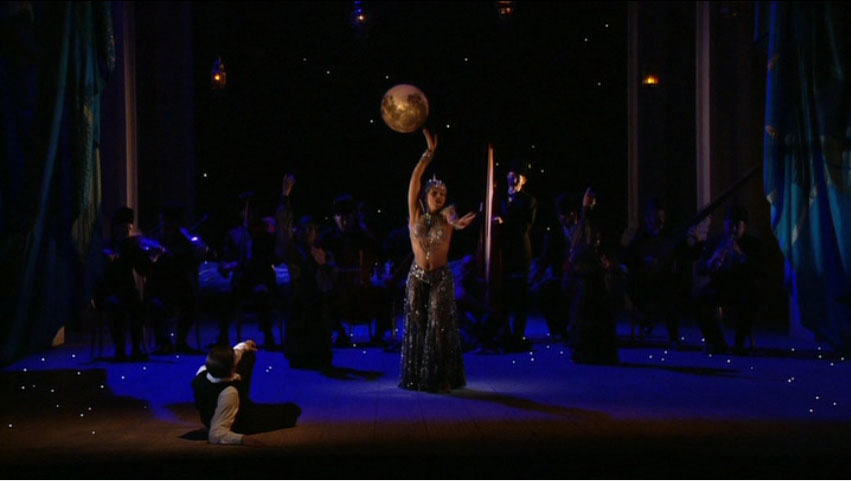
The DVD of the 2005 Glyndebourne Festival production of Handel’s Giulio Cesare in Egitto is one of the most satisfying that I have ever got my hands on. David McVicar’s production is a delight. The cast is consistently excellent with stand out performances from Sarah Connolly as Caesar and Danni de Niese as Cleopatra. William Christie gets wonderful playing from the Orchestra of the Age of Enlightenment. The production for DVD/Blu-ray is exceptional in every way. There’s even over an hour of worthwhile extras giving a total of over five hours of material.
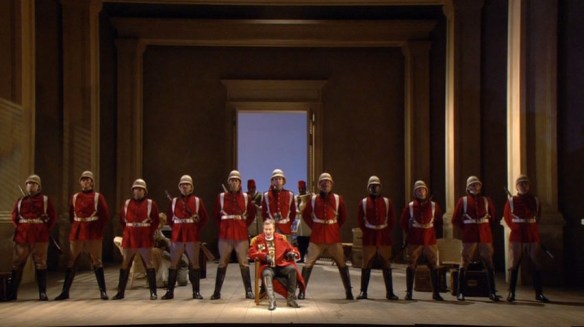
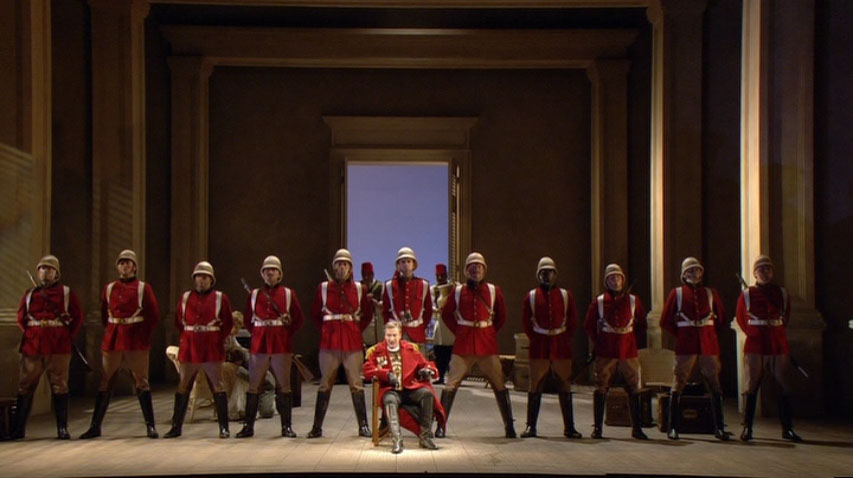
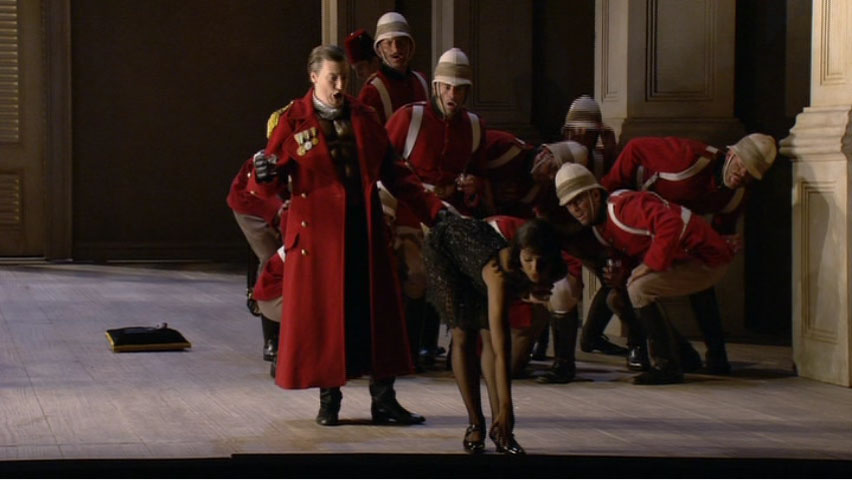
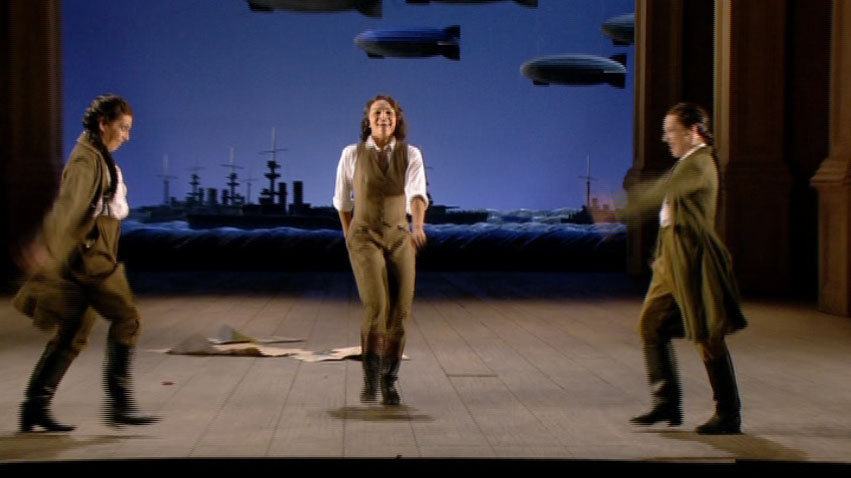
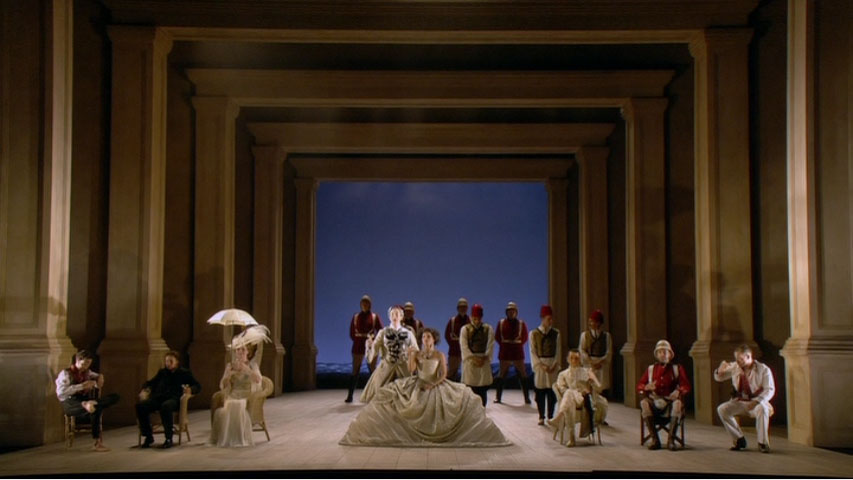
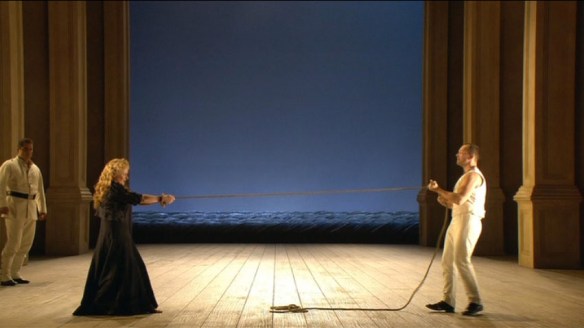
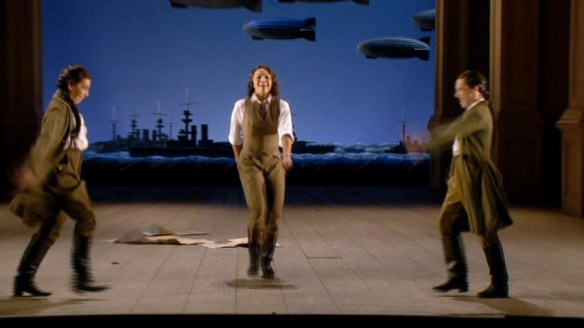
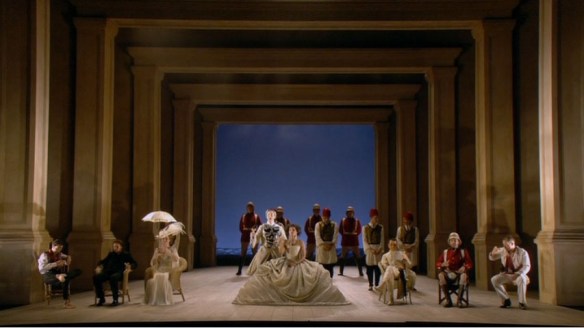
Let’s start with the production. McVicar and his design team have placed the action firmly in Egypt but moved the time period to the late 19th century with the Romans being portrayed in the manner of the British who effectively ruled Egypt at the time. There are a number of elements taken from Bollywood musicals which seems to have led some reviewers to dismiss it as not being “serious” enough to be a proper Handel production. I think this is misguided. The Bollywood elements are well integrated dramatically and musically and serve a dramatic purpose. They point up the cultural rift between the Romans and the Egyptians without getting into a crude and heavy critique of colonialism. There are a few places where Andrew George’s choreography is a bit over the top but mostly it works and, if nothing else, it’s tremendous fun. McVicar has obviously worked really hard on the and all the main characters and their interactions are clearly defined. The gulf between Romans and Egyptians emerges through these relationships though perhaps the rather overwrought Sesto of Angelika Kirchschlager somewhat undermines the chilly memsahib Cornelia of Patricia Bardon. Throughout there are neat little touches like Cleopatra ditching her cigarette in the urn containing Pompey’s ashes or the Roman/British warships sailing into Alexandria harbour with airship cover during Da tempeste il legno infranto. At the very end, Achilla and Tolomeo, blood soaked, (both are dead at this point) reappear and flank the line of seated dignitaries sipping champagne. It’s weird but works. Notably the production team got one of the biggest ovations of the night when they appeared for a curtain call.
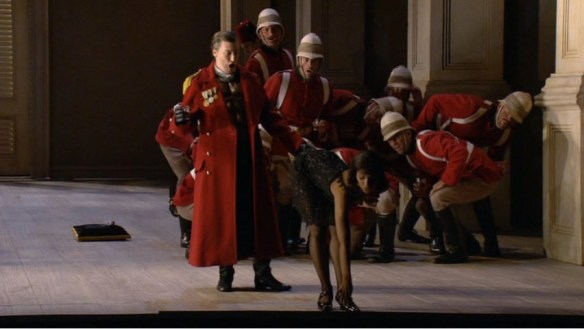
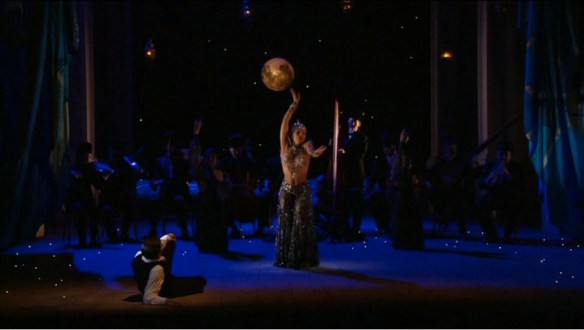
The individual performances range from very good indeed to spectacular. Musically the star is Sarah Connolly. She’s utterly brilliant with completely secure coloratura and ornaments that are far more than just decorative. Right from Empio, dirò, tu sei where she manages to spit out her disgust while maintaining 100% musicality, to the very end she’s note perfect. Her acting is also really good. She covers a wide range of emotions and her physical acting is genuinely masculine. She really does not look or move like a woman in drag. Then there’s Danielle de Niese! Musically there may be subtler or more refined exponents of the art of Handelian singing but I doubt whether there are any who could handle the role Danni is handed here. (Jane Archibald maybe, just maybe). She sings very well in fact. Some of her big numbers are very well done indeed and Piangerò la sorte mia is very fine and she’s very clever vocally in Da tempeste il legno infranto here she works some ornamentation in to accompany miming firing a sub-machine gun. But singing is only a fraction of the work she gets through. She has a lot of physical acting and several major dance numbers. She’s a very good dancer and, of course, she really looks the part. It’s really quite a performance!
Patricia Bardon acts well in a chilly way and sings beautifully. Priva son d’ogni confortois a real tear jerker. Kirchschlager sings very well but is a bit overwrought in the acting department and doesn’t really come across as a young man set on revenge. Rachid Ben Abdeslam is wonderful as Nireno. He gets the basically scaredy cat (and somewhat effeminate) functionary spot on. Chris Maltman is an appropriately brutal and coarse Achilla without letting the coarseness affect his singing. Alexander Ashworth in a kilt, is a solid, if unexciting, Curio but that’s the role. Christophe Dumaux is brilliant as Tolomeo. He looks like Captain Darling from Blackadder Goes Forth and is similarly petty and petulant. He’s also a vicious, spoiled bully and narcissist. Dumaux brings out all these aspects while singing at the highest level. It’s almost up there with de Niese and Connolly. The musical direction and orchestral playing is of the highest order.
Glyndebourne has been really well treated on video in recent years and this Opus Arte release is no exception. The production for DVD is both excellent and opulent. The DVD version is spread across three disks (the Blu-ray gets two which is remarkable!). The video direction, by Robin Lough, is sympathetic and unobtrusive. The production was filmed in 1080i (which is what one gets on the Blu-ray) and the DVD rendering of the picture is about as good as DVD gets. The audio choices on DVD are LPCM stereo and DTS 5.0 with the latter being superior. In fact it’s superb; maybe the best sound I’ve come across on DVD. The fidelity with which the brass and woodwinds are captured is exceptional. The Sinfonia just before the final scene is thrilling to listen to. I’d really like to hear what the PCM 5.0 track on the Blu-ray sounds like. There are English, French, German, Italian and Spanish subtitles. Besides a synopsis and cast gallery there are two documentaries incluced. There’s a “making of” called, appropriately “Entertainment is not a dirty word” and a feature on “Danielle de Niese and the Glyndebourne experience”. It’s rather touching as Danni gushes over what an amazing place Glyndebourne is and interviews Gus Christie about what it’s like to live there. I’d like to see the follow up with Mrs Gus Christie, chatelaine!
This really should be watched by anyone who thinks baroque opera is difficult and boring and needs to be dumbed down for the average audience. But I don’t suppose he’s listening.
Baldrick, you’ld laugh at a Shakespeare comedy
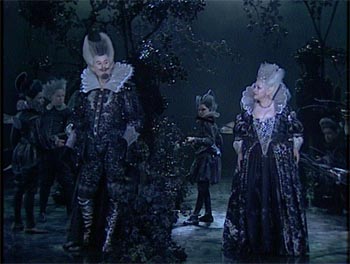
Peter Hall’s 1981 Glyndebourne production of Britten’s A Midsummer Night’s Dream was quite celebrated in its day. How does it wear, thirty years later? The bottom line is it looks and sounds a bit tired.
The production was innovative in its day. The scenery in the forest is inhabited by supers who make it, in a sense, “enchanted” and the lighting is interesting (at least so far as one can tell on the DVD). The problem is it never manages to generate any sense of menace from the world of the Fairies without which, to me at least, Dream (Britten’s version or Shakespeare’s) is insipid. Part of this lies in the old fashioned counter tenor sound of James Bowman and part in the very childlike fairies. As a result the first act starts very slowly and the Hermia (Cynthia Buchan) and Lysander (Ryland Davies) scene fails to spark. The “I swear to thee” duet is really slow and a bit lack lustre. Things do liven up a bit with the entry of Demetrius (Dale Duesing) and Helena (Felicity Lott). All in all Act One is a bit of a snooze.
Act Two is better and the cat fight between Hermia and Helena is funny but there is still little element of menace. Oberon can’t even make “This is thy negligence” threatening and even the scenes with Bottom having an ass’ head don’t really have any bite. The Act Three lovers’ quartet is lively but Act Three really turns on whether the Rude Mechanicals are actually funny. That takes close to a miracle from both director and singers and a miracle just doesn’t happen here. Both Bottom (Curt Applegren) and Flute (Patrick Power) have their moments but it never gels. Throughout it’s fairly static with only Damien Nash’s “cheeky chappy” Puck creating much movement. So, lack of both menace and humour rather undermines some interesting design elements.
Musically this is pretty mixed too. Especially in the first act the orchestral playing seems oddly unfocussed. It’s partly a matter of tempi. Bernard Haitink is eight minutes slower overall compared to the composer’s studio recording for Decca. He also fails to get the rhythmic attack and dynamic range out of the LPO that Britten gets from the LSO. (Part of the problem here may be the soft recorded sound versus John Culshaw’s excellent Decca recording). The overall effect is a bit insipid. The singing is OK but really only Duesing and Lott stand out vocally. Ileana Cotrubas as Tytania is oddly anonymous.
Dave Heather directed for TV and video and it’s a typical early 1980s directed for TV effort. I don’t think the whole stage (and this is the old, small Glyndebourne stage) is visible even once. The picture is 1981 quality too. It’s soft by DVD standards. There is flickering on the subtitles. Don’t watch from too close on a modern TV. The Dolby 2.0 sound is barely average. There’s no real depth and at times the orchestra seems to be muffled. It’s not remotely as good as the sound on the 1966 studio recording. There are English, French and Spanish subtitles, no extras and minimal documentation.
I haven’t seen the only other Dream currently available but it’s a recent Robert Carsen production from Barcelona with Harry Bicket in the pit and David Daniels as Oberon plus video direction is by the excellent Francois Roussillon. I’d certainly advise taking a look at that before buying this one.
From corpse to corpse
I managed to get my hands on the DVD of the Gianni Schicchi that formed the second half of the evening’s entertainment with The Miserly Knight that I reviewed yesterday (Glyndebourne 2004). It’s the same creative team of Jurowski and Arden and they reinforce the end on a corpse, start on a corpse symmetry by using the aerialist Matilda Leyser as the corpse in Schicchi. Both Jurowski and Arden stress the dark side of the work in interviews but to be honest it comes off here more as a madcap comedy. Perhaps that was inevitable when following the very dark and enigmatic Rachmaninov piece. It’s set around the time of the work’s composition and a unit set with balcony and bed and a cupboard to stuff the body in serve throughout. It’s workmanlike and effective. The blocking is very precise and effective. After all there are at least eight characters on stage throughout this piece. Arden moves and groups them with precision and my only beef is that (surprise) we miss much of her careful work because of closeupitis.
The performances are excellent. Alessandro Corbelli is superb in the title role confirming my opinion of him as one of the great comic baritones. The acid aunt Zita is wonderfully played by the seemingly timeless Felicity Palmer and the rest of the family back her up strongly with excellent ensemble work. Sally Matthews as Lauretta and Massimo Giordano as Rinuccio are the romantic interest and they are both good. Matthews manages a version of O mio babbino caro that is lovely to listen to and spectacularly insincere. She also acts very well and looks the part. Giodarno has a lovely Italianate tenor voice, acts well and is also most pleasant to listen to. Jurowski handles the score well building to some impressive climaxes where required, for example in the scene where the family are imagining all the good things the monks will get to eat from Buoso’s legacy.
The video direction isn’t as egregious here as in the Rachmaninov but it’s still annoying. The scene where Schicchi is preparing to impersonate Buoso is particularly irritating. Technical details and standard of execution are the same as for the Rachmaninov. The interviews with Jurowski, Arden and Corbelli are also equally good. I could listen to Jurowski talk about music and its relationships to other art forms and social developments for a long, long time. Just a reminder that this is also available as a double bill with the Rachmaninov on Blu-ray as well as separately on DVD.
It will be interesting to see how this compares to the upcoming COC production which will be paired with the very dark Eine florentinische Tragödie by Zemlinsky from Wilde’s play. It has a starry cast, Sir Andrew Davis conducting and Catherine Malfitano directing so we may be in for a treat.
A Knight to remember
Rachmaninov’s The Miserly Knight is a very strange one act opera and it isn’t often performed. A production by as cerebral a creative team as Vladimir Jurowski and Annabel Arden looks like a very promising idea so I was very intrigued to see what they made of it in this 2004 Glyndebourne recording.

This work lasts only a little over an hour and is split into three scenes which scarcely relate to each other. In Scene 1 a young knight laments that he can’t keep up his social position on his meagre allowance. A Jewish moneylender refuses to extend further credit but suggests that he can provide the knight with poison if he wants to do his old man in. The knight refuses. Act 2 consists of a monologue in which the father, the Miserly Knight of the title, rhapsodizes over his six chests of gold in a fairly overtly sexual way for twenty five minutes. In Scene 3 the Duke orders the father to make an appropriate allowance to his son. The father refuses ultimately claiming, ironically, that his son is trying to poison him. The son rushes in and denounces his father. They have a row and the father drops dead. End of story. All this takes place to an incredibly complex score full of leitmotivs. In a real sense the orchestra is the main character, functioning as Chorus in the original Greek sense. How to bring some sense of the dramatic to this is no mean problem. Arden’s solution is to embody Greed in the form of an aerialist who is present whenever the father is present. This seems like a great idea and on the odd occasion the video director lets the DVD audience see the interaction between Greed and the father it seems to work. Unfortunately the video director, Franceska Kemp, is even more wedded than most of her ilk to superfluous close-ups and so most of Arden’s intelligent work is lost on us.
Musically this is pretty impressive. The music is not typical Rachmaninov. There are no big tunes and it looks forward to the musical language of early Schoenberg or Bartok as much as it looks back to Wagner and Tchaikovsky. In other words it’s an uncompromising early 20th century score. Jurowski gets this and conjures up superbly detailed and incisive playing playing from the London Philharmonic. He’s backed up by an excellent cast of singing actors. The star, clearly, is Sergei Leiferkus as the father. He manages a part that is usually cast for a bass but goes uncomfortably high for most basses. He can sing the music and he brings an absolutely revolting quality to his quasi sexual monologue about money and power. He’s amazing. The rest of the cast are more than adequate. I particularly liked Albert Schagidullin’s powerful baritone as the Duke. Richard Berkeley-Steele, Maxim Mikhailov and Vyacheslav Voynarovsky are solid as the young knight, the servant and the moneylender. Matilda Leyser is the aerialist portraying Greed. What little we see of her is impressive but I really would like to see much more.
Video direction aside this is pretty impressive as a DVD package. The DTS 5.1 soundtrack is superb (LPCM stereo also available). The picture is also excellent. There are French, German, English, Italian and Spanish subtitles. The extras on the disk include very useful interviews with Jurowski, Arden and Leiferkus as well as a quick look at the Gianni Schicchi with which it was paired at Glyndebourne. The documentation also includes a couple of essays that are worth reading. There’s also a Blu-ray release that includes both The Miserly Knight and Gianni Schicchi.
This is the only currently available video recording of The Miserly Knight so I think it’s worth a look despite the dreadful video direction. If that had been done properly I think this would likely have been really impressive.
Searing Kat’a Kabanová
The searing intensity of this 1988 Glyndebourne recording of Janáček’s Kat’a Kabanová overcomes a rather indifferent DVD transfer to great effect.
The production by Nikolaus Lehnhoff focuses on the inner emotions, or lack of them, of the principal characters especially Kat’a and the Kabanovicka. This focus is greatly aided by the simple but colourful semi-abstract sets that bring to mind Chagall or Kandinsky in their bold use of colour. The execution of the concept is first class. Nancy Gustavson, in the title role, gives a quite breathtaking portrayal of a mental breakdown, especially intense in the confession scene. She also sings quite superbly. Felicity Palmer as her mother in law is as chilling as one could possibly wish, nowhere more so than in the final scene as she walks away from Kat’a’s body. The Varvara, Louise Winter, the facilitator of Kat’a’s fatal affair, brings some real charm to what would otherwise be pretty unrelentingly grim.
The men have less to do and the only real stand out is bass Donald Adams as Dikoj. His scene with Palmer is oddly compelling in a revolting sort of way. The other men are perfectly adequate but it’s the women who carry the show here. The other real star is the LPO under Andrew Davis. This is a hell of a score and Davis, wonderfully supported by his players, makes the most of it. I just wish the sound quality had been better.
The production for DVD is adequate. Helped by the small stage of the old theatre at Glyndebourne video director Derek Bailey lets us see what is happening and only in Act 3 does he get a bit close up happy. All in all it’s not a bad job for a 1988 TV broadcast. The picture is tolerable. It’s 4:3 with hard English subtitles. As all 100 minutes of the opera are crammed onto one DVD5 it’s perhaps surprising it’s as good as it is. Sound is Dolby 2.0 and again “adequate” is as good as it gets. There are no extras or documentation beyond a chapter listing. The european release on a different label may be a little less Spartan.
Technical reservations aside, this is well worth seeing.
Exemplary Blu-ray transfer for Glyndebourne’s Fairy Queen
I’ve reviewed two DVDs of Purcell’s semi-opera King Arthur on this blog. One was excellent and one was terrible and between them they went a long way to showing how difficult these semi-operas are to stage well but how rewarding when they succeed.
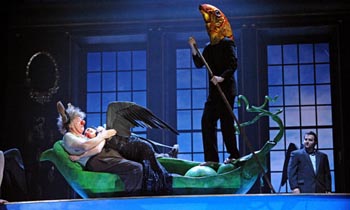
In 2009 Jonathan Kent and William Christie combined to produce a version of The Fairy Queen for Glyndebourne. It’s quite different in style from the successful Salzburg King Arthur but it works splendidly on its own terms. The Fairy Queen combines a libretto based on A Midsummer Night’s Dream with songs, masques and dances of a largely allegorical nature. Like the play itself they range from high flown allegory with classical elements to bawdy humour. It is very English. It almost epitomises what separates the English baroque from the French. Kent and Christie tackle this with a robust English sensibility, There are some changes to the dialogue and to the order of the numbers but it all makes sense (so far as this piece can). The allegorical elements are gorgeously and wittily staged making good use of a large circular lift at centre stage that allows fully formed tableaux to rise into our sight.
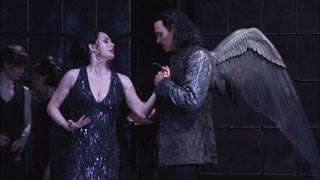
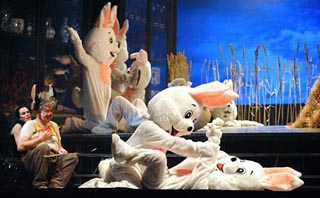
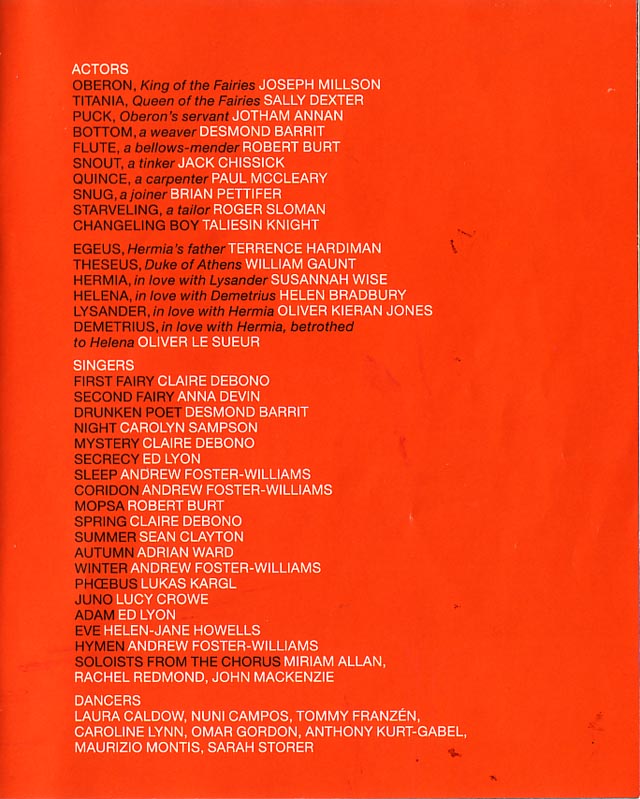
The bawdy elements are tackled head on with a robustly TV Mopsa (Robert Burt) in the “Dialogue of Corydon and Mopsa” and the, by now, notorious bonking bunnies in the “Dance for the Haymakers”. The audience is totally engaged and one hears plenty of that commodity, rather rare in the opera house, uninhibited laughter. The team of designer Paul Brown and lighting designer Mark Henderson make all of this look quite spectacular. The dramatic action is played out in fairly long segments and the parts are taken by actors rather than singers. The fairies are appropriately sinister with wings that look inspired by contemporary prints of fallen angels. The Rude Mechanicals are rude and not too mechanical. The “humans” are credibly 17th century in manner though dress gets less formal as the action proceeds. The disparate elements are integrated very well. There’s plenty of dance and it’s choreographed by Kim Brandstrup in a style that is robustly muscular but solidly in the classical ballet tradition.
The cast of actors, singers and dancers is huge and consistently excellent.
I was particularly impressed with Sally Dexter’s Titania and Desmond Barrit’s Welsh accented Bottom among the actors. Barrit even got to do some singing with a not too over the top version of the “Song of the Drunken Poet”. The singing stars were the wonderful, sweet toned Lucy Crowe; her “if love’s a sweet passion” was a delight, and the robust bass-baritone Andrew Foster-Williams who, among other sings, sang a truly chilling Winter. Singling out individual performances isn’t the point though. This is very much an ensemble performance. Christie directs the Orchestra of the Age of Enlightenment from the harpsichord and is as idiomatic as one could possibly hope for.
So, how well does the stage production transfer to disc? Extremely well! The video director is François Roussillon. Unlike most of his peers he appears to have realised that opera lovers are not, for the most part, watching on tiny screens anymore. He makes sure we can see what the designer and director intended. Sure, there are close ups but never at the expense of the bigger picture. The technical quality is of a very high order. There are two formats available; a two DVD set and Blu-Ray. I watched the latter but I doubt most people would see a huge difference. It was filmed in 1080i HD and the picture is clearly better than my first generation HD TV can fully do justice to.
The sound is incredibly good. On Blu-Ray it’s DTS-HD Master Audio (DTS 5.1 on DVD). The quality is apparent even as Christie is walking to the pit. The applause simply sounds as if one is in the house rather than the usual muffled fluttering noise. The balance, clarity and spatial depth are exemplary throughout. Both formats also have LPCM stereo. There are English, French, German and Spanish subtitles. There are useful extras. The disc includes interviews with Kent and Christie which are well worth watching and the booklet includes an informative essay by Kent as well as a track listing and synopsis.
All in all this is an excellent production given an exemplary transfer to disc. Here’s the official trailer, unfortunately in less than exemplary Youtube quality:
A girl called Maria
Maria Ewing has always been a bit of an enigma to me. It’s the range of roles I’ve heard her in; Salome, Dido, Carmen, Rosina. Soprano to mezzo and bel canto to dramatic. In the recording under consideration here she sings Rosina in Rossini’s Il Barbiere di Siviglia. It was recorded at Glyndebourne in 1982 when she was 32. Her performance is typical Ewing. She acts really well, looks great (if her unusual looks work for you – they do for me!) and sings really well without ever really sounding beautiful and occasionally giving one the feeling one gets watching somebody corner a little too fast on a large motorbike. I find watching her fascinating.
The production is as traditional as one could get and makes the small, old Glyndebourne stage look even smaller. Costumes too are absolutely generic 19th century comic opera. Blocking is basic. Mostly it’s very straightforward “park and bark”. All in all it’s the sort of thing you simply wouldn’t see in a modern opera house (except maybe the Met) and I’m sure it would please the investment banker’s wife in the Salzburg King Arthur. The singing and acting, Ewing aside, backs the production up.
John Rawnsley is a very broad Figaro with winks and big gestures and little mincing footsteps. He sings very well indeed but he has a voice that seems two sizes too loud for the production and tends to dominate ensembles. Max-René Cosotti is the Count. He has an old fashioned Italian tenor voice that works really well in this context. The rest of the cast is perfectly OK too and there’s a bit of a bonus in that Basilio is sung by a 33 year old newcomer called Ferrucio Furlanetto. We are a million miles away from Phillip II here! The London Philharmonic are in the pit under Sylvain Cambreling. They are balanced well back from the voices but seem OK to me. All in all, this is musically quite fine, if rather old fashioned, but dramatically it’s rather like watching superior panto for adults.
Technically this disc is about what one might expect. It’s taken from an ITV broadcast and is very much video directed for small screen. The picture is barely DVD quality 4:3 and the sound is Dolby 2.0. It isn’t particularly good either being slightly muffled and with quite unrealistic balance. Subtitles are available in English, French, German and Spanish. There are no extras and minimal documentation. All in all I think one has to treat this like a dodgy mono sound recording from the 1950s. It’s worth having if one wants a record of these singers but otherwise one is better off looking for something more recent. Certainly Dario Fo’s Amsterdam production is much more fun to watch.