Albert Herring

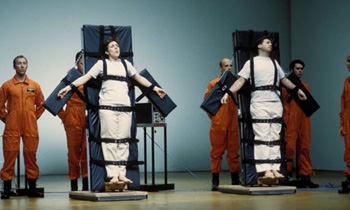
Britten’s Albert Herring is mysteriously under represented in the DVD catalogue.  The work is performed quite often being relatively inexpensive to mount and suitable for smaller venues but the many productions haven’t led to many recordings.  I have only been able to find one and that dates back to 1985 when it was recorded at Glyndebourne.  That’s appropriate enough as that’s the house the piece premiered in in 1947.  At least it’s a  fair and effective representation of the work.  Peter Hall’s production takes few liberties with the libretto and is a rather literal and effective, if necessarily somewhat caricatured,  representation of life in a Suffolk village.  The sets and costumes are evocative; especially the hall of Lady Billows’ house which really evokes a 17th century Great Hall and, as the view through the window tells us, is set in or close to the village, not in an isolated park.  There’s quite a lot of that kind of attention to detail in this production.

1.window Continue reading

Adventure story

Robert Carsen doesn’t seem disposed to treat Handel too reverentially.  Although there is some of the trademark Carsen cool minimalism in his 2011 Glyndebourne production of Rinaldo (not to mention symmetrically arranged furniture) there’s also a degree of humour, as there is in his Zürich Semele.  I find it very effective and, judging by the audience reaction, so did the people who saw it at Glyndebourne.

1.cane Continue reading

Theodora redux

Peter Sellars’ 1996 Glyndebourne production of Handel’s Theodora just gets better with every viewing. I utterly retract my original view that the music isn’t Handel at his finest. It’s very good indeed and the production and performances on this disk are fantastic. Despite not being the best recording ever (though the recent Blu-ray release is an improvement) it remains a “must see” for any fan of Baroque opera or challenging music theatre.

What makes it so compelling? I think it’s two factors. The first is the production. The contemporary American setting works with very little violence to the libretto or music and yet speaks directly to very contemporary concerns. It’s particularly effective that current reality is inverted with respect to mainstream Christianity. Added to this are some extraordinarily intense performances led by the late Lorraine Hunt as Irene, the leader of the Christians. “As with rosy steps the morn” and “Lord to thee, each night and day” bring me out in goosebumps every time. The chemistry between David Daniels and Richard Croft is also palpable and Dawn Upshaw could hardly be bettered in the title role. Even Christine Schäfer in the only competing recording doesn’t come close.

One of the notes I made while watching this the other night reads “anybody not moved by this is an emotional cripple”. It’s a fair summary.


Love is stronger than death

The 1996 Glyndebourne Theodora, featuring Dawn Upshaw as Theodora and David Daniels as DidymusPeter Sellar’s production of Handel’s Theodora has long been one of my favourite video recordings of opera.  It’s brilliant in so many ways and I don’t think I’ve ever made it through the whole thing without tearing up. It’s now been remastered from the original tape and reissued on Blu-ray.  The video and sound quality are distinctly better than previous DVD releases though not, inevitably, in the same class as the best modern recordings.  It’s also still a depressingly bare bones release with no extras and minimal documentation but don’t let that put you off.

My original review is here.  I thought about rewriting it but for the most part I stand by my original comments.  The only judgement I’d change is that, on greater experience, I do think this is one of Handel’s best works.

Wild Thing

1.wildthings So I thought the obvious antidote to Robert Carsen’s Dialogues des Carmélites would be the recording of Ollie Knussen’s Where The Wild Things Are and Higglety, Pigglety, Pop that was sitting in my ‘to watch’ pile.  It’s a 1985 Glyndebourne recording and the Associate Director is one Robert Carsen, assisting Frank Corsaro.  So it goes.  Actually it was rather fun, if a bit irritating in the way that children’s literature written for kids with ADD seems to be.  The music is terrific and not at all dumbed down.  The sets and designs, as well as the libretto, are by Maurice Sendak himself and there’s some pretty neat lighting by Robert Bryan.  The Wild Things are really cool and almost make up for the fact that Max (played here by Karen Beardsley) is an appalling little s$%t who needs a good kick in the backside.  HHP is a bit more restrained and simultaneously manages to be less fun but also less annoying.  It has a rather splendid lion and Cynthia Buchan does rather well as, to the best of my knowledge, the only Sealyham terrier in opera.  Knussen conducts the London Sinfonietta and they sound really good.  Continue reading

Gerry Finley’s Don Giovanni

Jonathan Kent’s 2010 Glyndebourne production of Don Giovanni has a great cast and high ambitions but, ultimately, doesn’t really come off, largely because the relationships between the characters too often fall short of anything interesting.  The concept, as explained in the two short bonus segments, is that Don Giovanni is set in a society in transition and that the title character is a sort of harbinger of the new mores.  The “society in transition” chosen by Kent is a sort of hybrid of Fellini’s La Dolce Vita and the last years of Franco’s regime in Spain.  He might have done better to just pick one as the Fellini elements get pretty much reduced to the costumes and the Franco elements really don’t go anywhere.

window Continue reading

Time is a funny thing

A series of blog posts discussing time, perceptions of time and historically informed performance (HIP) plus seeing Opera Atelier’s Der Freischütz got me thinking along some curiously convergent lines and arriving at the conclusion that HIP isn’t and can’t be what it is often purported to be; a fairly faithful attempt to reproduce a work as it would have been seen by its first viewers or “as the composer intended” or something like that.  Not, of course, that even if it was, we would see and hear it as the original audience did but that perhaps is a topic for another day.

Continue reading

Chacun à son goût

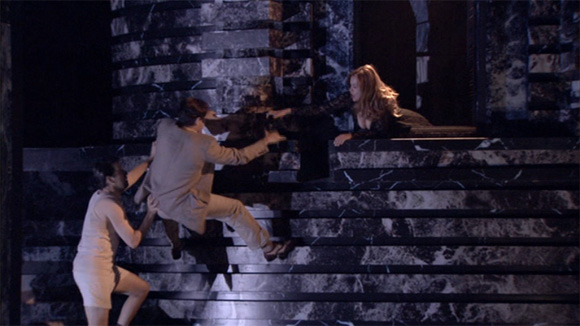
There’s lots to like in the 2003 Glyndebourne recording of Die Fledermaus.  Let’s start with Stephen Lawless’ production.  It’s attractively designed, quite slick and has a few good new gags without going overboard.  The sets are designed with striking diagonals and staircases and gantries.  Rotation is used both as a device to change the setting and as an element in the scene composition.  The overall effect is that the scene changes from drawing room to a sort of “gilded cage” for Orlofsky’s party – which opens out to create space for the action – to a prison with minimum disruption to us or the action.  Spots are used to create stagey effects and at one point Jurowski in the pit ostentatiously upstages the actors on stage.  Lawless never lets us forget this is a “show”.  Continue reading

La cosa vostra?

If you are a fan of bel canto comedies you will probably enjoy the 2009 Glyndeboure production of Donizetti’s L’Elisir d’Amore quite a lot.

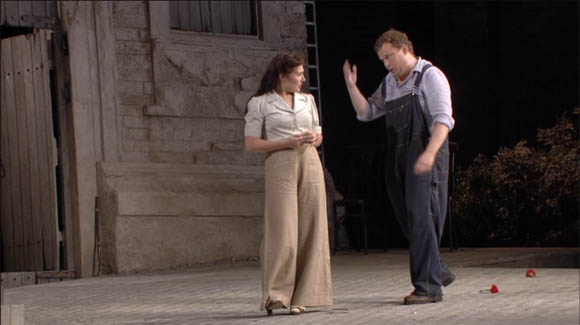
Director Annabel Arden sets this bucolic comedy in the Italian countryside of the 1950s (though some of the iconography is more appropriate to the Mussolini period).  It has some of the look, but little of the edge of Italian neo-realist cinema.  It does though take the work fairly seriously with a Dulcamara who is isn’t the obvious quack we usually see but just hints at having real powers.  Dulcemara also acquires a rather bizarre mute assistant.  Beyond that it’s all carefully staged with the chorus action well directed and performed. Continue reading

Patchy Figaro

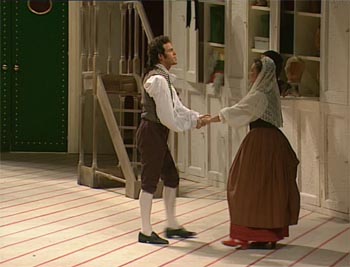
There are, I think, eighteen DVD versions of Mozart’s Le Nozze di Figaro currently available so there needs to be something very special about a recording for it to stand out. Unfortunately Stephen Medcalf’s 1994 Glyndebourne production doesn’t really despite having a strong looking cast. It’s a pretty traditional looking production with breeches and crinolines and sets which look a bit like a giant doll’s house. The Personenregie is well thought out and the stage picture often artfully composed. The acting is almost uniformly excellent. It’s a good solid production but with nothing original in the least about it. Continue reading