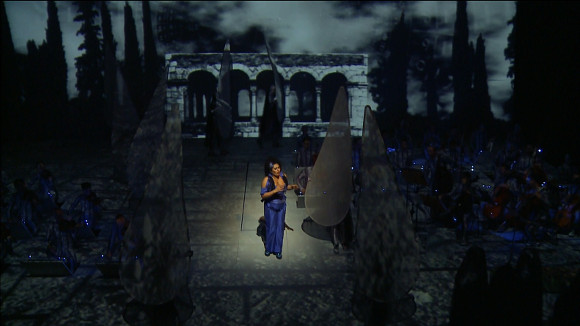
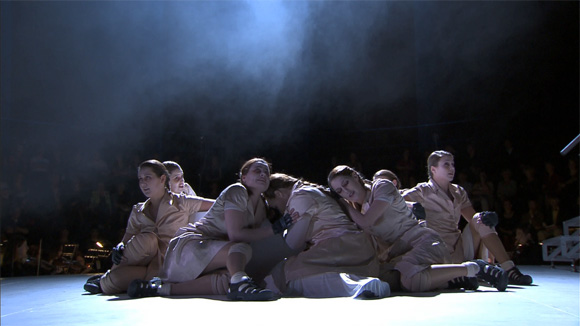
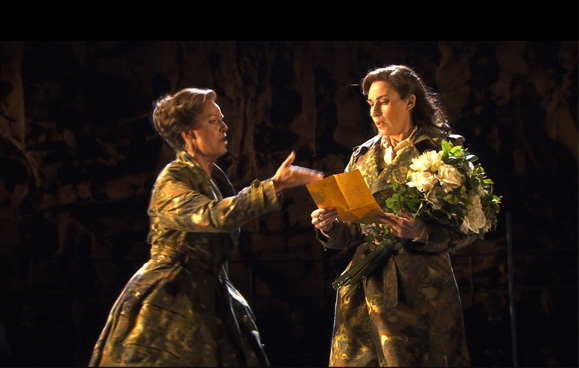
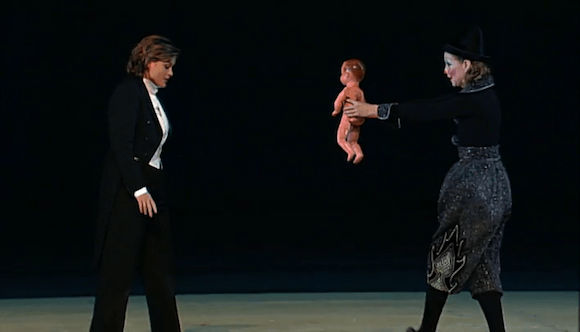
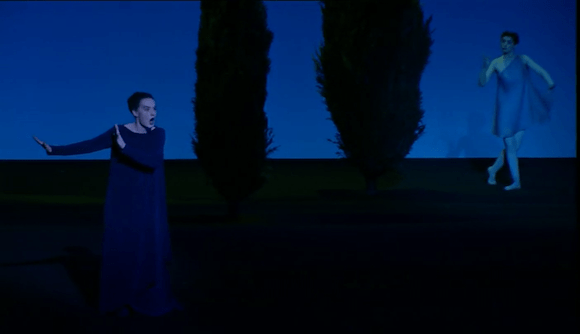
La Fura dels Baus mounted a spectacular production of Gluck’s Orfeo ed Euridice at the Festival Castell de Peralada in 2012. The concept has the orchestra in costume, on stage and fully involved in the action. There are lots of video projections and spectacular lighting effects. In fact at times the whole thing resembles a son et lumière. There’s also lots of aerial action. It’s all rather exciting. Great work from director Carlus Padrissa.
Tag Archives: gluck
More Iphigénie
The second half of the Amsterdam double bill that opened with Iphigénie en Aulide is, of course, Iphigénie en Tauride. In this piece the more usual version of the Aulis story, where Diana substitutes a stag for Iphigenia on the altar and whisks the girl off to be her priestess among the savage Scythians of Tauris, is assumed. So the piece opens with Iphigenia and six other Mycenean priestesses (how they got to Tauris is a mystery) in Diana’s temple at Tauris where their job is to sacrifice any strangers who show up. Almost at once the capture of two Greeks is announced. They turn out to Iphigenia’s brother Orestes and his sidekick Pylades and the the next 90 minutes turns on Iphigenia failing to sacrifice either of them.
Iphigénie at last
Gluck’s Iphigénie en Aulide is finally available on Blu-ray and DVD. It was staged and recorded as a double bill with Iphigénie en Tauride at De Nederlandse Opera in September 2011 in productions by Pierre Audi. It’s excellent in just about every respect. The cast is to die for, the production is interesting and so is the staging in the rather challenging space of The Amsterdam Music Theatre, which also poses problems for the video director. Backed up, on Blu-ray, by a 1080i picture and DTS-HD-MA sound it’s a pretty compelling package.
Not a DVD review
There are an awful lot of opera DVDs about. It sometimes seems like there’s a new Tosca or Traviata out every week, often for no apparent reason. It’s perhaps surprising then that some works don’t make it to DVD. One particularly egregious case would seem to be John Adams’ Nixon in China. It’s a good piece and has had plenty of productions both in North America and elsewhere. A couple of years ago I saw it twice in 24 hours; on a Friday evening at COC followed by the HD broadcast from the Met the following afternoon and I’ve been listening to an audio recording of the COC version on my walk to and from work. But there’s no DVD! I guess that the Met probably planned to release the HD recording but James Maddalena, the Nixon in the recording, was so obviously ill I was actually surprised that he continued after the interval and I guess that scuppered that. Continue reading
Kupfer’s Orfeo
I’ve owned a VHS tape of Harry Kupfer’s 1991 Royal Opera House production of Gluck’s Orfeo ed Euridice pretty much since it came out. I really can’t bear to watch VHS anymore so I haven’t watched it in ages and was intrigued when I managed to get my paws on a DVD copy and was able to see what I thought after all this time. Continue reading
Beautiful simplicity
I don’t think I’ve ever been to an opera with higher expectations than last night. The show was a piece I love; Gluck’s Iphigénie en Tauride. My favourite director, Robert Carsen, was directing. The cast; Susan Graham (Iphigénie), Russell Braun (Oreste), Joseph Kaiser (Pylade), Mark Doss (Thoas) with solid young singers in the minor roles, was as starry as I have seen at the Four Seasons Centre. How could it live up to my expectations? All I can say is that it did.
The stage design for Carsen’s production is about as minimalist as it gets. The raked stage is enclosed by three plain grey walls in the form of a regular trapezoid. Occasionally a rectangular slab (altar) appears centre stage. The chorus chalk the words AGAMEMNON, IPHIGENIE, KLYTEMNESTRE on the walls and later Iphigénie erases them. The rest is done with lighting (Peter van Praet). Even the lighting plot is spare. The palette is predominantly blue-grey with orange/red appearing to symbolise the Furies and the violence of the history of the house of Atreus. Only at the very end does the gloom and claustrophobia lift. Within the gloom though van Praet creates ominous giant shadows of the characters which enormously enhance key scenes.
To play out the drama in this gloomy space Carsen uses dancers and places the chorus in the orchestra pit. Occasionally this leads to minor balance issues between the soloists and chorus but it is a small price to pay for the action on stage. In one particularly effective scene, the Furies carry Oreste and force him to walk sideways across the text of KLYTEMNESTRE. In another they turn into writhing serpents who back Oreste into a corner. In the final scene the “dea ex machina” element is handled about as well as I have ever seen it done. Diana (Lauren Segal) sings, unlit, from what sounded like Ring 4 stage left. The characters on stage are frozen. She resolves the drama and the stage walls rise about six feet to flood the stage with very white light. Unfussy and effective. All in all one feels that Gluck’s ideal of a “beautiful simplicity” is achieved. The one place where the minimalism is a bit of an issue is that all the characters pretty much look the same to the point where it isn’t always obvious who is singing. A good pair of opera glasses, a decent seat and knowing what the main singers look like helps here. I think the approach works in part because the drama moves ahead at a breathless pace. Wagner would need about fifteen hours to get through a story that Gluck manages in less than two hours.
Musically the evening was about as good as it gets. Pablo Heras-Casado pushed things along at a pretty fair pace but didn’t lose the drama. He was helped by some gorgeous woodwinds. The soloists were all quite excellent. Susan Graham owns this part, her rather bright mezzo suits the role and she sounded utterly in command. Joseph Kaiser and Russell Braun worked really well together in a reading that wasn’t as obviously homoerotic as some I’ve seen. Kaiser has a lovely Mozartian tenor and Braun has power and beauty of tone to spare. Mark Doss was appropriately violent as Thoas and I’d really like to see what he could do with something more lyrical. The minor roles were all more than adequately covered by local singers who will be familiar to anyone who frequents the Four Seasons Centre.
So, my unrealistic expectations were met and I thoroughly enjoyed one of the best evenings I’ve spent in an opera house. I’m late to the party though. If you want to catch this show Susuan Graham is singing just one more time on October 12th and there is a final performance with Katherine Whyte in the title role on October 15th.
Munich Orphée hits 11 on the WTFometer
Back in July I reviewed John Eliot Gardiner’s Paris recording of Gluck’s Orphée et Eurydice which I found musically fine, in good taste (too much so) and ultimately unengaging. Lydia pointed me to a Bayerischen Staatsoper version with Vesselina Kasarova in the title role. It’s the 1859 Berlioz version with a ballet tacked on at the end, more of which below. Musically it’s very good. Chorus and Orchestra under Ivor Bolton are excellent, Kasarova sings and acts very competently and manages an amazing cadenza in her big first act aria. Rosemary Joshua as Eurydice is perfectly adequate if a bit anonymous and Deborah York is an androgynous looking and sounding Amour which works fine for this production.

Orphée et Eurydice – Gardiner DVD
John Eliot Gardiner chose to videorecord the French version of Gluck’s Orphée et Eurydice at the Théâtre Musical de Paris – Châtelet. Choosing the French version is consistent with Gardiner’s other Gluck recordings. The Paris cast is a bit less starry than his Lyon CD version but more than adequate. Orphée is sung by mezzo Magdalena Kozena, Eurydice by Madeline Bender and Amour by Patricia Petitbon. Gardiner uses his usual forces for chorus and orchestra; the Monteverdi Choir and the Orchestre Révolutionnaire et Romantique. Choreography is by Giuseppe Frigeni, stage direction by Robert Wilson and video direction by Brian Large. The DVD is on EMI, has 16:9 video and Dolby 2.0 sound. It was recorded in 2000.

Orfeo ed Euridice
Gluck’s Orfeo ed Euridice was written in reaction to what the composer saw as the excesses of contemporary opera seria. Out went the glitzy display numbers for star singers and extraneous ballets. In came the idea of telling a strong story simply through words and music. This “stripping down” is emphasised by Robert Carsen’s very spare production, originally created for Lyric Opera of Chicago and currently playing at the Canadian Opera Company.
Carsen gives us a slightly raked stage covered in rubble with the only “feature” being Euridice’s grave. There are no dancers. The three principals and the chorus are dressed in modern black suits or dresses with, where appropriate, white shrouds. In a few scenes pots of fire are used on stage but that’s as near as we get to colour until the very final moment. Despite the lack of dancers there’s plenty of work for the chorus who weave intricate patterns around the principals. Most of this is lit (if anything so dark can be said to be lit) so as to project shadows onto the back of the stage. It’s simple and effective. Only at the very end, as Euridice is redeemed for the second time do we get light. It’s really effective. The stage glows and the houselights come up briefly effectively including us, the audience, in the redemption through love.
Countertenor Lawrence Zazzo sings Orfeo. It’s the crucial role. He’s on stage for virtually the whole 90 minutes and has pretty much all of the famous solos. He was very good last night. He is the ‘modern’ kind of countertenor, sounding more soprano like than say James Bowman or Alfred Deller. That worked very well for this role (though not as well for Oberon two seasons ago when a bit more “otherwordly” would have been welcome). He was very well backed up by Isabel Bayrakdarian as Euridice. It was lovely to hear her sing a role that really suits her current voice; darker and more mature than it was just a few years ago. Amore was sung by Ambur Braid. I think this role suits her voice far better than the Queen of the Night, which is what I last heard her sing on this stage. I think it was quite an inspired bit of casting because, besides the vocal suitability, Ambur is perfect as the gender fluid Amore that Carsen gives us. She looks equally good and equally convincing in a suit as in a dress. So, terrific singing and acting all round.
The chorus is crucial in this piece and didn’t disappoint. It’s a really good chorus and once again did its thing admirably, as did the orchestra The whole thing was musically held together by Harry Bicket in the pit. It’s another excellent choice for this work responds well to his cool, classical style.
So, no histrionics or emotional manipulation here, just an hour and a half of very beautiful and satisfying music theatre that had most of the audience members on their feet for the extended curtain calls. There are three more performances next week and decent tickets still available (surprisingly given the universally stellar reviews). Failing that, Mr. Carsen is back next year to direct Gluck’s Iphigénie en Tauride with Susan Graham and Russell Braun.
Iphigénie en Tauride
Iphigénie is one of my all time favourite operas and has some absolutely gutwrenchingly beautiful music. The Met production had Susan Graham, Placido Domingo and Paul Groves. This looked set to be amazing. It wasn’t quite though it was very good indeed and the problems were all with the production. Despite Peter Gelb announcing before the curtain that Ms. Graham and Mr. Domingo were both suffering from colds the singing was first rate across the board. I’m looking forward even more to Susan Graham singing this with Russell Braun and Joseph Kaiser next year in Toronto.