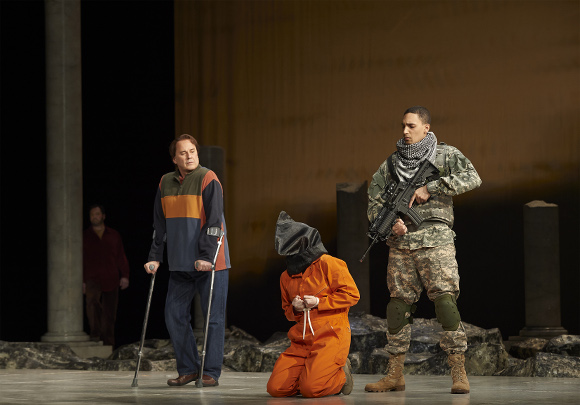
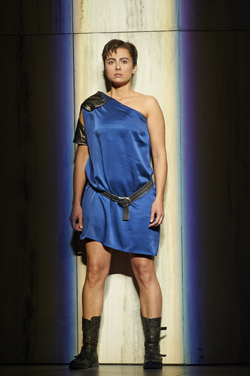
Opera Atelier’s first real venture into Handel is accompanied by some significant shifts in aesthetic coupled with some slightly puzzling throwbacks. The work chosen is Alcina. It’s not Handel’s best known (or, indeed, best) but it’s a perfectly serviceable example of Handel’s Italian works for the London stage. The plot, ultimately from Ariosto’s Orlando Furioso, concerns the sorceress Alcina who has an illusory kingdom made up of the souls of men she has ensnared. Her most recent conquest is the knight Ruggiero. His betrother, Bradamante, disguised as her brother, Ricciardo, shows up with Ruggiero’s former tutor, Melisso. Melisso has a ring which shows things as they are, shorn of illusion. Eventually they use this to return Ruggiero to his duty and Alcina’s kingdom goes up in smoke. Along the way there’s also a sub-plot involving Alcina’s sister, Morgana, who falls in love with Ricciardo to the dismay of her lover Oronte. In the original there’s also a boy looking for his father and a lion but they got cut in Marshalll Pynkoski’s version. In fact there’s probably close to an hour in total cut from Handel’s score.
Tag Archives: giunta
Faster Still Anaïs Nin
This concert at Koerner Hall was the second in this summer’s Twenty-First Century Music Festival. It advertised works by Christos Hatzis, Brian Current, R. Murray Schafer and Louis Andriessen. In fact we kicked off with a short bonus selected from Youtube entries to make up 21 premieres for the C21. Unfortunately I didn’t catch composer or title and it lasted less than two minutes. Continue reading
Inspired by Love
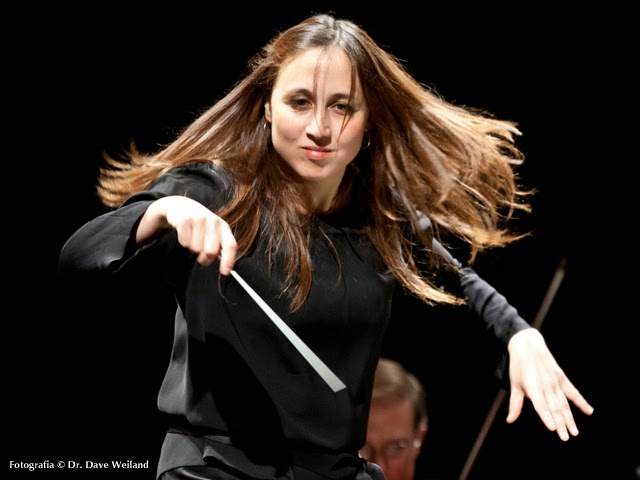
Once in a while it’s fun to go to something almost entirely undemanding (for the audience at least!). So, yesterday afternoon I attended a concert of classical “lollipops” given by the TSO under the baton of young Portugese conductor Joana Carneiro. The chief attraction for me was that recent Ensemble Studio graduates Simone Osborne and Wallis Giunta were also performing. Things got going with the overture from Il Nozze di Figaro. It was a brisk and stylish performance with Ms. Carneiros displaying a very physical conducting style.
Ok, so how did I miss this?
Saturday (7.30pm) and Sunday (3pm), at Roy Thomson Hall, the TSO has a programme that includes operatic lollipops from Simone Osborne and Wallis Giunta. Joana Carneiro conducts. I had to go all the way to Sudbury to find a picture with wallis and Simone. Anyway, here’s the programme for the concert:
| Mozart: Overture to The Marriage of Figaro | |||
| Mozart: “Letter Duet” from The Marriage of Figaro | |||
| Offenbach: Intermezzo and Barcarolle from The Tales of Hoffmann | |||
| Delibes: “Flower Duet” from Lakmé | |||
| Beethoven: Symphony No. 6 “Pastoral” – Mvt. I | |||
| Glinka: Overture to Ruslan and Lyudmila | |||
| Villa-Lobos: Bachianas brasileiras No. 5 | |||
| Tchaikovsky: Romeo and Juliet Fantasy-Overture |
So three lovely ladies (plus the TSO) at one low (not especially actually) price.
Heading towards May
Here are a couple more upcoming events that readers may be interested in. The Royal Conservatory has a festival of contemporary music from April 21st to May 25th. There are eight concerts in a variety of genres. The most interesting to me is on May 22nd when there is a concert to celebrate R. Murray Schafer’s 80th birthday. The concert will feature four pieces; Quintet for Piano and Strings Shafer himself, played by the ARC Ensemble; a world premiere of The Questioning by Canadian composer Christos Hatzis, written for and played by the Afiara String Quartet, Faster Still, a work by the by Canadian composer Brian Current played by the ARC Ensemble; and the Canadian premiere of Dutch composer Louis Andriessen’s Anaïs Nin, a semi-staged work for chamber ensemble, video, and mezzo-soprano, based on the diary entries of Anaïs Nin. Singing the role of Anaïs Nin will be a favourite of mine, Wallis Giunta most recently seen in the COC’s Così fan tutte. More details and tickets available here.
On May 1st at 1pm 96.3 FM are broadcasting Sondra Radvanovsky in recital live from the Zoomerplex. You can catch it on the radio or at www.classical963fm.com. There’s also a draw for free tickets for the recital and the reception before. I believe to enter you need to email name, phone number and email address to classical963fm1031@gmail.com.
A School for Lovers
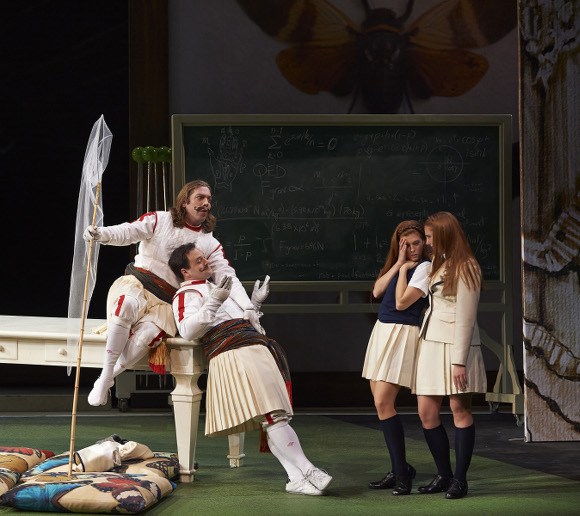
Atom Egoyan’s new production of Mozart’s Così fan tutte opened at the Four Seasons Centre last night. It’s a visually appealing production with an interesting concept and some glorious singing and acting. One may question aspects of the concept but nowhere does it do serious violence to da Ponte’s libretto and the end result, coupled with some outstanding performances makes for a most enjoyable evening.
Ex Alden semper aliquot novis
Last night saw the final performance of the COC’s run of La clemenza di Tito. I had seen the Ensemble Studio performance a couple of weeks ago and really enjoyed it but had some questions and reservations about the production. Last night many of those issues were resolved. It seemed more closely directed and the characterizations were more fully rehearsed. A good example of this would be Michael Schade’s intensely neurotic Tito which was central to the concept. Many things make sense if one sees Tito as being in love with an idea of himself. In this context his betrayal by Sesto is particularly hurtful because it implies that his closest confidante isn’t buying it and his “clemency” is necessary to restore his faith in his own self-projection. This Tito gives Robert Gleadow’s Publio space and reason to be more than the dutiful, rather thick plod. He’s the one who has seen through Tito but must “play the game”. His final, rather sharp, exchanges with Vitellia suggest a genuine capacity for malevolence. This is, after all, an Imperial Court, where by definition life is dangerous and nothing what it seems.
Les adieux
Today’s lunchtime concert at the Four Seasons Centre was the farewell recital for three departing COC Ensemble Studio members; Michael Uloth (bass), Wallis Giunta (mezzo) and Anne Larlee (piano).
Michael started the show with Brahms’ Vier Ernste Gesänge, accompanied by Liz Upchurch. The piece is a bit of a downer but it was nicely, expressively sung. A bit of an odd choice for this sort of recital though I thought. Wallis picked a fairly eclectic mix of songsranging from Gretchen am Spinnrade to Send in the Clowns via some rather odd Spanish pieces but all very stylishly sung.
Perhaps surprisingly, the two of them had managed to find a couple of duets for mezzo and bass; As-tu souffert? from Thomas’ Mignon and Iradier’s El Arreglito, which apparently, was what gave Bizet the idea and most of the music for the Habañera in Carmen. Both pieces were really good though it has to be said that Wallis acted Michael (admittedly suffering from a bad neck) off the stage.
Michael is off to the young artists programme at Seattle Opera and Wallis is joining the Lindemann Young Artists program at the Met in New York. I expect Wallis to do really well. She has a more than adequate voice, can act, is good looking and has tremendous stage presence; in short, the modern opera package.
News is that their replacements will be soprano Mireille Asselin and baritone Philippe Sly.
Quilico Awards
Last night we went to the Quilico Awards competition. The prize was set up in honour of Canadian baritone Louis Quilico to support various aspects of vocal competition and performance and it has been competed for and awarded in different ways over the years. This year it was a vocal competition featuring the ten young singers of the COC Ensemble Studio. It was held in the Richard Bradshaw Amphitheatre at the Four Seasons centre and Alexander Neef (COC), David Spears (Opera Hamilton) and John Hess (Queen of Puddings Music Theatre) were the judges. It was a free gig but held at 5.30pm with minimal publicity on a week day so it perhaps wasn’t surprising that the audience was a bit thin. The format was that each singer prepared three arias. S/he sang one of his/her choice then the jury selected one of the other two. The third was held in reserve in case of a tie (which didn’t happen). Liz Upchurch was the accompanist throughout which was rather impressive in itself.
The standard was really very high. I’ve heard all these singers before, either in recital and/or on stage at the Four Seasons Centre. They are all good and getting better. Repertoire was quite varied. There was lots of Mozart (unsurprising since the Ensemble Studio’s last two productions have been Idomeneo and Die Zauberflöte) but we also got Barber, Purcell, Tchaikovsky, Stravinsky, Handel, Verdi, Wagner, Floyd, Smetana, Korngold, Britten and Barber. Quite a variety really.
One of my top picks would have been Met bound Wallis Giunta (mezzo) who sang “Parto, parto” from La Clemenza di Tito which I’ve heard her do before and the very different “Nobles seigneurs, salut!” from Meyerbeer’s Les Huguenots. Wallis’ musicality (as well as technical ability) was very evident in the way she tackled the tricky rhythmic flexibility of the piece. (You can check out what I mean about tricky rhythms here).
The other would have been baritone Adrian Kramer who goes from strength to strength. He gave us “Pierrot’s Tanzlied” from Korngold’s Die tote Stadt and what has rather become his party piece, Sid’s aria “Tickling a trout” from Britten’s Albert Herring. Watch out for this guy. He has a very good voice and wicked comic timing but showed he also has a lyrical side in the Korngold.
Had I been a judge I would have found picking a third winner close to impossible. There was so much to like. So what did the judges decide?
In third place they had tenor Chris Enns (a fine Tamino earlier this season). Last night he gave us Lensky’s aria from Eugene Onegin and “Here I Stand” from Stravinsky’s The Rake’s Progress. I particularly liked the Tchaikovsky which showed off a nicely developing lyrical tenor voice very well.
Second was dramatic soprano Ilieana Montalbetti. Ileana is a bit of an anomaly. The other girls in the programme are your modern lyric, look the part, sort of modern soprano/mezzos (one of them moonlights as a fashion model). Ileana is the one truly dramatic voice and can we say she looks a bit more like the popular image of a dramatic soprano (actually she’s not really that big but…). She gave us “Come in quest’ora bruna” from Simon Boccanegra and “Einsam in trüben Tagen” from Lohengrin. The RBA is not a huge space and it was piano accompaniment so I don’t think she was close to maximum power (I’ve heard her sing much louder!) but the impression of lots of gas in the tank was definitely there along with a good deal of control and attractive tone colour.
The winner was Adrian Kramer. No surprise there.
Fortunately for us we will get to see most of these singers next month on stage in various roles. Ambur Braid is singing Amore in Orfeo ed Euridice, where Simone Osborne is understudying Isabel Bayrakdarian’s Euridice. Rihab Chaleb will sing Tisbe and Ileana will sing Clorinda in La Cenerentola. Ariadne auf Naxos has a slew of Ensemble Studio members in the cast. Simone Osborne sings Naiad, Adrian Kramer is the Wigmaker, Chris Enns is Scaramuchio and Michael Uloth is Truffaldino and it seems like everyone is understudying something!
There are good things in Toronto. How many places can you see ten first rate singers perform for two hours in a beautiful, acoustically excellent setting, for free?
Nature or nurture?
The Canadian Opera Company’s Ensemble Studio; its young artists training programme, has an exchange with the equivalent in Montreal. This week the Montrealers are in town and there was a lunch time concert featuring four singers from each programme. Being a big fan of the Ensemble Studio I went along to see how the products of the two programmes compared. I don’t know whether the Toronto programme is harder to get into or provides a more rigorous experience or, likely, both, but in terms of musicianship, stage presence and generally readiness to meet the world, the Toronto singers outclassed the Montrealers. I don’t want to write negatively about young singers who are working really hard so I’m only going to talk positives. The best of the Montrealers was soprano Chantale Nurse. She has a dramatic voice with a pronounced vibrato that was heard to good effect in a Massenet aria; “Il est doux, il est bon” from Herodiade and she was fine in the Mozart ensemble pieces. If her voice continues to develop and gain power she could do very well. I just can’t see the other three progressing to major professional careers. Of the Toronto based perfomers, one of the stand outs, unsurprisingly, was mezzo Wallis Giunta, who is heading for the Met next season. She will likely be a great success in mezzo trouser roles and today did very well with some of Dorabella’s music from Cosi as well as as Annio in La Clemenza di Tito. The other star was Adrian Kramer who continues to develop as a baritone with a leaning to comedy. He’s making a name for himself as Sid in Albert Herring in various locations and the excerpt he sang today shows why; excellent comic timing and presence coupled to a voice that is getting bigger. I’ve heard him sing Papageno from Ring 5 at the Four Seasons Centre so I know the power is there! Locals Neil Craighead and Jacqueline Woodley did fine in more Mozart excerpts and it rather sums things up to say that Jacqueline, as Zerlina, rather outsung her Montreal Don Giovanni.