With a month or so to go before the Canadian Opera Company officially announces its 2013/14 season it’s surely time for some uninformed speculation.
There are three big anniversaries in 2013; the bicentenaries of Verdi and Wagner and the centenary of Benjamin Britten. One would think all would be represented but maybe not. We know Verdi will be. Gerald Finley announced at the Rubies that he would make his role debut in the title role in Falstaff at COC in 2013/14 so we can ink that one in. Britten seems probable. There’s a Houston/COC co-pro of Peter Grimes, directed by Neil Armfield that is due to to come to Toronto. I think we can pencil that one in. No idea on casting but I would love to see Stuart Skelton myself. Wagner, I’m not so sure. Maybe February’s run of Tristan und Isolde will be COC’s sole nod to Wagner. Certainly the next most likely candidate; the Lyon/Met/COC Parsifal is, apparently, not expected before 2015.
Jonathan Kent’s 2010 Glyndebourne production of Don Giovanni has a great cast and high ambitions but, ultimately, doesn’t really come off, largely because the relationships between the characters too often fall short of anything interesting. The concept, as explained in the two short bonus segments, is that Don Giovanni is set in a society in transition and that the title character is a sort of harbinger of the new mores. The “society in transition” chosen by Kent is a sort of hybrid of Fellini’s La Dolce Vita and the last years of Franco’s regime in Spain. He might have done better to just pick one as the Fellini elements get pretty much reduced to the costumes and the Franco elements really don’t go anywhere.
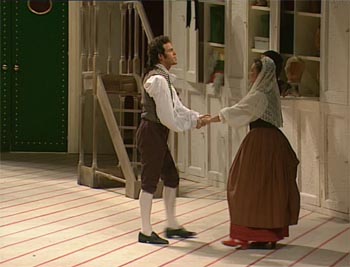
There are, I think, eighteen DVD versions of Mozart’s Le Nozze di Figaro currently available so there needs to be something very special about a recording for it to stand out. Unfortunately Stephen Medcalf’s 1994 Glyndebourne production doesn’t really despite having a strong looking cast. It’s a pretty traditional looking production with breeches and crinolines and sets which look a bit like a giant doll’s house. The Personenregie is well thought out and the stage picture often artfully composed. The acting is almost uniformly excellent. It’s a good solid production but with nothing original in the least about it. Continue reading →
I’ve watched John Adams’ DoctorAtomic three times now. The first time; a MetHD broadcast, I wasn’t impressed at all. The second time; an AVI rip of the Dutch television broadcast, I started to come around. Having now watched the Opus Arte DVD based on the Dutch TV broadcasts I’m converted. This piece is every bit as good as Nixon in China and probably surpasses it in emotional impact due to the more visceral nature of the material. The orchestral writing is classic Adams. The musical argument is swept along on a strong rhythmic pulse and overlapping waves of colour. In contrast the vocal line often seems duller though there are passages of great lyricism, notably Oppenheimer’s big Act 1 aria Batter my heart, three personed God. Kitty Oppenheimer and the native woman, Pasqualita, also get some good singing. I also found myself warming to the libretto. Some rather self conscious passages of Donne and Baudelaire aside, it lacks the poetry of Goodman’s libretti for Adams but Peter Sellars’ selection of words taken from the documentary record is, in its way, quite compelling; reflecting the mix of high and banal concerns that people under great tension express. It’s particularly interesting to see the relatively high level of respect for and confidence in the moral judgement of politicians displayed by the scientists. One doubts whether that would be the case today. In total, it’s a strong additiion to the repertoire of 21st century operas.
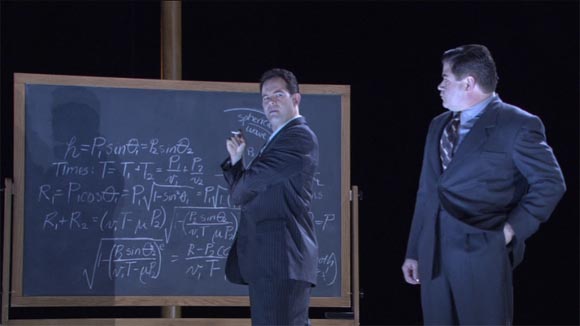
Gerald Finley (Oppenheimer) and Richard Fink (Teller) do physics
So, continuing my Robert Carsen binge in an especially appropriate manner considering last night’s Iphigénie shindig, I bring you the DVD of Carsen’s 2004 Paris production of Richard Strauss’ Capriccio. This may be even more incoherent than usual as I am reeling a bit, in a good way, from this production.
Britten’s Owen Wingrave is one of very few operas written for television. It’s also the second opera Britten wrote based on a Henry James ghost story. Owen Wingrave comes from a family of soldiers and their portraits and their ghosts dominate the family mansion. Owen is an officer cadet and a brilliant student who, for reasons of conscience, decides to abandon the family line of work. The family, his fiancée, his ancestors and the house are not at all keen on the idea. There is no happy ending.
The version I watched is a 2001 production directed by Margaret Williams for Channel Four. The story has been updated to the 1950s which works fine. Filming is extremely atmospheric mixing location shots with archive footage of troops parading in London. Clever use is made of fades into black and white and a certain ambiguity surrounds the ghost figures. Musically and dramatically it is very strong throughout. The ever reliable Gerald Finley sings the title role brilliantly. He often seems at his best in modern music and this is no exception. He is both powerful and sensitive while always remaining thoroughly musical. The other stand out is Peter Savidge as the military academic Coyle; the one character who makes a real effort to understand Owen. His is a really sensitive, nuanced and finely sung performance. I also enjoyed the rather fetching Swedish mezzo Charlotte Hellekant as Kate, Owen’s girlfriend. The only singer I have reservations about is Josephine Bairstow as Miss Wingrave, Owen’s aunt. She seems a bit shrill to me but maybe that’s intentional. It’s certainly one with the role. All of the singers articulate clearly, sound idiomatic in English and are well recorded. This is more than usually important as there are no subtitles on the disc. Kent Nagano directs the Deutsches Symphonie-Orchester Berlin in a neat, tight reading of the score which is twelve tone influenced with a lot of tuned percussion. There seem, appropriately enough, to be a few references back to the War Requiem buried in there. The choral contribution, which is pretty small, is from the choristers of Westminster Cathedral Choir. All in all this is a very fine realisation of a work I’m glad I have now seen as, up until today, it was one of only a couple of Britten operas that I had neither seen nor heard.
Technically it’s a pretty limited affair. The picture is 16:9 anamorphic and the only sound option is Dolby stereo. As mentioned before there are no subtitles. The disc does include an hour long documentary about Britten called The Hidden Heart. It’s a bit vague and waffly but it does include some interesting archive footage. The disc is available from Kultur in North America and Arthaus in Europe.

 With a month or so to go before the Canadian Opera Company officially announces its 2013/14 season it’s surely time for some uninformed speculation.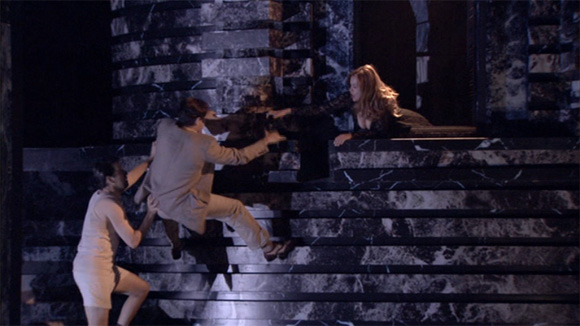

 operaramblings