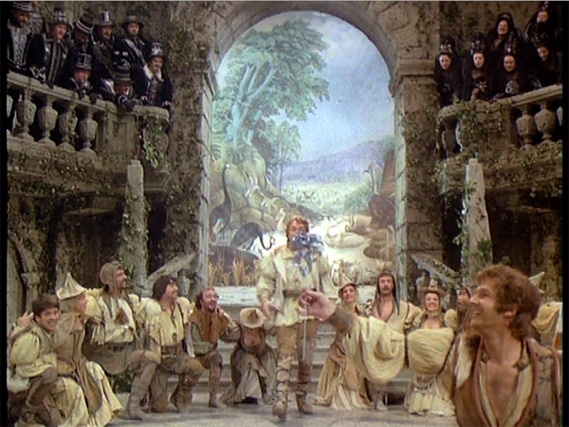
Seven Veils theatrical release

Atom Egoyan’s 2023 film Seven Veils filmed at the Canadian Opera Company and featuring members of the cast of that season’s run of Strauss’ Salome is getting  a theatrical release on March 7th.  I can’t find exact details on whe and where it’s showing but at least some Cineplex and Landmark cinemas will have it.  I saw it pre-pre-release at the Four Seasons Centre in September 2023.  My thoughts are here.

.

Sweat: The movie

Back in 2017 Bicycle Opera Project toured the a cappella opera Sweat by Anna Chatterton and Juliet Palmer.  I caught it in Hamilton and Toronto.  In the intervening years it’s been turned into a film that premiered at the Revue Cinema on Roncesvalles on Saturday night.

Sweat - the film Continue reading

Lonely Child

I sort of remember when I saw an early stage workshop of soprano Stacie Dunlop’s interpretation of Claude Vivier’s Lonely Child.  I think it was back in 2019 and I remember it was in a grungy former industrial space on Sterling Road.  There’s a video of/about that performance. Time has passed and the work has now been fully realised and it’s available as a 17 minute film which I’ve had a chance to watch the latter.  There’s more work going on to make it the core of a longer live show.

lc1

Continue reading

Ema Nikolovska and Steven Philcox

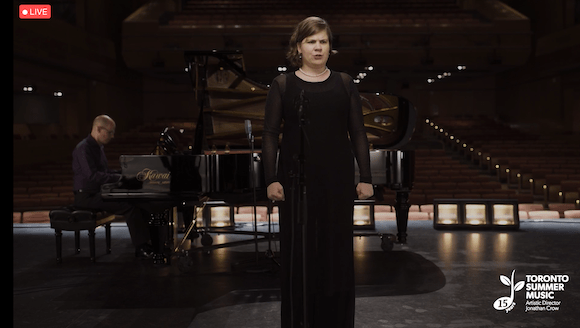
Yesterday was the one vocal element in this year’s virtual Toronto Summer Music; a recital streamed from the Burlington Arts Centre by mezzo Ema Nikolovska and pianist Steven Philcox.  I think this was quite the best on-line event I have seen/heard since this schmozzle started.  It started off with a master class in German Lieder singing.  There were three Beethoven and three Schubert songs and they were just lovely.  Ema’s voice is a lovely rich mezzo and she showed great expression and attention to the text backed up by perfect diction.  Steven, as ever, was an exemplary accompanist.

emanikovska

Continue reading

Historic Der Freischütz

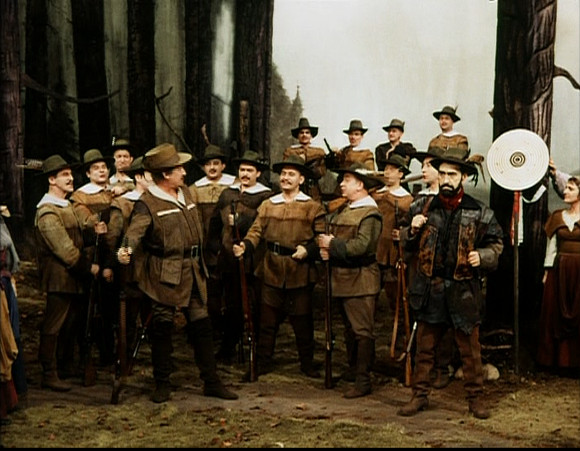
In the late 1960s and early 1970s the Hamburg State Opera cooperated with Polyphon and NDR to make a series of thirteen films for television of assorted operas.  They are all available as a boxed set called Cult Operas of the 1970s but one or two of them are also available separately.  One such is a 1968 recording of Weber’s Der Freischütz.  It was directed for film/TV by Rolf Liebermann and recorded in the studio using the HSO’s stage production.  I think the action is lip synched to a pre-recorded soundtrack (normal practice at the time) but I’m not sure.

1-men

Continue reading

How can peace come from so much pain?

Making a film of an opera rather than filming an opera involves interesting choices and one of the strengths of the DVD of Penny Woolcock’s film of John Adams’ and Alice Goodman’s The Death of Klinghoffer is that includes 47 minutes of Woolcock, Adams and others discussing just how one takes a rather abstractly staged opera (the original staging was, inevitably, by Peter Sellars) and turn it into an essentially naturalistic film.  Of course, naturalism will only go so far with opera but this goes a long way in that direction.  The soloists are filmed mainly on location and they sing to the camera.  The choruses, mainly backed by documentary footage, and the orchestra were recorded in the studio but the actors sing ‘live’.  The one concession to “being operatic” is having a mezzo voice one of the Palestinians though he is played by a male actor.

1.palestine Continue reading

Ponnelle’s Ulisse

Il ritorno d’Ulisse in Patria is the third of the Ponnelle/Harnoncourt Monteverdi collaborations and perhaps the best.  Itseems to stick closer to the original Zürich staging and be less obviously a film though it was recorded in the studio and lip synched.  The orchestra and conductor are visible and, in Act 3, Irus descends into the pit throws himself all over Harnoncourt.  It’s the conductor too who gives him the knife he kills himself with.  Is this the first (of many) times when Harnoncourt has been drawn into the theatrical action?

1.penelope Continue reading

Campy Poppea

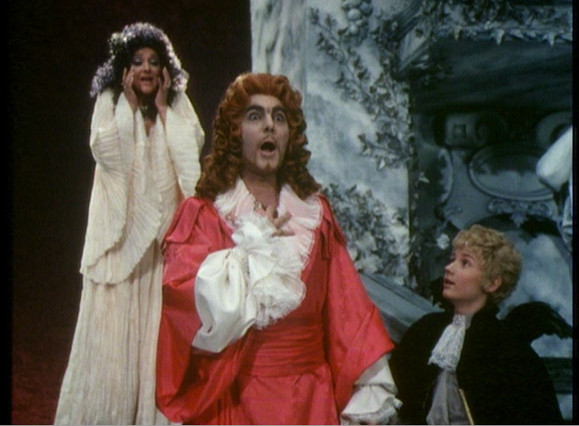
J-P Ponnelle’s 1979 film of Monteverdi’s L’incoronazione di Poppea with Zürich forces conducted by a young Nikolaus Harnoncourt is like his Orfeo only more so.  Sets and costumes are that rather odd “ancient baroque” that Ponnelle is so fond of.  The acting is stylized and hyperkinetic and so is the camera work with close ups from weird angles all over the place.  So far, so Ponnelle.

1.wtf Continue reading

Paramore shall welcome woe

Various thoughts about the Channel 4 film of Britten’s Owen Wingrave led to me seeking out the original BBC TV version from 1970, now available on DVD.  It’s extremely interesting and worthwhile.  Britten himself conducts and the cast includes many of the people involved in the first productions of many other Britten operas.  They include Peter Pears (General Wingrave/Narrator), John Shirley-Quirk (Coyle), Benjamin Luxon (Owen), Janet Baker (Kate), Heather Harper Mrs.Coyle) and Jennifer Vyvyan (Mrs. Julian).  The quality of the music making is superb and I found myself constantly surprised and delighted by details brought out by Britten supported by the excellent English Chamber Orchestra.  At the same time, the fluent and idiomatic singing pointed up the excellence of Myfanwy Piper’s libretto.  This really is Britten at his best.

1.portrait Continue reading

Back to the beginning

Monteverdi’s L’Orfeo is one of the few 17th works still in the canonical opera repertoire though little performed before the “early music revival”.  So it was quite a bold step when the Opernhaus Zürich in the 1970s staged all three extant Monteverdi operas in productions by J-P ponelle and with Nikolaus Harnoncourt leading an orchestra of period instruments.  All three productions were subsequently made into lip-synched films and have been re-released on DVD by Deutsche Grammophon as a boxed set.

1.Oz Continue reading