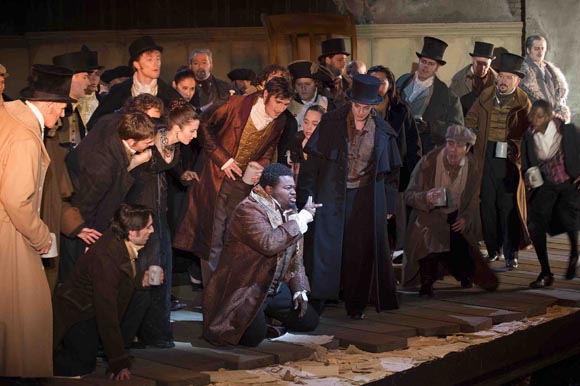
An engaging Semele from the COC’s Ensemble Studio

Mireille Asselin and Phillipe Sly

Last night saw the annual main stage performance by the COC’s young artist programme, the Ensemble Studio.  This year it was Handel’s Semele in the production which I saw a couple of weeks ago.  The main roles were cast from the Ensemble Studio with the the exception of the countertenor role of Athamas which was played by Ryan Belongie, an Adler Fellow.  The title role was split with Mireille Asselin singing the first two acts and Ambur Braid coming in for the third act.  This seemed like a sensible solution given the size of the role and the two singers’ strengths. Continue reading

Tales of Hoffmann at Canadian Opera Company

Last night saw the third performance in the current run of Offenbach’s Les Contes d’Hoffmann at the Canadian Opera Company.

It’s a peculiar work.  It was Offenbach’s first and only foray into grand opera and he didn’t live to complete it.  This leaves all sorts of performance issues regarding orchestration, sequence of the acts and spoken dialogue vs accompanied recitatives among others.  The COC version uses the conventional act order; Olympia, Antonia, Giulietta, and recitatives with orchestral accompaniment which makes for a long night but is probably the best fit with director Lee Blakeley’s take on the piece, previously seen at Vlaamse Opera in 2000.

Continue reading

Russell Braun and friends

The free concert series that the COC puts on in the Richard Bradshaw Amphitheatre at the Four Seasons Centre often has interesting programs and frequently the performances are very good indeed. It’s also pretty good value for money. It’s not often though that the line up is as starry as today’s gig. Baritone Russell Braun was joined by his L’Amour du Loin costars Erin Wall (soprano) and Krisztina Szabó (mezzo) plus Ensemble Studio tenor Chris Enns.  On the piano were COC Music Director Johannes Debus and Carolyn Maule.

They kicked off with Brahms’ Liebeslieder-Walzer.  They were performed with verve and skill and quite a bit of humour but I’m afraid it was still Brahms.  In my book Brahms should be loved from afar.  I much preferred the selections from Schumann’s Spanische Liebeslieder which followed.  I particularly liked Russell’s rendering of Flutenreicher Ebro which showed great feeling for the words and real skill in articulating different moods through voice colour.  Krisztina also gave us a ravishing version of Hoch, hoch sind die Berger.

The revelation for me though was John Greer’s settings of Canadian folk songs; All Around the Circle.  Looking at the words I thought this was going to be really hokey but in fact both the vocal arrangements and piano accompaniments are really pretty sophisticated and right up there with better known English and Australian folk song settings for voice and piano.  The quartet gave them all they had.  Lots of attack, good ensemble work and tons of humour.  (One needs humour with a line like “She’ll be waiting for me there with the hambone of a bear”!).  Terrific piano playing here too from Johannes and Carolyn.  It was fun!  (And great value for money)

COC Ensemble Studio – Works by female composers

It feels good to be back listening to live music after a bit of a drought. Today I was at a lunchtime recital in the Richard Bradshaw Amphitheatre given by members of the Canadian Opera Company Studio Ensemble. It was very good indeed. I want to start with the undoubted highlight; Jacqueline Woodley‘s performance of Judith Weir’s piece for unaccompanied soprano, King Harald’s Saga. It’s a complex, fascinating and very difficult piece requiring the singer to switch between voices and to pull off a range of singing styles. Woodley was awesome. I’ve heard her now in quite a few contemporary pieces, though perhaps none as hard as this, and she has always impressed.

Almost as impressive was Ileana Montalbetti’s performance of Libby Larsen’s Donal Oge. It’s a work that requires considerable power from the singer and Ileana, unsurprisingly delivered. She’s got a big voice and she knows how to use it. Neil Craighead gave us two songs by Cecile Chaminade. He sounds a good deal more powerful than last time I heard him. He has a lovely tone and now the power too. He hasn’t quite got the knack of throttling it back yet but that will come I expect. We also got some fiendishly difficult Alma Mahler songs which clearly taxed tenor Chris Enns. They would have taxed anyone I think. Mireille Asselin gave a pleasing unaccompanied performance of a piece from Hildegard von Bingen and the programme was rounded out by two duets by Fanny Hensel sung by Asselin and Craighead and Montalbetti and Enns.

The pianists were the excellent Jenna Douglas and the even more impressive Timothy Cheung. All in all, this was as good a concert as I have heard in the COC’s free lunchtime series.

Quilico Awards

Last night we went to the Quilico Awards competition. The prize was set up in honour of Canadian baritone Louis Quilico to support various aspects of vocal competition and performance and it has been competed for and awarded in different ways over the years. This year it was a vocal competition featuring the ten young singers of the COC Ensemble Studio. It was held in the Richard Bradshaw Amphitheatre at the Four Seasons centre and Alexander Neef (COC), David Spears (Opera Hamilton) and John Hess (Queen of Puddings Music Theatre) were the judges. It was a free gig but held at 5.30pm with minimal publicity on a week day so it perhaps wasn’t surprising that the audience was a bit thin. The format was that each singer prepared three arias. S/he sang one of his/her choice then the jury selected one of the other two. The third was held in reserve in case of a tie (which didn’t happen). Liz Upchurch was the accompanist throughout which was rather impressive in itself.

The standard was really very high. I’ve heard all these singers before, either in recital and/or on stage at the Four Seasons Centre. They are all good and getting better. Repertoire was quite varied. There was lots of Mozart (unsurprising since the Ensemble Studio’s last two productions have been Idomeneo and Die Zauberflöte) but we also got Barber, Purcell, Tchaikovsky, Stravinsky, Handel, Verdi, Wagner, Floyd, Smetana, Korngold, Britten and Barber. Quite a variety really.

One of my top picks would have been Met bound Wallis Giunta (mezzo) who sang “Parto, parto” from La Clemenza di Tito which I’ve heard her do before and the very different “Nobles seigneurs, salut!” from Meyerbeer’s Les Huguenots. Wallis’ musicality (as well as technical ability) was very evident in the way she tackled the tricky rhythmic flexibility of the piece. (You can check out what I mean about tricky rhythms here).

The other would have been baritone Adrian Kramer who goes from strength to strength. He gave us “Pierrot’s Tanzlied” from Korngold’s Die tote Stadt and what has rather become his party piece, Sid’s aria “Tickling a trout” from Britten’s Albert Herring. Watch out for this guy. He has a very good voice and wicked comic timing but showed he also has a lyrical side in the Korngold.

Had I been a judge I would have found picking a third winner close to impossible. There was so much to like. So what did the judges decide?

In third place they had tenor Chris Enns (a fine Tamino earlier this season). Last night he gave us Lensky’s aria from Eugene Onegin and “Here I Stand” from Stravinsky’s The Rake’s Progress. I particularly liked the Tchaikovsky which showed off a nicely developing lyrical tenor voice very well.

Second was dramatic soprano Ilieana Montalbetti. Ileana is a bit of an anomaly. The other girls in the programme are your modern lyric, look the part, sort of modern soprano/mezzos (one of them moonlights as a fashion model). Ileana is the one truly dramatic voice and can we say she looks a bit more like the popular image of a dramatic soprano (actually she’s not really that big but…). She gave us “Come in quest’ora bruna” from Simon Boccanegra and “Einsam in trüben Tagen” from Lohengrin. The RBA is not a huge space and it was piano accompaniment so I don’t think she was close to maximum power (I’ve heard her sing much louder!) but the impression of lots of gas in the tank was definitely there along with a good deal of control and attractive tone colour.

The winner was Adrian Kramer. No surprise there.

Fortunately for us we will get to see most of these singers next month on stage in various roles. Ambur Braid is singing Amore in Orfeo ed Euridice, where Simone Osborne is understudying Isabel Bayrakdarian’s Euridice. Rihab Chaleb will sing Tisbe and Ileana will sing Clorinda in La Cenerentola. Ariadne auf Naxos has a slew of Ensemble Studio members in the cast. Simone Osborne sings Naiad, Adrian Kramer is the Wigmaker, Chris Enns is Scaramuchio and Michael Uloth is Truffaldino and it seems like everyone is understudying something!

There are good things in Toronto. How many places can you see ten first rate singers perform for two hours in a beautiful, acoustically excellent setting, for free?

Zwei Zauberflöten

Thursday night I attended the COC Studio Ensemble’s performance of Mozart’s Die Zauberflöte and last night lemur_catta and I were back to the see the main cast. For context, the Studio Ensemble is the COC’s training programme for young professional singers so the cast members on Thursday are mostly under 25 and I doubt that anyone outside Canada would recognize any of the names. Yet! The main cast was a typical COC cast with established international singers playing the main roles with current and former Ensemble Studio members taking the lesser parts. In both cases the full COC orchestra and chorus was used and Johannes Debus conducted.

The stage production and design was the same for both shows so let’s start there. The production concept is that the opera is being given in a temporary theatre in the garden of a Viennese aristocrat as part of the celebrations for his daughter’s name day. As things go on, the aristocratic audience and their servants are drawn in as actors in the drama. The daughter is Pamina, the father Sarastro etc. In Act 2, the stage on a stage has gone and the action plays out in the garden with hedges being rearranged at intervals to create the Temple of the Initiates etc. In keeping with the setting, costumes are more or less 18th century though decidedly Disneyfied. In particular Pamina wears a flouncy pink dress throughout and Tamino is all in white except for a teal frock coat. When they are together one almost expects animated love birds to circle around them. The Queen of the Night looks straight out of Snow White but the Three ladies look more like a post apocalyptic women biker gang or scary clones of zingerella. There are some effective touches; the animals are whimsical without being too whimsical and effective use of dancers is made in the trials scene.

Overall, I felt the play within a play element didn’t add anything much and it didn’t take much away either. The costumes and sets were OK for the work that Die Zauberflöte is. They didn’t try too hard to be “this is srs opera” like the current ROH production equally they didn’t capture the blend of fairy tale whimsy and menace that the 2006 Salzburg production achieved. Of course, this is the personal view of a somewhat jaded opera goer who has seen the work many times. From what I heard of the audience reaction of, especially, children and first time and occasional opera goers, the whole thing was a big hit. In the overall scheme of things I’d rather a production of Die Zauberflöte helped bring a new audience to opera than made my highly enjoyable evenings into truly memorable ones.

So what about the singing? The two nights were different and had a very different vibe. The Ensemble Studio show was youthful and energetic and felt like everyone was having terrific fun. The main show cast felt like a polished performance towards the end of a longish run. None of that a surprise really.

The differences were perhaps best exemplified by the respective Taminos and Paminas. On Thursday Tamino was sung by Chris Enns who looked the part and sang heroically, giving it his all and achieved the feat of making Tamino believable and likeable. No mean feat. Last night the role was played by 46 year old Michael Schade who has sung this role 250 times in just about every house of consequence. He was immensely stylish and polished and it was almost a master class in what a Mozartian tenor should sound like but, inevitably, he lacked the freshness of Enns, who is half his age.

It wasn’t quite the same with the Paminas. Thursday gave us Simone Osborne, who is an Ensemble Studio member but is also singing four performances with the main cast. She’s right on the edge of becoming an established singer with bookings for the next year that one would expect from a rising young soprano. She sang with confidence, enough heft for the role and a very sweet youthful tone, especially in her high register. It was very affecting. Friday gave us one of the COC’s established favourites; the lovely Isabel Bayrakdarian. She sang and acted with great skill but one really wonders whether Pamina is what she should be doing these days. She has always had a big voice for a lyric soprano and it’s darkened, especially at the top end, over the years. Her website doesn’t give much information about her future plans but it will be interesting to see where she goes from here.

The other key roles are the Queen of the Night, Papageno and Sarastro. In the first of these we got the impressive young coloratura Ambur Braid on Thursday and the established Canadian Aline Kutan on Friday. Ambur looks the part in a Diana Damrauish sort of way and did a pretty good job on her two arias. If I’m being picky I’d say she nailed the high coloratura but didn’t really articulate the tricky legato runs as clearly as needed. Kutan seemed to be holding back in “O Zitt’re nicht, mein lieber Sohn” which was distinctly sonically and emotionally underwhelming though accurate. Maybe she had a bit of a cold and was saving herself for Act 2 because she gave an excellent full throttle rendition of “Der Hölle Rache”. The same may have been true of Friday’s Papageno, Rodion Pogossov, who was definitely stronger in the second act. He was good. He got the physical comedy right and went from pretty good to better than that vocally as the night went on. On Thursday we had Adrian Kramer in the role. he’s a very good comic actor and a stylish singer but sounded just a bit underpowered when heard from Ring 5 of the Four Seasons Centre. Sarastro is always going to be a problem for a young cast. Young basses with gravitas aren’t much more common than unicorns. That said, Michael Uloth was much better than I expected and did a very competent job if, inevitably, a little lighter than Fridays Mikhail Petrenko, who isn’t Rene Pape either, but sang and acted the part well.

The other parts were all perfectly adequate. On both nights The Three Ladies camped it up nicely. Maybe their ensemble was a little crisper on Friday and the physical comedy more evident on Thursday but fine differences. Both nights saw the excellence we have come to expect from the COC orchestra and chorus and Johannes Debus.

I’m glad I saw both performances. The differences were interesting and if I hadn’t gone on Thursday I would have missed Simone Osborne’s Pamina which would have been a shame. It also meant I could have a look at a performance at the Four Seasons Centre from a different angle. On Thursday I was up in Ring 5 which is definitely ice axe and crampons territory and very different from my usual seat in the Orchestra Ring. The sound up there is excellent and with opera glasses it’s OK visually. (Plus $22 ticket so who’s complaining!).

Just to finish on a sour note, I am going to commit homicide in that theatre if people don’t stop their inane chatter during the performance. Also, is it asking too much that if you have a cough you take medication and cough lozenges with you to an opera? The one drawback of a house with excellent acoustics is that every cough reverbs around the theatre and once again, the frequency and volume of coughing was bordering on the absurd.

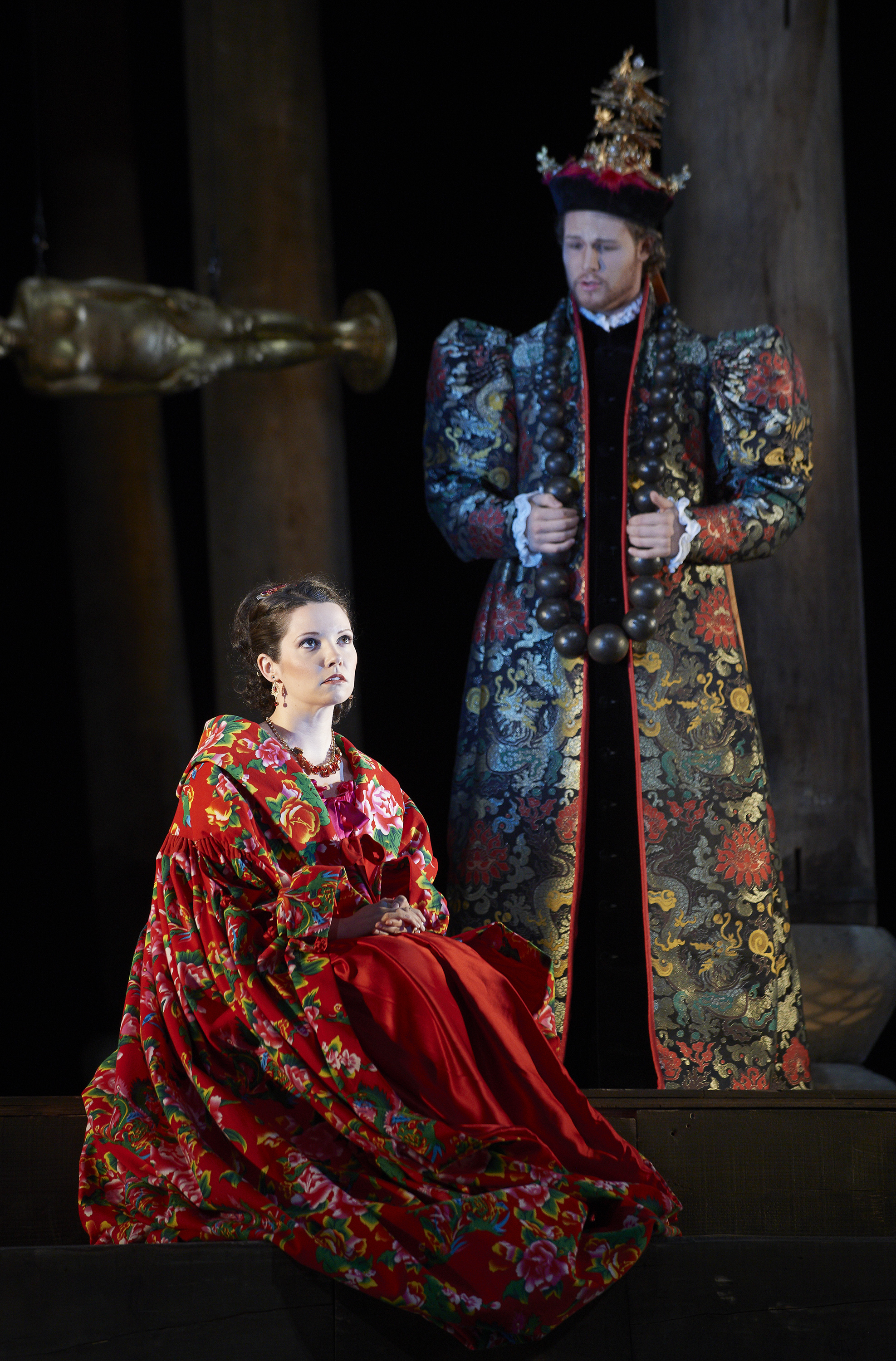
Lunchtime recital at the Four Seasons Centre

I went to a free recital at the Four Seasons Centre earlier today. The Studio Ensemble cast(*) for the new Magic Flute were performing excerpts. It was really very good. I’ve seen some of the singers before and it pretty much confirmed what I thought the first time. I really think we will see a lot of Wallis Giunta, Ileana Montalbetti and Ambur Braid in the next few years. Adrian Kramer and Christopher Enns look to have bright futures too. The rest of the cast were solid enough they just didn’t grab me quite the same way.

* The Ensemble Studio is Canadian Opera’s training program for young professional singers. Once a year they get to put on a fully staged performance of one of the COC season productions. They are doing Magic Flute at the FSC on February 17th. Tickets are $55 and $22 (ring 5 only). If anyone is planning to buy tickets for the regular performances I’ve got a 15% off discount code you can use.