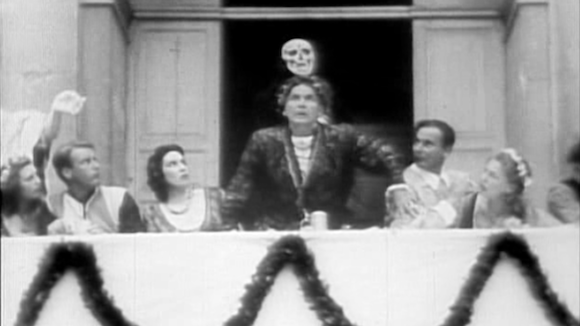
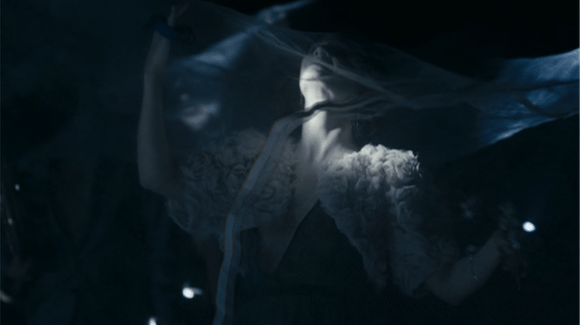
Canadian design/direction team Barbe & Doucet were engaged to create a new production of Mozart’s Die Zauberflöte at Glyndebourne in 2019. As they explain in the introductory feature The Making of the Magic, they had refused for 20 years to tackle this work because of what they saw as its inherent racism and sexism. Part of the interest therefore in watching this recording is to see whether and how they deal with those two issues.
Tag Archives: dvd
Taking Risks/The Rake’s Progress
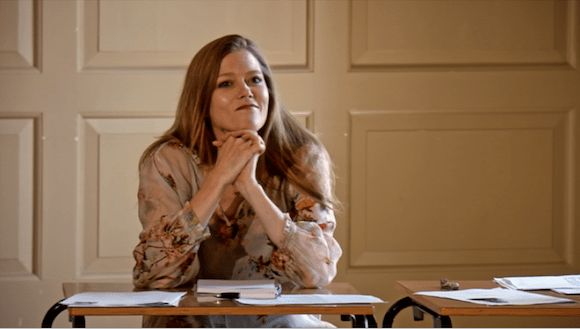
This recently released two DVD set focusses on Barbara Hannigan’s first venture into conducting opera; Stravinsky’s The Rake’s Progress in a semi-staged version featuring the young artists of her Equilibrium mentoring programme and the Gothenburg Symphony. One disk contains the opera itself, the other a documentary by Maria Stodtmeier, called Taking Risks, looking at the creation of Equilibrium and the build up to the Gothenburg performances.

Le postillon de Lonjumeau
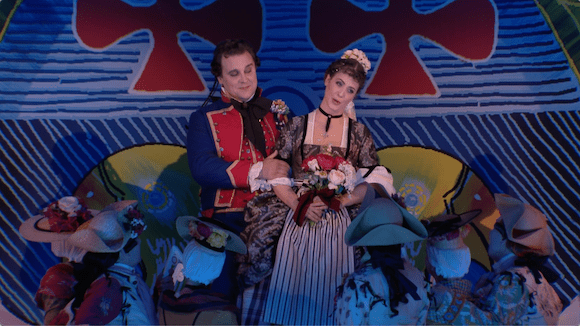
Most people probably know Adolphe Adam as the composer of the music for the ballet Giselle but he was more than that. He was also a scholar who worked hard to study and revive the work of Rameau and other pre-Revolution composers. So, when tasked with composing a piece for the Opéra Comique he chose to combine elements that had produced previous “hits”; a vocationally based plot, a love story and so on with a Louis XV setting that allowed him to include pastiche Baroque. The result was Le postillon de Lonjumeau; a work that had much success across Europe during the mid 19th century (Wagner conducted it in Riga) but which had long disappeared from the repertory when the Opéra Comique revived it in 2019. Denise Wendel-Poray reviewed it in the Summer 2019 issue of Opera Canada and it has now been released on DVD and Blu-ray.

La morte d’Orfeo
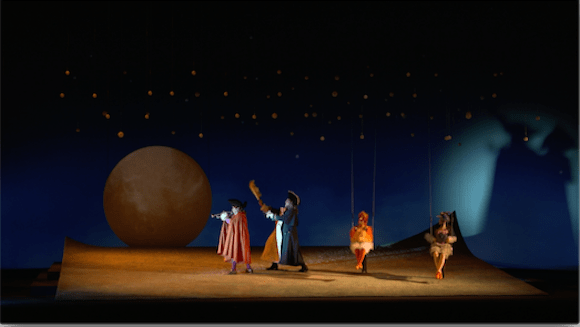
Stefano Landi’s La morte d’Orfeo of 1619 is interesting for several reasons. It’s one of relatively few operas from this early in the history of the art form that we have enough information on to perform. It was also written in and for Rome so it reflects the clerical influences of that environment rather than the more secular Venice of Monteverdi. It’s also an unusual take on the Orfeo legend. It takes off from where Monteverdi and many others leave off. Euridice is dead, for good this time, and the opera deals with the balance of Orfeo’s life. Briefly, he is heartbroken and renounces Pleasure; including wine and women. He compounds this by not inviting Bacco to a birthday celebration attended by most of the other gods. Bacco and his female followers are not pleased. Orfeo is torn to pieces by the Maenads. Orfeo is quite OK with this because now he will be united with Euridice but Charon refuses to take him; a demi-god, across the Styx. Mercury fetches Euridice from the Elysian Fields but she has drunk from Lethe and doesn’t recognise him. She’s quite clear that she wants nothing to do with this so-called Orfeo. Giove makes it up to Orfeo (who also drinks the water of Lethe and forgets Euridice) by making him into a constellation and all the gods rejoice. (for consistency’s sake I’ve used the Italianised versions of the Roman versions of the various Greek characters in the same way as the libretto).
Fernand Cortez
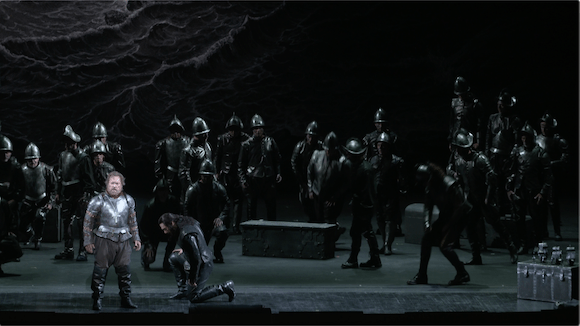
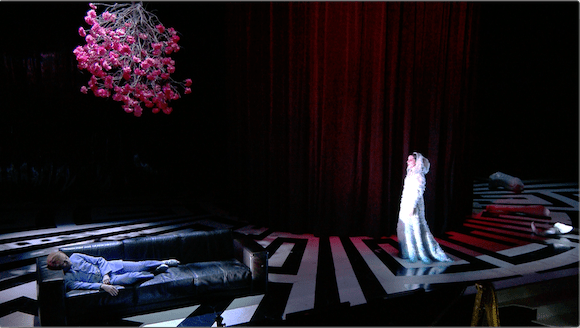
For probably the first time in almost 200 years the 1809 original version of Gaspare Spontini’s Fernand Cortez ou la conquête de Mexique got a theatrical run last October. It was at the Teatro del Maggio Musicale Fiorentino in a new edition by Paolo Petazzi where it was recorded for video release. There’s tons to unpack here because few people will be familiar with the work and if they are it will likely be in the very different 1817 version. It’s also a far from straightforward production.

Another fifties Falstaff
Directors seem to see the 1950s as the logical time period to stage Verdi’s Falstaff though they come up with very different 1950s. Robert Carsen set his in a rather dark world that pits the nouveau riche against a declining gentry. Richard Jones went for a sort of Carry on film aesthetic that was entirely English. Laurent Pelly in his production filmed at the Teatro Real in Rome in 2019, despite some overtly English elements in the set design, gives us a distinctly continental European feel. Indeed Falstaff, Pistola and Bardolfo might easily be hangovers from the more criminal end of the French resistance. There’s much less of “class struggle” in Pelly’s rather straightforward production. In fact it seems like a fairly light comedy with the darker aspects emerging only rarely.

Respighi’s Sleeping Beauty
Resphigi’s La bella dormente nel bosco (libretto by Gian Bistolfi) is a take on the Charles Perreault fairy story. It was originally written for a puppet theatre and later adapted for human performers. Its heritage shows in it that it’s very much a numbers opera and it’s quite short. The three acts come in at around eighty minutes. Musically it’s a bit of a hodge podge. It’s mostly quite atmospheric and colourful (similar to Resphigi’s better known orchestral works) with elements of parody. One can sort of hear echoes of Debussy, Stravinsky and Strauss. It finishes up with a cakewalk and a Broadway style finale which is decidedly odd.
The Salzburg Festival: A Brief History
Tony Palmer’s 2006 documentary about the Salzburg Festival is over three hours long and uncomfortable to watch in the way the best films are. He combines interviews with performance and other documentary footage to extremely good effect to go beyond telling the “Salzburg story ” to explore fundamental questions of the arts and the state and the very purpose of art.
Traviata – Vous méritez un avenir meilleur
Traviata – Vous méritez un avenir meilleur is a theatre piece that combines elements of Verdi’s La Traviata with elements of the source material for it; Dumas fils’ La Dame aux camélias (both the novel and the play). There is also some newly written and composed material. The creators; Benjamin Lazar (director), Florent Hubert (arrangements and musical direction) and Judith Chemla (who sings Violetta) aimed to create a work that goes further than the source material in exploring the inner psychology of the main character.

Grim Trovatore
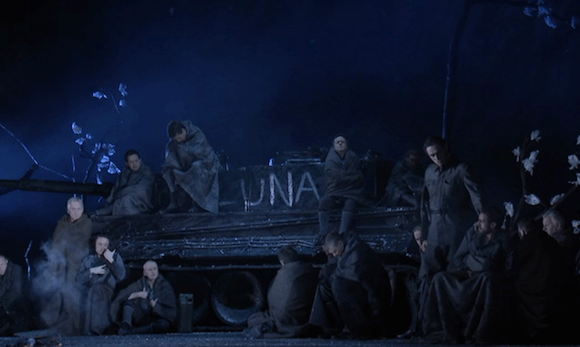
Verdi’s Il Trovatore is always pretty grim. It’s hard to lighten up an opera with multiple executions, suicide and babies being barbecued. David Bösch in his Covent Garden production (remounted and recorded in 2017 with Julia Burbach directing), probably wisely, doesn’t even try. This is as grim as Grimsby on a wet Sunday in February with extra gratuitous violence. The setting is some roughly contemporary civil war. The Conte di Luna’s troops are a scruffy lot but they have a pretty cool looking tank. The gypsies are a bit gayer though Azucena’s caravan is disturbingly plastered with baby dolls reflecting her obsession. It’s all quite dark. Really only Leonora (and her maid) stand out as they wear white in contrast to the greys of pretty much everyone else. The story is told straightforwardly enough and the sets and costumes do provide some kind of moral differentiation between the two camps with Leonora sort of standing above and apart from the violence.