Scintillating Il Turco in Italy from Zurich

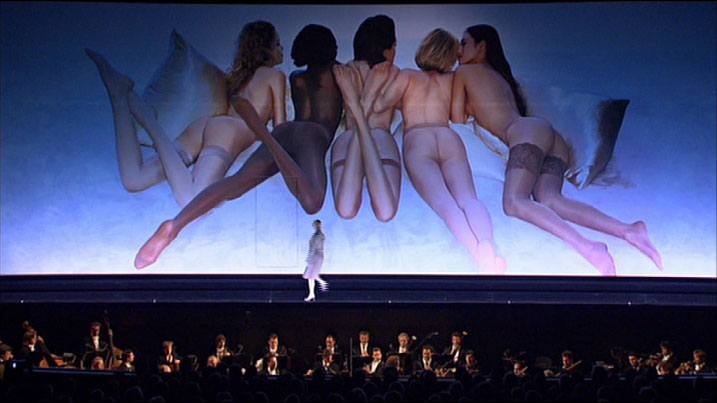
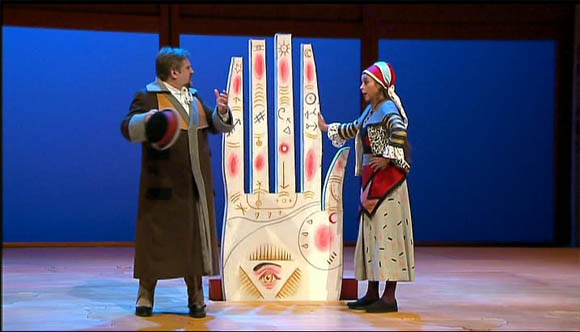
I don’t suppose anybody watches a Rossini comedy for profundity or great insights into human nature but there’s no denying that done well they can be great fun.  This 2002 performance of Il Turco in Italia from the Opernhaus Zürich certainly manages to be that.

The basic plot is predictably silly and full of stock characters; gypsies, flirty young wife, dim older husband, lecherous Turk etc. but wrapped around this is the idea of a poet who is recording what he is seeing as the basis for a new play while, sometimes successfully, sometimes not, trying to influence the action to meet his needs.  It’s quite clever and often very funny.
Continue reading

Tosca at La Scala

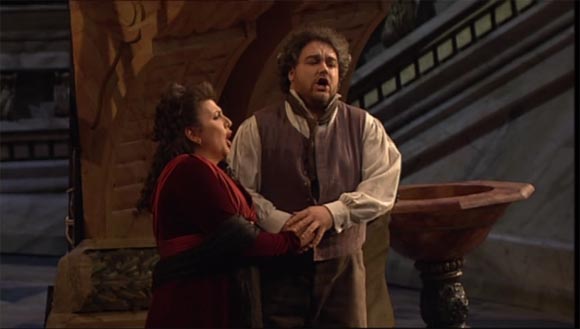
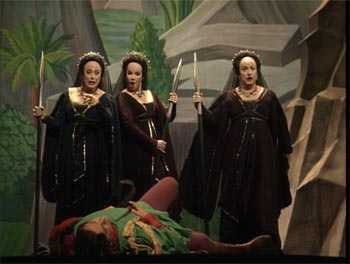
This 2000 La Scala recording of Puccini’s Tosca is straightforward and rather good.  It’s a revival of Luca Ronconi’s 1996 production which I’m somewhat astonished to read was regarded as controversial.  Sure, the sets are sort of fractured and feature some weird angles but everything else seems to be “by the book” down to the smallest details like the candlesticks and cross.  Regietheatre this isn’t.  In this performance the acting is OK, if tending to the “stand and wave your arms about” default Italian mode.  The stand out exception is Leo Nucci’s Scarpia.  He doesn’t have the physical presence to be brutal in the way that, say, Bryn Terfel can be but he manages to project a very nasty securocrat indeed.  This is a Scarpia who would be good at making Powerpoint presentations to his bosses detailing how many women and children his unmanned drones had killed today.

Continue reading

Patchy Figaro

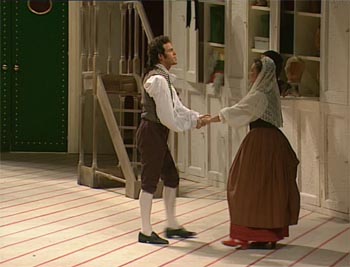
There are, I think, eighteen DVD versions of Mozart’s Le Nozze di Figaro currently available so there needs to be something very special about a recording for it to stand out. Unfortunately Stephen Medcalf’s 1994 Glyndebourne production doesn’t really despite having a strong looking cast. It’s a pretty traditional looking production with breeches and crinolines and sets which look a bit like a giant doll’s house. The Personenregie is well thought out and the stage picture often artfully composed. The acting is almost uniformly excellent. It’s a good solid production but with nothing original in the least about it. Continue reading

One can rob a bank or use a bank to rob others

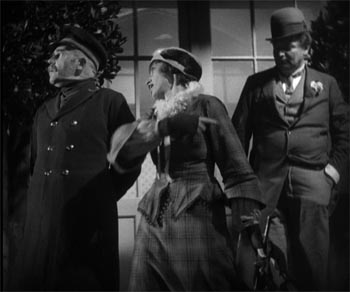
I don’t really know whether the collaborations between Brecht and Weill deserve to be called operas but some of them at least are sung by opera singers and produced in opera houses so I think they are legitimately within the ambit of this blog.  Arguably the best known of them all is Die Dreigroschenoper which premiered in Berlin in 1931.  I’ve seen it a couple of times in English translation and, like most people I guess, I’m familiar with the music (in both English and German) through recordings by people like Lotte Lenya, Ute Lemper and Robyn Archer.  With that background I was very interested to take a look at the 1931 film of the work directed by GW Pabst. Continue reading

Don Giovanni – choices and futures

This is a continuation of a discussion of how Martin Kušej treats sex in his Salzburg Don Giovanni. The first installment, dealing with Act 1, is here.

At the conclusion of Act 1 the cycle of, at least apparently, consensual kinky sex has been broken by the first clearly non-consensual action; Zerlina has been hunted down by Don Giovanni and forcibly borne off by the sisters of Persephone. Where is this going? Continue reading

Don Giovanni in the 21st century

After a week of nostalgia wallowing in ancient “productions” from the met and the COC it’s back to Regietheater with a vengeance for the 100th DVD review on this blog.  The subject is Martin Kušej’s Salzburg production of Don Giovanni which premiered in 2002 but was recorded in 2006 as part of the M22 project.

For a start there’s nothing giocoso about this dramma. It’s a very bleak and complex production with lots of ideas; some of which work and some of which are more problematic, and it’s provoked more discussion at the Kitten Kondo than just about any other recording we’ve watched recently.  Rather than write a 3000 word review I’m going to write a normal length review and follow it up with one or more posts on aspects of the production that seem particularly worth exploring. Continue reading

Kathleen Battle steals the show again

In this next episode of our wallow in Met nostalgia we  are looking at the 1988 production of Richard Strauss’ Ariadne auf Naxos.  It’s a starry affair with James Levine conducting, Jessye Norman in the title role, James King as Bacchus, Kathleen Battle as Zerbinetta and Tatiana Troyanos as the Komponist.  There’s even a bit of luxury casting in the minor roles with Barbara Bonney and Dawn Upshaw among the nymphs.  It’s also as old fashioned as one could possibly imagine, being a revival of a production that premiered in 1962. Continue reading

Hockney’s Flute

It seems to be “looking back at older Metropolitan Opera productions” week here in the blogosphere.  Over at The Earworm there’s a series of posts on a 1980 production of Don Carlos.  Our subject will be the 1991 Die Zauberflöte.

The production was designed by David Hockney and the look varies from the whimsical; the opening scene, to the grandiose; the final scene, with bits of Egyptiana in between.  It’s very handsome.  The direction is described as “original direction” by John Cox and “direction” by Guus Mostart.  I’m not entirely sure what this means as there doesn’t really seem to be a production concept and the Personeregie is pretty basic.  Basically it looks like acting is considered to be an optional extra.  Some of the singers are good actors and some don’t even try.  There’s no consistency.  The impression is that the “production” is just a backdrop for the singers to do their thing. Continue reading

Fidelio at Glyndebourne 1979

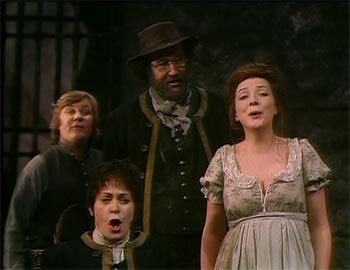
Southern Television’s 1979 Glyndebourne broadcast was Beethoven’s Fidelio. The production by Peter Hall with designs by John Bury is conventional enough though tendencies to exaggerate are clearly creeping in. The chorus of prisoners is almost zombie like and Florestan looks disconcertingly like the legless sea captain from Blackadder II. Apart from that it’s a conventional 1800ish setting where the prison’s a prison, the dungeon’s a dungeon etc. It’s also very literal in that the dungeon is so dark it’s almost impossible to see anything.  Continue reading

Normal service will be resumed shortly

On a bit of a hiatus here caused in part by bad luck with some library DVDs; a couple of which turned out to be pretty much unwatchable and certainly not worth a full blown review.  For the record:

Shannon Mercer - Extremely Silly

Le Nozze di Figaro; Glyndebourne 1973.  Dates from the era before acting or stage direction made it into opera.  eg: Susanna “this is the hat that I made”. Stops, grins, points to hat…

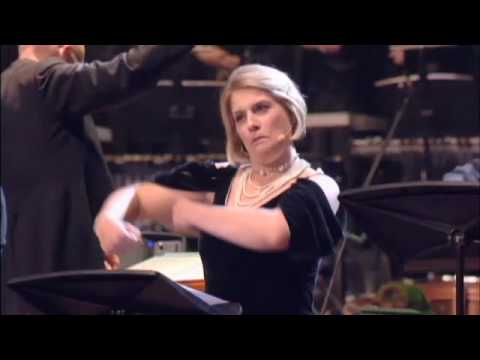
Not the Messiah (He’s a Very Naughty Boy); RAH 2009.  I was searching the library catalogue for Claus Guth’s staged Messiah.  Not a chance of course but I did find this.  How bad could a Monty Python oratorio be I thought?  That bad!  How did the lovely Shannon Mercer and a trouper like Rosalind Plowright get mixed up with this pile of dreck?

Hopefully the “to watch” pile will turn up something better soon.