Vogt and Nylund bring dead city to life

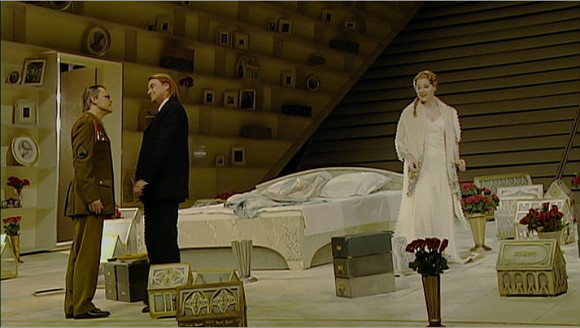
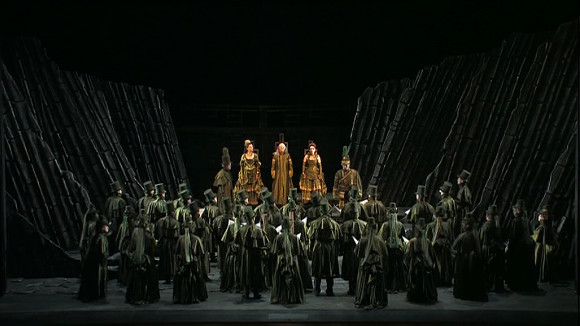
Kasper Holten shows his customary inventiveness in his production of Korngold’s Die Tote Stadt, recorded at Finnish National Opera in 2010.  He places the whole opera inside Paul’s “Marie museum” with a chaotic, higgledy, piggledy model of the the city of Brugge as a back wall.  He emphasises the dream elements of acts 2 and 3 through devices such as having the troupe of players and their boat emerge through Paul’s bed or assorted ecclesiastics popping up randomly in the “city model”.  He also inserts a non-speaking Marie who is present throughout the piece, often to very interesting effect.

1.bed Continue reading

Kleiber’s Rosenkavalier

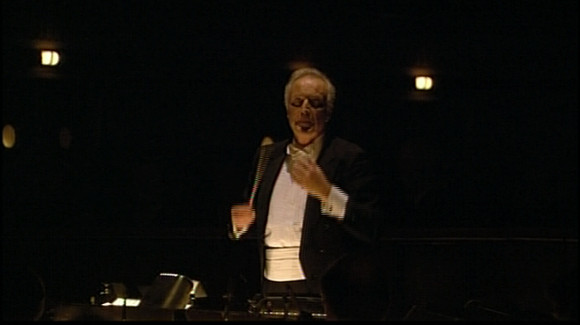
Carlos Kleiber didn’t record much despite enjoying something of a cult following as a conductor.  In 1994, shortly before his death, he conducted four performances of Der Rosenkavalier at the Wiener Staatsoper; the first of which was recorded.  It’s clearly Kleiber’s night.  His appearances at the start of each act are greeted with cheers and wild applause.  One can only guess at the reception he got afterwards because the curtain calls don’t make it onto the recording.  And, yes, it is a masterly conducting performance with fine support for the singers, beautifully shaped lines and an infectious sense of fun.

1.kleiber Continue reading

Adelaide di Borgogna

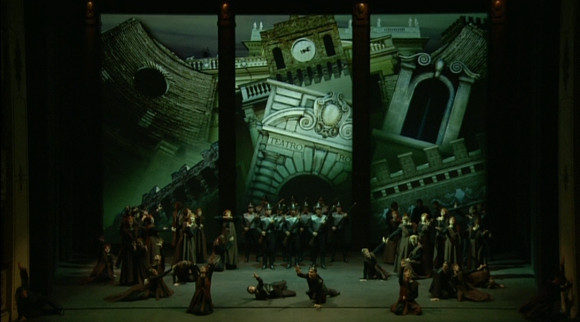
Adelaide di Borgogna is one of those rather odd “serious” Rossini works where bel canto collides with opera seria.  The plot is fairly accurately based on an episode from 10th century history and is most definitely not a comedy.  The form has progressed well beyond a succession of da capo arias with multiple ensemble numbers and quite a few choruses.  But there’s a throwback to an earlier tradition in the use of high voices for heroic male roles though it seems that by 1817 castrati were rather rare and the crucial role of Ottone, the German emperor, was from the beginning sung by a female contralto.

1.teatro Continue reading

Dove è Amore è Gelosia

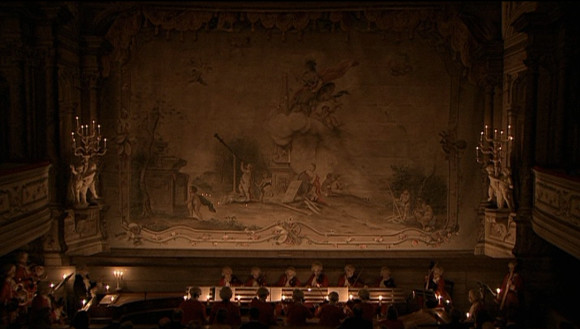
Dove è Amore è Gelosia is a 1768 comic opera by Giuseppe Scarlatti, probably the nephew of the more famous Domenico.  It was written for wedding celebrations at Krumlov Castle where Scarlatti was music teacher to the children of the Duke of Krumlov.  It was performed and recorded in the newly restored theatre at Krumlov using the original stage machinery and lighting.  Krumlov is, along with Drottningholm, one of only two baroque theatres preserved as they were in the 18th century.

1.stage Continue reading

The Scottish opera

Verdi’s Macbeth is one of those early works where he seems to be trying to grow out of bel canto but not quite making it.  There is some splendidly dramatic music and some that just seems completely incongruous given the subject matter.  The witches’ chorus at the beginning of Act 3 is a case in point.  That said Phyllida Lloyd’s production for the Royal Opera House takes the piece seriously and does a pretty good job of presenting the drama in a straightforward but visually attractive way.

1.witches Continue reading

Le Roi d’Ys

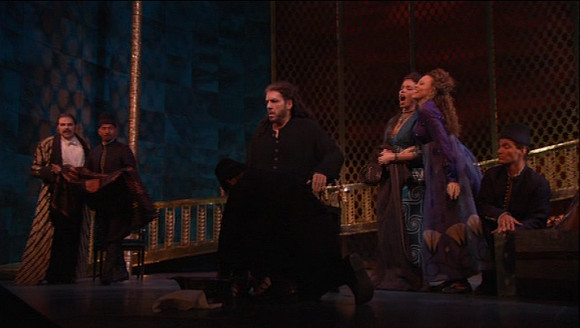
It’s perhaps surprising that Lalo’s Le Roi d’Ys isn’t performed much more often than it is.  Most people probably only know it for the tenor aria Vainement, ma bien-aimée which crops up from time to time in recitals and competitions.  Sure, it’s not strikingly original.  The plot is a love triangle with overlays of revenge and divine retribution and the music is, with the exception of the rather fine overture, a bit on the rumpty tumpty side.  But, let’s face it, there are plenty of standard repertoire works with implausible romantic plots and banal, if tuneful, music.  I think there’s a large section of the opera audience that would very much enjoy this piece.

1.people Continue reading

Il Trittico

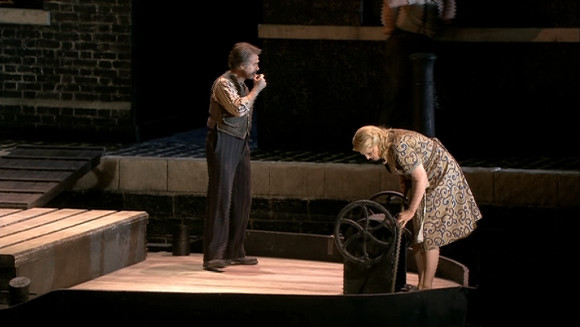
Puccini’s Il Trittico is a collection of three one act operas designed to be performed on a single evening.  They rarely are.  Perhaps this is because performing all three makes for a rather long evening (and for a huge cast) or maybe it’s because two of the three aren’t all that great.  In any event, while most opera goers will likely have seen the comedy Gianni Schicchi, most will likely not have seen the two tragedies that precede it; Il Tabarro and Suor Angelica.  However, all three works were performed as a triple bill at the Royal Opera House in 2011.  The show was broadcast by the BBC and is available on Blu-ray and DVD.  All three pieces were directed by Richard Jones and Anthony Pappano conducted.

1.michele_giorgetta Continue reading

Where’s the Champagne?

It’s really hard to know where to start with Hans Neuenfels’ Die Fledermaus.  It’s a prodcuction that enraged the more conventional patrons when it opened at the Salzburg Festival in 2001.  It even provoked a “false pretences” lawsuit!  There is so much going on that it almost seems to call for a catalogue raisonnée of the various scenes though one fears that would actually be both tedious and unhelpful.  Let’s try instead to explore it thematically.  Neuenfels takes very considerable liberties with the libretto.  A lot of dialogue is cut, a lot is added and numerous non-canonical characters are inserted.  That’s just a start.

1.nosejob Continue reading

Die tote Stadt

My acquaintance with Korngold’s Die tote Stadt has been pretty much limited to recital and competition performances of Glück, das mir verlieb, better known as Marietta’s Lied and, apparently, the last opera aria to become a hit single and Fritz’ act 2 piece Mein Sehnen, mein Wähnen.  So, I was quite glad to get my hands on a complete recording of this lushly lyrical and rather weird piece.  The “dead city” of the title is Brugge and the story concerns a wealthy man, Paul, who has turned his house, and his life, into a shrine to his dead wife Marie.  He encounters a dancer, Marietta, who very closely resembles his late wife.  What follows is wild and chaotic and is, ultimately, revealed to be a dream.  Paul realises that only in the next world can he be reunited with Marie.

1.room Continue reading

Renée and her frocks

John Cox’s production of Massenet’s Thaïs at the Metropolitan Opera is probably most remembered for the rather extraordinary collection of Christian Lacroix frocks that Met perennial Renée Fleming gets to wear.  It’s rather more than that.  In fact it’s a pretty good example of what the Met does best.  It’s sumptuous and spectacular and has a pretty much ideal cast which, together, go a long way toward making this curious piece rather enjoyable.

1.athaneal Continue reading