
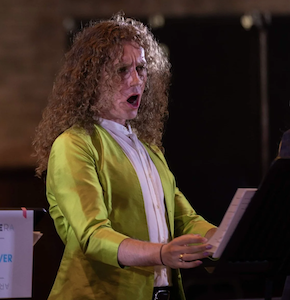
 My second Walter Hall DMA recital on Tuesday featured one of Toronto’s most interesting, and least predictable, musical talents; countertenor Ryan McDonald. Having seen Ryan perform as Dido and as a rather menacing nightmare figure in Rebecca Grey’s Bus Opera (as well as in several more conventional capacities!) I was expecting the unexpected. The presence on stage of a drum kit rather reinforced that.
So, no big surprise that the opening number was “Mon coeur s’ouvre à ta voix” from Saint Saêns’ Samson et Delila (with Ivan Estey Jovanovic at the piano). It was some gorgeous singing as long as one wasn’t distracted by the shiny back outfit topped by a transparent rain cape (really sorry there are not more photos!). Then after a quick change to something that looked a like a very shiny vampire impersonating a boy in the lower school at Eton, we got a lovely account of John Dowland’s If my complaints could passions move which was bookended by electronics and some vocalising into the piano. This was followed by a straightforwardly lovely version of Schumann’s “Der Nussbaum”. And so to “Dido’s lament”. I did mention that I’d seen Ryan sing the role some years ago in Opera Q’s gender bending Dido and Belinda. Continue reading
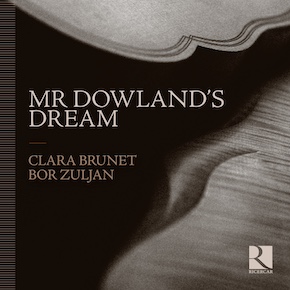


 I guess I’ve learned never to expect the predictable from Emily D’Angelo (except for the black clothes and boots). Her new album; freezing, is as unexpected as
  The second concert in this year’s West End Micro Music Festival took place at Redeemer Lutheran Church on Friday night. Titled Alchemical Processes it featured a mix of early and modern works written or arranged for some combination of string quartet (Jennifer Murphy, Madlen Breckbill – violins, Laila Zakzook – viola, Philip Bergman – cello), harpsichord (Alexander Malikov) and clarinet or bass clarinet (Brad Cherwin).
 operaramblings