Herheim and Egoyan

This Sunday afternoon (in Toronto) and evening (in Oslo) Brent Bambury of the CBC will interview Atom Egoyan (in Toronto) and Stefan Herheim (in Oslo) about their respective approaches to Richard Strauss’ Salome.  The Egoyan version is just finishing up a run at COC (my impressions here) while Herheim’s version, previously seen in Salzburg, opens at Den Norske Opera & Ballett on Saturday.  There will be live audiences in both cities connected by videolink.  Details for Toronto are under the cut.

Continue reading

Another look at Carmélites

It’s becoming a habit.  For the fifth time this season I went back to take a second look at a COC production.  This time it was Poulenc’s Dialogues des Carmélites.  We were in our usual seats at the front of the Orchestra Ring rather than at the back of Ring 3 where I was on opening night.  I still didn’t notice any real issues of orchestra/singer balance, which had been complained of by some reviewers.  Maybe it was an issue towards the front of the Orchestra where the press tend to be?

Continue reading

Quilico Awards 2013

Last night, for the second time (the first was in 2011) the singers of the COC Ensemble Studio competed for the Christina and Louis Quilico Awards; a prize competition created by Christina in memory of her husband, baritone Louis.  It was the usual competition format; the singers offer three arias, they sing one and then the judges choose which of the remaining two they will sing.  It being the Ensemble Studio on show the standard was extremely high.  Nine singers and eighteen arias is too much to report in detail so I’ll concentrate on the winners.

ensemble

Alan Walker of the Ontario Arts Foundation, Christina Quilico and the Ensemble Studio

Continue reading

Searing Carmélites from COC

Poulenc’s Dialogues des Carmélites is a strange and compelling piece.  Dramatically it is very “slow burn” with a narrative arc that builds over almost two hours to a final scene of searing intensity.  Without that final scene the piece would have no reason but it justifies all and only one “fit for treasons, stratagems, and spoils” could possibly leave the theatre unmoved.  It’s not just moving, done well it’s emotionally devastating.  And that’s the state I left the Four Seasons Centre in last night after a near perfect performance of Robert Carsen’s extraordinary production.

1. Old prioress

Photo Credit: Michael Cooper

Continue reading

Another occupant for that little red dress

el-khouryCanadian soprano Joyce El-Khoury will make her company debut as Violetta at De Nederlandse Opera tonight, replacing Marina Poplavskaya.  It’s that Willy Decker production that’s been seen everywhere.  Might be worth a look for anyone planning to be in Toronto in the fall as Joyce will sing both Mimi and Musetta in the upcoming La Bohème at COC (though not in the same performances, she’s leaving that to Placido Domingo).

You can get a preview of her performance here.

ETA: May 10 – Apparently Joyce will now sing the whole run at DNO.

Alden productions heading for London

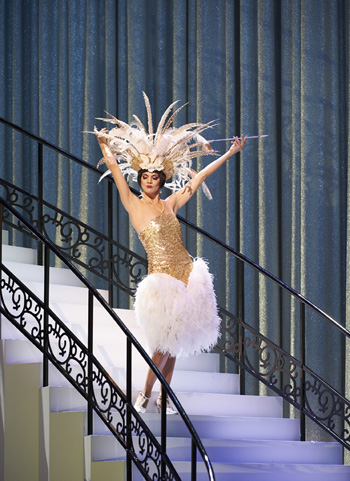
12-13-02-b-MC-D-3024English National Opera’s new season includes two Christopher Alden productions that originated at COC.  Die Fledermaus is brilliant and a must see.  Rigoletto may be a bit more of an acquired taste though it certainly has its strong points.  The London cast for Fledermaus doesn’t look as strong (to me) as the Toronto cast but the Rigoletto has the estimable Quinn Kelsey in the title role, Barry Banks as the Duke and Anna Christy as Gilda.

Dates and casts are on the ENO website; Die Fledermaus and Rigoletto.

My reviews of the Toronto performances; Die Fledermaus, with Ambur Braid and with Mireille Asselin (as Adele) and Rigoletto, with Lynch, Lomelli and Osborne and with Kelsey, Pittas and Sadovnikova (Rigoletto, Duke, Gilda).

Paedophilia di Lammermoor

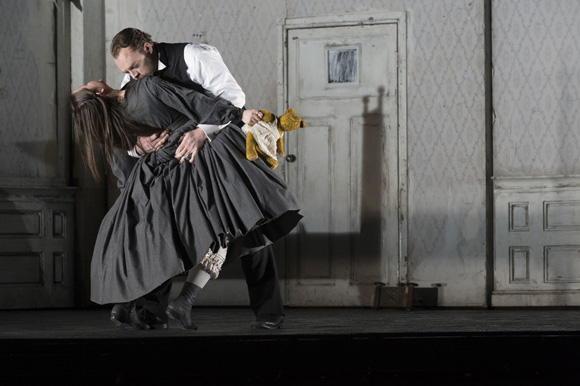
David Alden chooses to set his production of Donizetti’s Lucia di Lammermoor, currently playing at Canadian Opera, in Victorian Scotland in a rather decayed country house.  It’s all set up as classic Gothic schtick.  The angle is that Lucia herself is very young and is being sexually abused by her brother Enrico.  OK, I don’t have a problem with that.  It’s a better solution than the idea that women are all just inherently unstable and liable to go from shrinking violet to shrieking murderess at the drop of a forged letter.  So, it’s an interesting idea but it poses real problems about the nature of her relationship with her “fiance” Edgardo.  If he’s the hero of this thing what is he doing having a clandestine relationship with a girl who’s not yet out of the schoolroom?  (We can tell this by how she’s dressed).  This is a major Victorian taboo.  Respectable men don’t go after girls until they are “out”.  Are we then to see Edgardo as as a big a cad as Enrico?  Maybe.  The trouble with that concept is then why do we care what happens to him?  Edgardo kills himself.  Goodbye paedophile creep.  So what!  So bottom line, I can take the groping and the creepiness that some critics have complained about but I wonder what Alden is really trying to tell us about the piece.

67 – Anna Christy as Lucia and Brian Mulligan as Enrico in the

Photo credit: Chris Hutcheson

Continue reading

Song and scrunchions

So, apparently Toronto has three opera singers from the otherwise unremarkable town of Corner Brook, Newfoundland.  Today they (Michael and Peter Barrett and Adam Luther) together with Doug Naughton on guitar, Andrew Grimes on bhodran and, the definitely not from Newfoundland, Sandra Horst on piano produced a fun recital of arrangements of more or less traditional songs from Newfoundland and the British Isles together with a few pieces that aren’t actually traditional but people think they are.  And actually, of course, a lot of the time differentiating between a traditional Newfoundland song and a traditional British song is a bit fraught.

Continue reading

Cinematic Salome

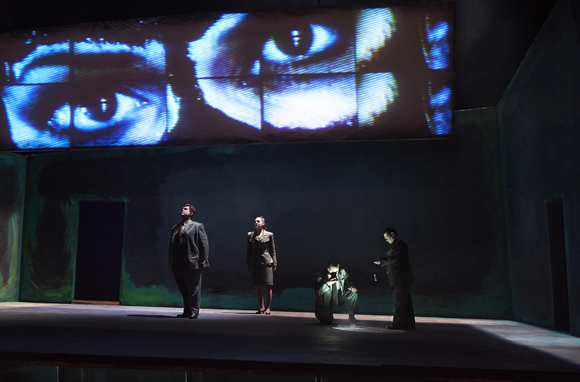
It comes as no surprise that an opera by Atom Egoyan comes across as somewhat cinematic but it’s hard not to use the term of his production of Richard Strauss’ Salome at Canadian Opera Company.  It’s quite a spare production.  There’s a raked stage; the raised end providing a sort of dungeon for Jochanaan and the back and side walls used for projections, especially of a giant mouth prophesying (shades of Big Brother here) and shadow puppets.  Costumes are simple and in shades of red, white and green.  The concept is based on the idea that Salome is a very young girl who has a history of sexual abuse at the hands of Herod that explains her “monstrousness”.  It’s most vividly explored during the dance of the seven veils where Salome rises above the stage on a swing and her robes form a scrim on which a video is projected.  It starts with a very young girl in a garden and gets progressively darker until it finishes up with today’s Salome being raped by her stepfather’s entourage.  Fittingly, the opera ends with Herod himself strangling Salome, perhaps more to silence her than out of disgust.

12-13-06-MC-D-081 Continue reading