
 Ecstatic Science is the fourth album from New York sextet yMusic. They are a young group of really excellent instrumentalists noted for their collaborations with composers who defy easy classification. There is plenty for a composer to work with in terms of palette. The group consists of Alex Sopp – flute, Mark Dover – clarinet, CJ Camerieri – trumpet and horn, Rob Moose – violin and guitar, Nadia Sirota – viola and Gabriel Cabezas – cello. The music on the record is all by young(ish) American composers noted for their eclectic styles. So everybody involved is a first rate classically trained musician who isn’t afraid to go to non-traditional places. Continue reading
Ecstatic Science
Reply
 Daron Hagen’s The Art of Song is a cycle of 24 songs for voices (various) and piano grouped thematically into four “seasons”. The texts are drawn from a wide variety of sources from Sappho to Donald Trump via, among others, Dante, Blake, Rossetti and Yeats plus various modern poets including members of the composer’s family.
 Cherubini’s Médée of 1797 is undergoing something of a revival at the moment albeit in an Italian version. But there’s an earlier and less known version of the same story with a libretto by (as opposed to based on) Corneille. It’s Charpentier’s Médée of 1693. It’s a tragédie lyrique with all the expected elements; an allegorical prologue in praise of Louis XIV, a classical subject, five acts, gods, spirits and demons and lots of spectacular theatrical effects. The Lully formula in fact.
  To round out this mini survey of the early discography of Purcell’s Dido and Aeneas I’m going to fast forward a bit to the 1995 recording by Tafelmusik. The most striking thing about this version is the very small instrumental ensemble; two violins, viola, violincello and harpsichord led by Jeanne Lamon. One quickly gets the feel for how they are going to perform with a very fast and rhythmically sprung overture.
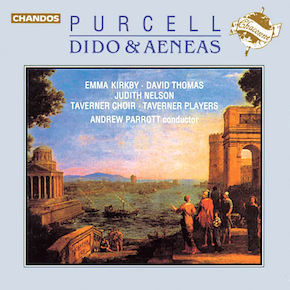 And so we come to the third in our historical sequence of recordings of Purcell’s Dido and Aeneas. We are talking about Andrew Parrott’s recording with the Taverner Players and Choir recorded at Rosslyn Hill Chapel in 1981. It’s a record that I bought when it first came out and has been a point of reference for me ever since.
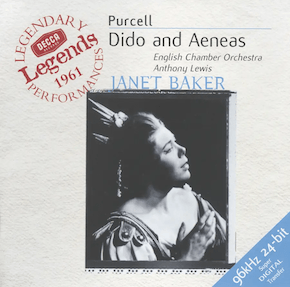 So, to continue our look at the recording history of Purcell’s Dido and Aeneas we turn to the 1961 Decca recording with Janet Baker in the title role. This has won so many awards and featured on so many “best of” lists that it might reasonably be considered to serve as some sort of “gold standard”. It’s certainly very good but I’m more interested in looking at what it says about the evolution of performance practice of Dido and Aeneas than in adding to the praise for Dame Janet’s performance.
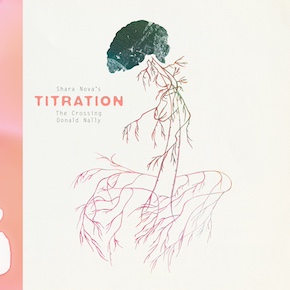 Titration is a song cycle for unaccompanied choir by American composer Shara Nova. On the CD it is performed by The Crossing and their conductor Donald Nally. It’s an interesting and unusual, indeed quite unconventional, piece but it is oddly compelling and has won a fair bit of recognition including a Gramophone “Critics Choice” award this year.
 I have to say that I was unreasonably excited to learn about a new CD from Bryn Terfel called Songs of the Sea. I’ve seen Bryn in recital and, besides being a fantastic singer, he’s a big personality and very good when he steps away from classic art song rep and especially when he sings in Welsh. There were also some interesting collaborators on the disk; Simon Keenleyside, Calan, Sting and Fisherman’s Friends for example. Plus there were some interesting language choices. Besides English and Welsh there are songs in Breton and Norn.
 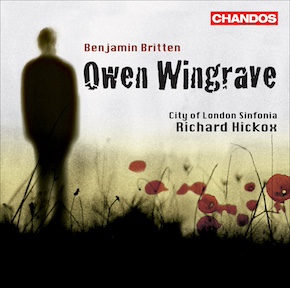 Britten’s Owen Wingrave is a curiously neglected opera. It’s rarely performed live and the only recorded versions are 2 CD recordings plus DVDs of TV productions. The earliest of each feature Benjamin Luxon in the title role and Peter Pears as General Wingrave. The
 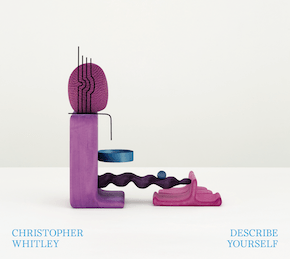 There’s a story behind violinist Christopher Whitley’s new solo album Describe Yourself. Entering the 2017 Canada Council for the Arts. Musical Instrument Bank Competition, he found himself required to offer a Canadian composition. The chosen piece was Jeffrey Ryan’s Bellatrix. He was successful and so this album is played on a
  operaramblings