Last night we saw Kaija Saariaho’s L’Amour du Loin at the Four Seasons Centre. It was really, really good. It’s a very unusual piece. There’s not a lot of action in the libretto, despite, or perhaps because of, which Daniele Finzi Pasca devised a most spectacular production (more below). It’s an opera about ideas; love, duty, honour, death, faith, God. The characters spend far more time debating what to do and why than doing it. The plot is very simple. Jaufré Rudel, prince of Blaye, tired of a life of meaningless pleasure, yearns for real love. The Pilgrim tells him of an ideal woman, a countess in Tripoli. devotes Jaufré devotes his life to writing love songs to his “Love from Afar”. The Pilgrim tells Clémence of Jaufré and she falls under his spell. Jaufré decides he must cross the sea and meet Clémence but in doing so falls mortally ill. They meet and throw caution to the winds but Jaufré dies. Clémence decides to take the veil but her attitude to God is ambiguous at best. To who is her finally ecstatically beautiful prayer directed; the deity or her “Love from Afar”? It’s not the easiest piece to engage with. It has something in common with other meditative operas like Dialogues of the Carmélites and Pelléas et Mélisande and it’s rewarding in the same sort of way.
 The music really impressed me. It haunted my dreams last night. It is an extraordinary score. In the last couple of weeks I’ve heard quite a few smaller scale works by Saariaho but this was the first time I had heard what she could do with a full orchestra. Her tachnique here seems influenced bu European minimalists like Górecki but the end result is utterly individual. She create waves of sound, often with one section of te orchestra picking a phrase up from another. The effect is almost architectural as textures interplay to create a thing of real beauty. Often, despite the wealth of visuals i found myself wanting to close my eyes and just listen. The solo vocal writing is more straightforward than in some of her chamber works. Each character has a distinct musical signature. The Pilgrim for example has any number of the trills common to medieval vocal music (which I think of as moorish but that’s just my association). The choral writing combines elements of the orchestral and solo vocal styles. It’s all really quite compelling.
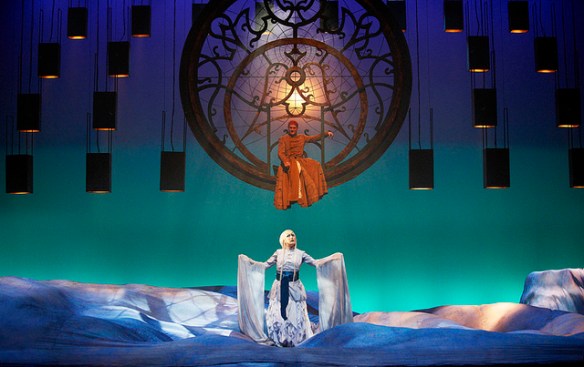 The performances were terrific. All three solo parts are long difficult sings and all three soloists were quite excellent. Russell Braun as Jaufré is on stage for four out of five acts. He was not as smoothly lyrical as he can be but his tougher, more muscular tone suited his line. Kristzina Szabó, as the Pilgrim, also has a lot to do. In many ways her acting must hold the piece together. This she said while sounding very idiomatic in the most ‘medieval’ sounding of the roles. Erin Wall almost stole the show at the end. Much of her part lies cruelly high and includes the sustained f and ff high notes that Saariaho likes to give sopranos. She coped admirably with those to close out the piece with a hauntingly beautiful rendering of the final, despairing prayer. The COC Orchestra and Chorus, were as ever, wonderful and conductor Johannes debus seemed to be right inside the music. Super stuff all round.
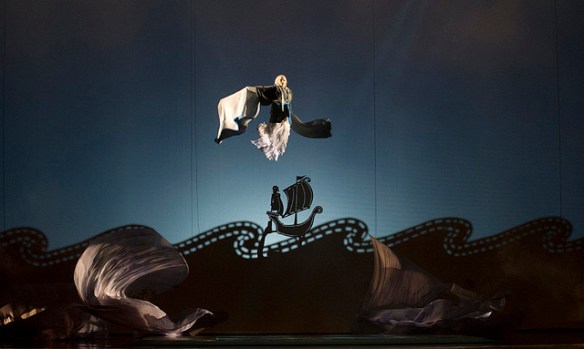
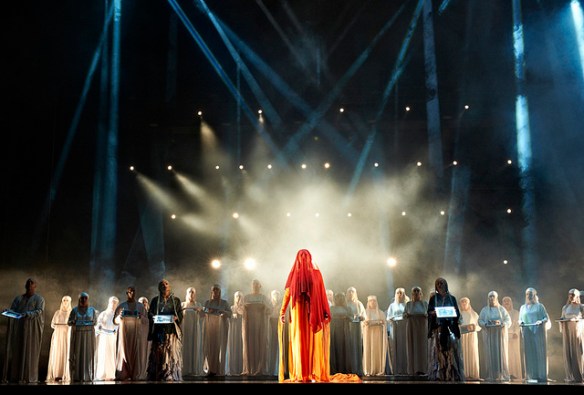
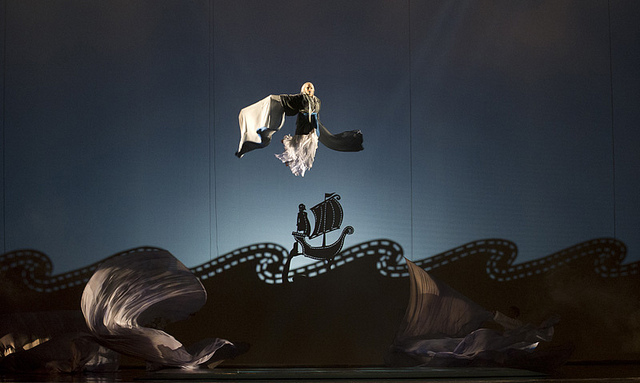
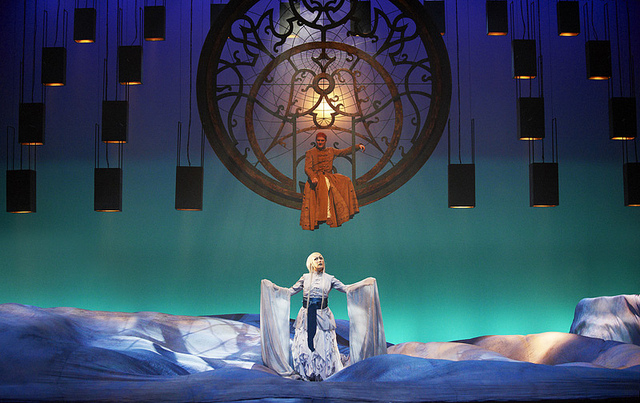
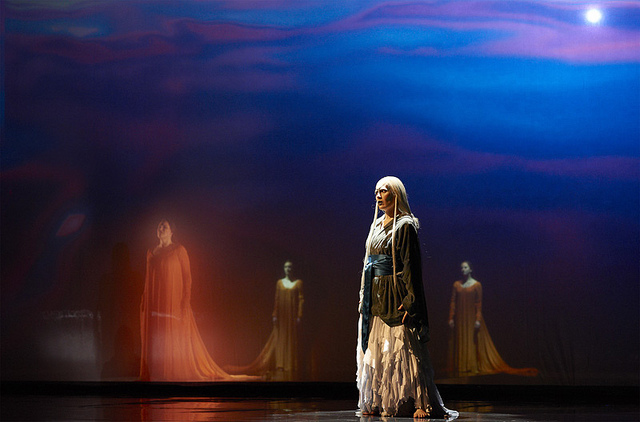
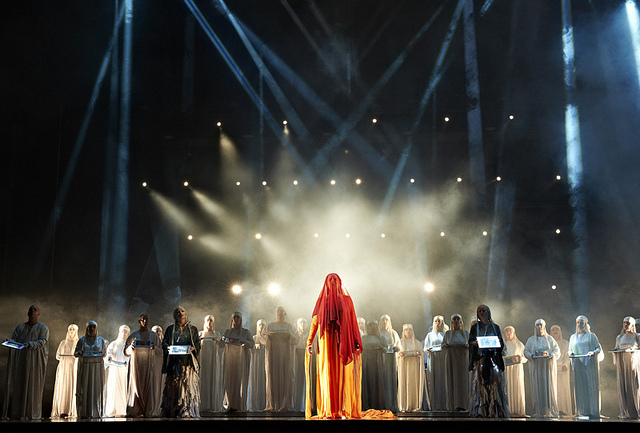
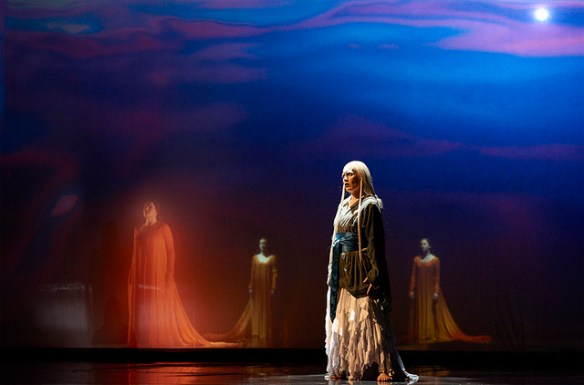 The production is very interesting. Gabriele Finzi pasca and his design team; Jean Rabasse – sets, Kevin Pollard – costumes and especially, Alexis Bowles – lighting and Roberto Vitalini – video, evoke the various settings of the piece extraordinarily vividly using cloth, light and video projections. The evocation of the sea in Act 4 is breathtaking and the ambiguous use of light shone into the auditorium at the beginning and end of the piece ask questions about the stage world and that f the audience. The story telling is embellished with shadow puppets, body doubles, acrobats and aerialists. It’s spectacular in the manner of a rather cerebral Cirque du Soleil performance. It might even be a little over the top to the point of distraction but there’s no denying the beauty of it.
 I thought it was a terrific modern opera, beautifully performed and I’d go see this in preference to traditional warhorse productions any time but what I saw last night suggests I may still be a bit unusual in that regard. The house wasn’t full and seats which I’m pretty sure are subscription seats were empty. A significant number of people, young and old, left at the interval. This disturbs me on all sorts of levels. This is quite an accessible piece and it was presented in a production that emphasised that and despite that some people obviously didn’t get it. This worries me far more than people who get offended by blood or nudity in a new production of some over performed Puccini piece. There’s a catch 22 here. A new audience is put off by the idea of opera as a boring museum piece and a section of the traditional audience boycotts anything that isn’t stuffed and mounted. Anyway, if anyone at COC is listening my vote is for innovation, risk and life.
There are four more performances ending on February 22nd. Go see it!
All photos © All rights reserved by Canadian Opera

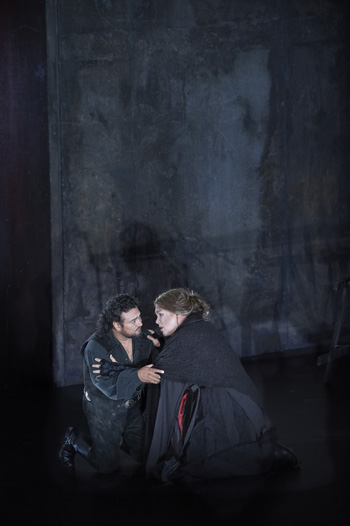 Verdi’s Il Trovatore notoriously has an episodic and highly improbable plot. It’s also famously difficult to cast. Creating a compelling production and staffing it with capable singers therefore presents a formidable double challenge. The current Canadian Opera Company production gets it half right. The problem is Charles Roubaud’s much travelled production. There’s not an idea in it. It’s not surprising that the director’s programme notes run to three short paragraphs. Roubaud sets each scene in a sort of grey box of towering walls. Unfortunately each grey box is just different enough that that the curtain comes down at the end of each scene and the stage crew spend what seems like an interminable amount of time setting up the next grey box. We just aren’t used anymore to sitting quietly through interminable scene changes. We expect slicker stagecraft and in a modern opera house there’s really no excuse for this 19th century approach. Within in each grey box the grey clad cast come and go and in between mostly stand around. Blocking is perfunctory, acting superfluous and old fashioned “park and bark” the order of the day. It’s the sort of production that might have passed muster thirty years ago but really doesn’t cut it in 2012.



 operaramblings