
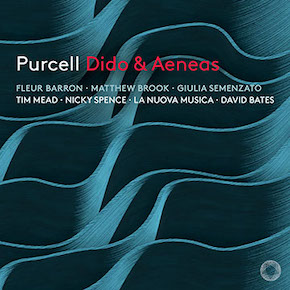
 This new CD recording of Purcell’s Dido and Aeneas sets out to produce a version that might have been heard at court in the early 1680s. This is, of course, one of several theories about the work’s genesis and it’s the one I find most credible. Taking this as a starting point allows music director David Bates a framework in which to consider issues of style and casting.
He posits significant French influence, which I would take as pretty much a given, but also some Italian flavour, which is a new idea to me and I think, too, that it’s clear that the Anglican choral tradition influences the choruses. So what does he do with these premises? First, and perhaps most importantly, he casts a rather dramatic mezzo, Fleur Barron, as Dido and encourages/allows her to present the role as if it were perhaps la grande tragédienne from one of Lully’s tragédies lyriques. Paired with the light, lyric soprano Giulia Semenzato as Belinda it produces an effect that strongly reminded me of Meghan Lindsay and Mireille Asselin in the recent Opera Atelier production though Semenzato ornaments more than most Belindas (and does it very well).
 Alburnum is a record of contemporary American art song from baritone Brian Mulligan (Torontonians may remember him as Enrico in the COC’s 2013 Lucia di Lammermoor) and pianist Timothy Long. There are two substantial pieces; each about 26 minutes long. The first is Walden by Gregory Spears and it sets four prose extracts from Thoreau’s work with an extremely minimalist piano accompaniment. I’m not really sure about turning prose into song and I’m not a huge Thoreau fan. Perhaps if I were I would have found this more interesting. It’s pleasant enough; it’s tonal and somewhat melodic and Mulligan has a pleasant voice but I wasn’t excited.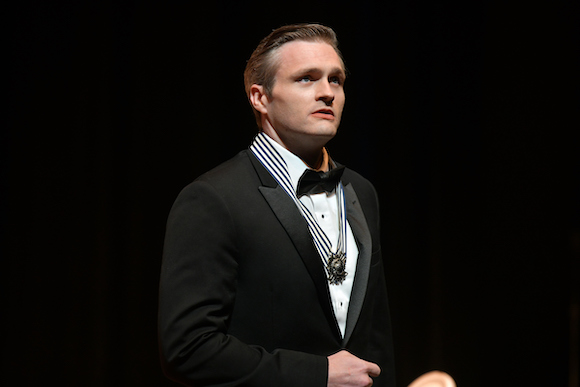

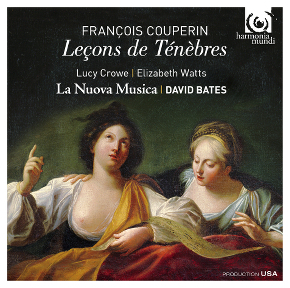 Couperin’s Leçons de Ténèbres sets texts from Lamentations and is incredibly beautiful in a very French baroque way as well as rather being music to cut your wrists to. There’s a new CD recording of it by English sopranos Lucy Crowe and Elizabeth Watts with La Nuova Musica directed by David Bates. It’s very fine. Both Crowe and Watts give exemplarty performances. They use minimal vibrato; just enough to create some resonance in louder passages and both have a wonderfully expressive trill. Coupled with really expressive playing from Jonathan Rees – viola da gamba, Alex McCartney – theorbo and David Bates – organ, it’s a real pleasure to listen to. Interestingly the three sections of the Leçons are separated by two trio sonatas by Sébastian de Brossard where the instrumentalists are joined by Bojan Čičić and Sabine Stoffer – violins. It works really well. The disc is rounded out by Brossard’s Stabat Mater, another rather lovely piece of Lenten dolorosity. The singers on this last are Miriam Allan, James Arthur, Nicholas Scott and Simon Wall with Jonathan Rees – viola da gamba, Judith Evans – double bass, Alex McCartney – theorbo and Silas Woolaston – organ. The recording, made in St. Augustine’s Kilburn, is clear and well balanced with an ambience that suits the music well.
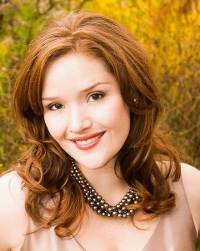 Oddly enough, what Toronto Operetta Theatre does best is operetta and the production of Romberg’s The Student Prince that opened yesterday afternoon is a pretty good example of why. I suppose, technically, that it’s a Broadway musical but everything about it, down to the humour and sentimentality seems Teutonic enough. Anyway, there’s a solid trio in the lead roles, the key back ups are thoroughly professional and the minor roles and chorus are filled out by talented and enthusiastic young singers. The band is big enough to cover all the colours of the score and the staging is appropriate and not overly ambitious. The piece gets to do its tuneful, rather bittersweet thing.
 operaramblings