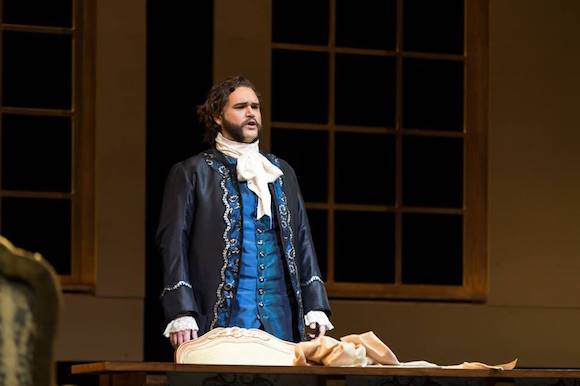
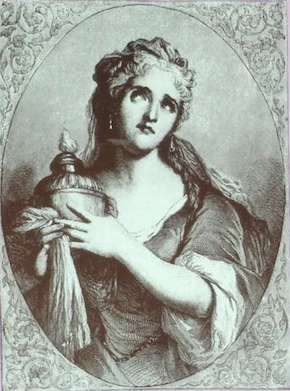
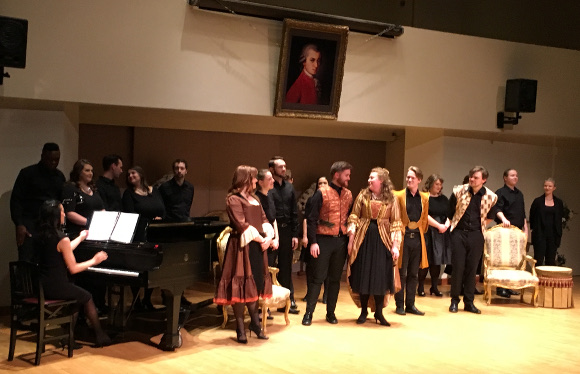
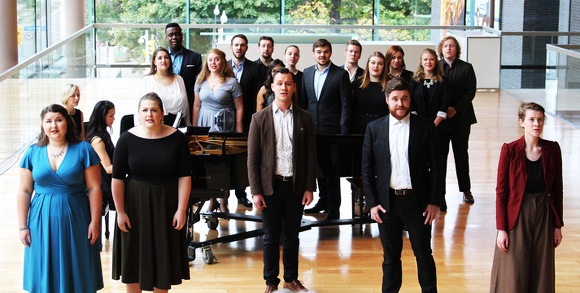
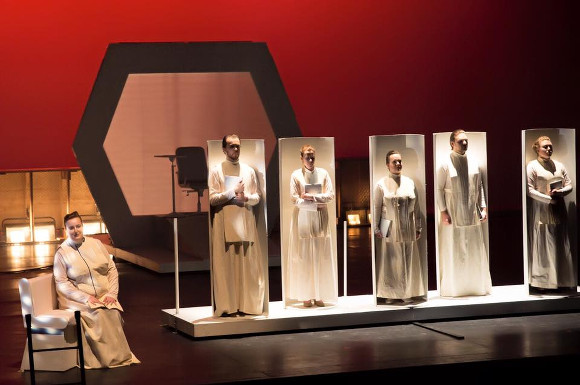
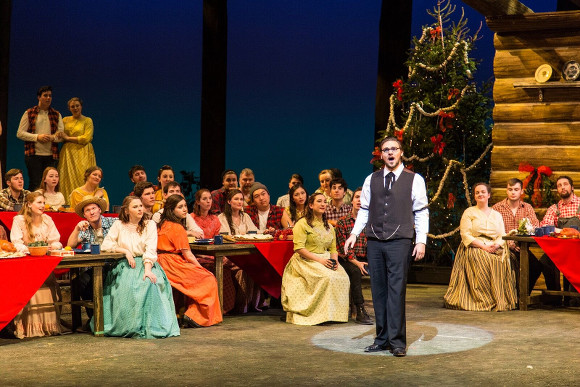
The annual Student Composer Collective opera at UoT is, as far as I know, unique. A libretto is written. The work is divided up and student composers write music for their assigned section(s). The finished work is presented fully staged with orchestra. In recent years the libretto and direction has come from Michael Patrick Albano, as was the case with this year’s effort presented in the MacMillan Theatre yesterday afternoon. Who Killed Adriana riffs off Cilea’s Adriana Lecouvreur. Adriana Amaro, a very divaish diva, is making her Covent Garden debut as Adriana. In the first half of the show, set backstage between Acts 2 and 3, we see her waspishly putting down all the other characters before making her grand entrance. This time though the poisoned violets of the final scene are just that and the second part is a whodunnit search for the murderer. Along the way no stock opera joke is left unused. Tenors are neurotic, understudies insecure, managers harassed, fans obsessive, there are fake Italians and so on. But in typical Albano style it works and provides a coherent, and at times very funny, plot line for the composers to work with. And some of the jokes were new. Adriana’s chauffeur, Umlaut, is revealed as the answer to every Austrian’s prayer; the inventor of musical strudel.
Tag Archives: albano
Energetic Street Scene
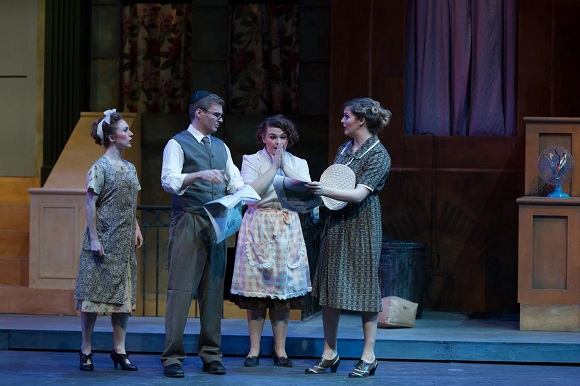
This year’s fall production by UoT Opera is Kurt Weill’s Street Scene. It’s a tricky piece in many ways. It’s part opera, part Broadway musical. The moods range from light comedy to something very much darker and lurking treacherously at its core is a sentimental streak that can easily overwhelm its merits. Michael Patrick Albano’s production, coupled with Anna Theodosakis’ energetic and varied choreography, managed to keep the focus on the strengths of the piece and deliver a very satisfying evening at the theatre.

Of Thee I Sing
There are some pretty silly opera plots. Donizetti’s Emilia di Liverpool comes to mind but the Gershwin’s Of Thee I Sing probably tops even the thundering torrents of the Mersey as it descends from the Cheshire Alps for silliness. Basically one John P. Wintergreen is a candidate for POTUS. His campaign gimmick is that he will marry whoever wins a beauty contest, held naturally enough, in Noo Joysy. Unfortunately(?) he falls in love with the homelier corn muffin maven Mary Turner and marries her instead. He duly gets elected but diplomatic complications with the French follow when it is revealed that the pageant winner; Diana Devereaux of Louisiana is the “illegitimate daughter of the illegitimate son of the illegitimate nephew of Napoleon”. Impeachment proceedings follow but, of course, there’s a happy ending. Along the way almost every US institution and region gets gently pilloried and the jokes are even funnier because what might have seemed risque in 1930 seems “business as usual” now, as when three White House interns sing about how the Presidential Mansion is the safest place in America for a young girl…

Porgi amor
UoT’s show Porgi amor consisted of a series of staged and costumed scenes from Mozart operas with linking commentary, all designed by Michael Patrick Albano. The operas ranged from La finta giardiniera to La clemenza di Tito with all the major bases in between covered off. The emphasis was on ensemble numbers and providing opportunities for as many singers as possible so there was a cast of thousands. It was well structured, quite slick and there was some very decent singing. One expects a reasonably high standard from UoT Opera and we got it. As I usually do with this kind of show I’ll refrain from a play-by-play and just talk about a few highlights and do some “talent spotting”.

UoT Opera’s Orpheus in the Underworld

Brittany Cann
French operetta is notoriously difficult to get right. The genre treacherously combines a kind of humour that doesn’t always translate well in time or language, difficult music to sing and a need to be as “naughty” as the original seemed without being crass. It’s a huge credit to Michael Patrick Albano and his student cast that they pretty much pulled off all of that last night with their new production of Offenbach’s Orpheus in the Underworld. One could nit pick details (I shall) but overall it was a well paced show with some good singing and acting and it was genuinely funny. Unsurprisingly the audience lapped it up. Continue reading
UoT Opera season opener
As has become the norm, UoT Opera opened their concert season with a free “preview” of their spring show in the RBA at noon today. It was a series of Mozart scenes which were given semi-staged today but will, in the fullness of time, form a staged and costumed performance. It’s always an interesting event because it’s so early in the academic year. It’s the first chance to try and talent spot and see how things develop over the rest of the cycle. As such, it’s often a bit rough but today really wasn’t. It was a surprisingly high quality across the board effort which augurs well. That said, it was all ensembles and nobody was asked to pull out vocal fireworks so maybe not the sternest test imaginable which makes star picking that bit trickier.
UoT 2016/17
UoT Faculty of Music have just announced their 2016/17 season. It’s the usual broad range of performances so I’ll highlight the opera and vocal music contributions.
UoT Opera is offering four shows. The fall main production is Offenbach’s Orpheus in the Underworld with new English dialogue and stage direction by Michael Patrick Albano. Choreography i by Anna Theodosakis and Russell Braun makes his podium debut. There are four performances November 24th to 27th. Spring sees a Handel rarity; Imeneo. Tim Albery directs and Daniel Taylor is in charge of the music. This one runs March 16th to 19th. Both shows are in the MacMillan Theatre.

Last year’s student composed opera; The Machine Stops
I am Way, I am Act
This spring’s main opera production from UoT Opera is Britten’s Paul Bunyan. It is a really peculiar work. The libretto is by WH Auden and is, well, weird. It mixes up the (apparently) profound with the absurd and the downright silly. There’s a Swedish lumberjack fish slapping dance, talking cats and dogs, trees that aspire to be product and a philosophical accountant (*). There are also countless pronouncements from the off stage voice of Bunyan along the lines of the closing:
“Where the night becomes the day, Where the dream becomes the fact, I am the Eternal guest, I am Way, I am Act“
Walt Whitman meets Dr. Seuss meets a lot of drugs? One of those 1970s English public schoolboy prog rock bands?

The Machine Stops
This year’s UoT Opera student composed opera sets a libretto by Michael Patrick Albano based on a 1909 story by EM Forster. It’s a dystopian sci-fi story and OK as these things go though one suspects it felt a whole lot more original in 1909. Basically, humanity is living underground in pods with limited face to face interaction. Life is mediated by “The Machine” which increasingly has become an object of veneration as well as utility. The principal characters are Vashti, a believer, and her rebellious son Kuno who is prone to make illegal excursions to the planet surface where, he realises, there are still people living. It’s a bit like Logan’s Run but not as sexy. The Relationship between the two breaks down over their belief systems until The Machine goes belly up at which point there is a reconciliation before everyone dies. Along the way there’s a fair bit of heavy handed philosophising by the narrator and chorus.

The Telephone and The Medium
UoT Opera’s fall production opened last night at the MacMillan theatre. It’s a double bill of Menotti works; The Telephone and The Medium. The former was cleverly updated by Michael Patrick Albano to reflect the age of the smartphone. It actually seems more relevant than ever and, slight as it is – an extended joke about a girl who won’t get off the phone long enough for her fiancé to propose – it was wryly amusing. The Medium I’m not so sure about. It’s a contrived piece written in the 1940’s but set a few years earlier about a fake medium and her deluded clients. It seems dated, not so much in the sense that seance attendance is pretty unusual today, but in the extent to which the characters are clichéd, cardboard cut outs even. The medium herself is bad enough but her sidekicks are her rather dippy, if kind, daughter and a boy who is mute (k’ching), Gypsy (k’ching) and “found wandering the streets” (k’ching, k’ching) “of Budapest” (k’ching, k’ching, k’ching). The first act in which the fake seancery goes on isn’t bad but then the medium gets a shock; a real or imagined cold hand on her throat (probably imagined as she is a raging alcoholic) and decides to go straight. The second act is pure bathos. I can see why it was a Broadway hit in the 1940s but I think tastes have moved on. And who the heck calls their daughter “Doodly”?