Anna Nicole

Last night I lasted about thirty minutes in to Mark-Anthony Turnage’s much hyped Anna Nicole. I quite liked the orchestral writing and Eva-Marie Westbroek was acting up a storm but in the end I just felt “meh”. Watching Tony Pappano’s doco on “fallen women” in opera that was meant to contextualize Anna Nicole I think I understand why. Turnage and his librettist are trying to do to “us” what Verdi did with La Traviata; challenge our hypocrisy at colluding in the creation of Anna-Nicole Smith while deploring her life. Doesn’t work for me. Until the opera came along I scarcely knew who she was. I hate the “cult of celebrity”. I despise everything about it and the people who feed off it so trying to guilt trip me over voyeuristic fascination in this particular specimen was doomed to fall flat. It did.

Also, not nearly so edgy as Turnage and company seem to think. The painfully fake Texas accents underlie what is, essentially, an assertion of British cultural superiority over the crass Americans. If the Royal Opera House wanted to make an opera about the cult of mindless celebrity and they had any balls they’d make it about the vacuity of Princess Diana and her family. Not much chance of that!

Le Docteur Miracle and L’Heure Espagnole

Last night lemur_catta and I braved the blizzard to see students from the Glenn Gould School and the Royal Conservatory Orchestra perform at Koerner Hall. The bill was two French one act comic operas; Bizet’s Le docteur Miracle and Ravel’s L’heure espagnole. Both have extremely silly plots but rather lovely music.

The Bizet piece concerns an officer who is in love with the mayor’s daughter (or maybe his wife, or maybe both. This is French opera) and wins her hand by disguising himself as “Docteur Miracle” and “curing” the mayor who thinks he has been poisoned by an omelette. The omelette gets a lot of air time. In last night’s version heavy use is made of three ballet dancers with omelette making headgear. I have no idea if this idea is original or in the libretto but it was very funny. It’s a pretty conventional early classical piece musically; arias for the soprano, tenor and baritone leads and a lot of ensemble numbers. The dialogue is spoken. It was generally well sung with the stand out being the daughter, a coloratura soprano part, played by Jennifer Taverner. The ensembles worked well except that the very young looking tenor, Zachary Finkelstein, was somewhat underpowered and tended to disappear. Solo, his voice was pleasant enough, if light. Pretty decent performances from baritone Maciej Bujnowicz and mezzo Danielle MacMillan as the mayor and his wife. Excellent work from the orchestra and conductor Uri Mayer.

After the interval we had the much more modern sounding L’heure espagnole by Ravel. In this piece the clockmaker’s wife takes advantage of her husband’s day out fixing the municipal clocks to find a lover. This is complicated by the arrival of a muleteer who needs his watch mending. She gets him out of the way by having him haul clock cases from the shop to her bedroom and back. At various points her two would be lovers; a dull grandee and a verbose poet are concealed in the clock cases and a lot of singing takes place through windows in the front of the clocks. Finally she decides that someone who can tirelessly haul loaded clock cases up and down stairs may have more of what she is after than the other two and takes the muleteer off to bed, sans clock. The work concludes with a quintet confirming that it is, indeed, the muleteer’s day. The work is heavier in tone; through sung and fewer set piece numbers. Bujnowica and Finkelstein appeared again as the lovers but the stars were the bluff, strong baritone of Todd Delaney as the muleteer and Leigh_Anne Martin’s strong soprano as Concepcion. It’s the sort of role that one could easily imagine Anna Netrebko singing and Martin managed the same sense of sly, sexy fun that Trebs brings to roles like Norina. Tenor Andrew Byerlay played the clockmaker. This is a much more musically complex work than the Bizet and uses a pretty large orchestra. I didn’t think the orchestral work was as crisp as in the Bizet but it was fine really.

Koerner Hall is a visually lovely venue with acoustics that help everyone. It’s really pleasant to hear and watch opera in a venue that size, 1100 seats, where every seat, pretty much, is a good one and the sound is excellent. All in all, a fun evening. I’m more and more convinced that I would rather see young artists having fun and really trying to put on a show than watch rather bored experienced professionals do their 200th performance of a work in a routine production in a big opera house. There’s another show on Friday night and decent seats are only $30 so think about it!

The COC crowd were out in force and I spotted Alexander Neef, Simone Osborne and Ambur Braid among others in the audience. One has to give credit to Mr. Neef. He spends a lot of time talent spotting young singers. I guess, given his background in casting in Paris, it’s not so surprising.

Theodora

Handel’s Theodora was conceived and first performed as an oratorio and it was a flop. closing after three performances. I’m not sure why. It may not be Handel’s best work but it’s got some very good numbers and it’s dramatically very strong.

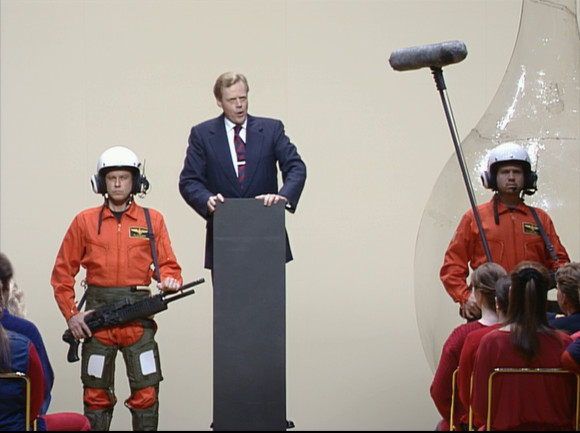
1.valensIn 1996 Glyndebourne staged an operatic version conceived by Peter Sellars. Occasionally Mr. Sellars frustrates me but most of the time I think he’s a genius who stages some of the most thought provoking music theatre out there. This Theodora is pure genius. Sellars sets the piece in contemporary America. The President of Antioch, Valens, (Frode Olsen) is a typical American politician; a nasty mixture of imperialist bluster, bonhomie and crass consumerism and he’s well supported by a brightly clad coke can bearing heathen chorus. The Roman soldiers wear US Navy helicopter pilot uniforms. By contrast the Christians wear combinations of black and white in pretty restrained cuts and combinations. The set is mostly bare but for some giant shattered glass vases and, as needed, a few props such as a lectern, chairs and, most chillingly, the gurneys on which Theodora and Didymus are executed by lethal injection. It all works really well. Although conceived 15 years ago it could have been last week. The idea that one can’t be a “proper Roman/American” if one doesn’t adhere to the state and socially approved approved religion and the chilling, deadly self righteousness of Valens seem especially contemporary in a week that sees an IRA supporter chairing a House investigation into Muslim disloyalty.

Continue reading →

So who’s biggest and baddest?

There’s a bit of a debate about which North American opera company is the second largest. Nobody, of course, disputes the Metropolitan Opera’s overwhelming lead in sheer size. With 26 productions in repertoire for 2011/12 and something like 220 performances it is over three times the size of it’s leading rivals. It also has the biggest house, seating 3,800 with 300 standing room spaces. The next largest operations are:

San Francisco Opera – 9 productions, 72 performances plus 2 “Carmen for Families”.

Canadian Opera Company (Toronto) – 7 productions, 68 performances plus 1 Ensemble Studio performance.

Lyric Opera of Chicago – 7 operas plus “Showboat”, 59 opera performances plus 12 of Showboat (It seems to be SOP at the Lyric to do 7 “proper” operas plus a musical or operetta).

No-one else has more than 6 productions. All figures based on 2011/12.

Now the war Memorial Opera House in San Francisco seats 3,146 so assuming a reasonable capacity utilisation I think that makes them no. 2 by any measure. The Civic Opera House in Chicago seats 3,563 so assuming they too sell a reasonable proportion of their seats they probably come in at 3. The Four Seasons Centre only seats around 2,100 (actually a much more typical number for an opera house by world standards) but is almost always virtually sold out. So around 140,000 seats are sold for the COC in a season bringing them in at no. 4.

Adams in Toronto

John Adams is in Toronto for the TSO’s New Creations Festival. Today he MC’d a free concert of extracts from his operas at the Four Seasons Centre. I feel really privileged to have been able to attend. Adams’ introductions for each piece were thoughtful, informative and deeply human. We had arias from A Flowering Tree, Nixon in China, Dr. Atomic and The Death of Klinghoffer performed by Peter McGillivray (baritone) and Betty Waynne Allison (soprano) with Anne Larlee at the piano. They both did very well with McGillivray being particularly effective, especially in Nixon’s “Mister Premier, distinguished guests”. To be fair to Ms. Allison, Adams’ writing for soprano is fiendish and throttling back a big voice in a fairly small space can’t have been easy.

I’m starting to feel a bit more at home with Adams’ music and to understand better why I like what I do like. Adams’ music seems to work best when it is fairly up tempo and has real rhythmic drive to it. Adams said that very little of his non operatic music is as slow as much of his operatic music and I think that’s significant. He doesn’t do relaxed and/or lyrical as well as the more driven stuff. So Nixon in China works pretty well because it is driven along at a pretty relentless pace and even the set piece arias are mostly fairly brisk. Dr. Atomic drags, has slow passages that lack any other real interest and is correspondingly less effective.

Iphigénie en Tauride

Iphigénie is one of my all time favourite operas and has some absolutely gutwrenchingly beautiful music. The Met production had Susan Graham, Placido Domingo and Paul Groves. This looked set to be amazing. It wasn’t quite though it was very good indeed and the problems were all with the production. Despite Peter Gelb announcing before the curtain that Ms. Graham and Mr. Domingo were both suffering from colds the singing was first rate across the board. I’m looking forward even more to Susan Graham singing this with Russell Braun and Joseph Kaiser next year in Toronto.

Continue reading →

Zwei Zauberflöten

Thursday night I attended the COC Studio Ensemble’s performance of Mozart’s Die Zauberflöte and last night lemur_catta and I were back to the see the main cast. For context, the Studio Ensemble is the COC’s training programme for young professional singers so the cast members on Thursday are mostly under 25 and I doubt that anyone outside Canada would recognize any of the names. Yet! The main cast was a typical COC cast with established international singers playing the main roles with current and former Ensemble Studio members taking the lesser parts. In both cases the full COC orchestra and chorus was used and Johannes Debus conducted.

The stage production and design was the same for both shows so let’s start there. The production concept is that the opera is being given in a temporary theatre in the garden of a Viennese aristocrat as part of the celebrations for his daughter’s name day. As things go on, the aristocratic audience and their servants are drawn in as actors in the drama. The daughter is Pamina, the father Sarastro etc. In Act 2, the stage on a stage has gone and the action plays out in the garden with hedges being rearranged at intervals to create the Temple of the Initiates etc. In keeping with the setting, costumes are more or less 18th century though decidedly Disneyfied. In particular Pamina wears a flouncy pink dress throughout and Tamino is all in white except for a teal frock coat. When they are together one almost expects animated love birds to circle around them. The Queen of the Night looks straight out of Snow White but the Three ladies look more like a post apocalyptic women biker gang or scary clones of zingerella. There are some effective touches; the animals are whimsical without being too whimsical and effective use of dancers is made in the trials scene.

Overall, I felt the play within a play element didn’t add anything much and it didn’t take much away either. The costumes and sets were OK for the work that Die Zauberflöte is. They didn’t try too hard to be “this is srs opera” like the current ROH production equally they didn’t capture the blend of fairy tale whimsy and menace that the 2006 Salzburg production achieved. Of course, this is the personal view of a somewhat jaded opera goer who has seen the work many times. From what I heard of the audience reaction of, especially, children and first time and occasional opera goers, the whole thing was a big hit. In the overall scheme of things I’d rather a production of Die Zauberflöte helped bring a new audience to opera than made my highly enjoyable evenings into truly memorable ones.

So what about the singing? The two nights were different and had a very different vibe. The Ensemble Studio show was youthful and energetic and felt like everyone was having terrific fun. The main show cast felt like a polished performance towards the end of a longish run. None of that a surprise really.

The differences were perhaps best exemplified by the respective Taminos and Paminas. On Thursday Tamino was sung by Chris Enns who looked the part and sang heroically, giving it his all and achieved the feat of making Tamino believable and likeable. No mean feat. Last night the role was played by 46 year old Michael Schade who has sung this role 250 times in just about every house of consequence. He was immensely stylish and polished and it was almost a master class in what a Mozartian tenor should sound like but, inevitably, he lacked the freshness of Enns, who is half his age.

It wasn’t quite the same with the Paminas. Thursday gave us Simone Osborne, who is an Ensemble Studio member but is also singing four performances with the main cast. She’s right on the edge of becoming an established singer with bookings for the next year that one would expect from a rising young soprano. She sang with confidence, enough heft for the role and a very sweet youthful tone, especially in her high register. It was very affecting. Friday gave us one of the COC’s established favourites; the lovely Isabel Bayrakdarian. She sang and acted with great skill but one really wonders whether Pamina is what she should be doing these days. She has always had a big voice for a lyric soprano and it’s darkened, especially at the top end, over the years. Her website doesn’t give much information about her future plans but it will be interesting to see where she goes from here.

The other key roles are the Queen of the Night, Papageno and Sarastro. In the first of these we got the impressive young coloratura Ambur Braid on Thursday and the established Canadian Aline Kutan on Friday. Ambur looks the part in a Diana Damrauish sort of way and did a pretty good job on her two arias. If I’m being picky I’d say she nailed the high coloratura but didn’t really articulate the tricky legato runs as clearly as needed. Kutan seemed to be holding back in “O Zitt’re nicht, mein lieber Sohn” which was distinctly sonically and emotionally underwhelming though accurate. Maybe she had a bit of a cold and was saving herself for Act 2 because she gave an excellent full throttle rendition of “Der Hölle Rache”. The same may have been true of Friday’s Papageno, Rodion Pogossov, who was definitely stronger in the second act. He was good. He got the physical comedy right and went from pretty good to better than that vocally as the night went on. On Thursday we had Adrian Kramer in the role. he’s a very good comic actor and a stylish singer but sounded just a bit underpowered when heard from Ring 5 of the Four Seasons Centre. Sarastro is always going to be a problem for a young cast. Young basses with gravitas aren’t much more common than unicorns. That said, Michael Uloth was much better than I expected and did a very competent job if, inevitably, a little lighter than Fridays Mikhail Petrenko, who isn’t Rene Pape either, but sang and acted the part well.

The other parts were all perfectly adequate. On both nights The Three Ladies camped it up nicely. Maybe their ensemble was a little crisper on Friday and the physical comedy more evident on Thursday but fine differences. Both nights saw the excellence we have come to expect from the COC orchestra and chorus and Johannes Debus.

I’m glad I saw both performances. The differences were interesting and if I hadn’t gone on Thursday I would have missed Simone Osborne’s Pamina which would have been a shame. It also meant I could have a look at a performance at the Four Seasons Centre from a different angle. On Thursday I was up in Ring 5 which is definitely ice axe and crampons territory and very different from my usual seat in the Orchestra Ring. The sound up there is excellent and with opera glasses it’s OK visually. (Plus $22 ticket so who’s complaining!).

Just to finish on a sour note, I am going to commit homicide in that theatre if people don’t stop their inane chatter during the performance. Also, is it asking too much that if you have a cough you take medication and cough lozenges with you to an opera? The one drawback of a house with excellent acoustics is that every cough reverbs around the theatre and once again, the frequency and volume of coughing was bordering on the absurd.

Nixons in China

What looked like a bit of a nuisance turned out instead to be an interesting opportunity. By chance, the Friday evening performance of the COC’s Nixon in China (our season tickets are for Friday nights) fell the evening before the Met’s HD broadcast of its production of the same piece affording me the opportunity to see two contrasting productions in less than 24 hours.

Continue reading →

Another lunchtime concert

Another excellent lunchtime concert at the Four Seasons Centre. This time it was more of the Ensemble Studio with an all Mozart programme. It was consistently very good indeed.

First up Ileana Montalbetti sang the virtuoso concert aria Bella mia famma, addio!. Ileana has an amazingly powerful voice for a young singer and as I was sitting about ten feet away from her I practically got blown away. Lovely work! I really look forward to seeing how her voice matures.

Next Jacqueline Woodley sang two movements from the Exsultate, Jubilate. She is a very winning singer with an infectious enthusiasm and a great sense of comic timing that was better displayed in Batti, batti, o bel Masetto and especially in the duet La ci darem la mano which she sang with Neil Craighead. The duet was very funny indeed. I wonder if I’m the only person who thinks Jacqueline looks a bit like a young Miranda Richardson.

Besides the duet with Jacqueline, Neil sang Madamina, il catalogo e questo, again with very nice comic touches as well as power and beauty of tone. He grows on me. He closed out the concert with a rarity, Per questa bella mano which is a virtuoso concert aria for bass-baritone with an equally virtuosic bass obbligato, provided on this occasion by Alan Molitz.

Before Neil closed things out we also heard the slightly terrifying Ambur Braid sing Non mir dir and the fiendish concert aria Vorrei spiegarvi, o dio. Ambur is definitely at her best in the batshit insane soprano repertoire. She’s agile and accurate and nails the high notes and difficult runs. I wish I liked the colour of her voice better. If she could also pull off a real richness or sweetness of tone she’d be set for superstardom. As it is I find her tone colour a bit harsh and metallic though still very impressive.

Anne Larlee was at the piano and excellent as always.

For added operatic squee bonus points I got to meet Simone Osborne who previously I’ve engaged with a little on Twitter but never met. She is lovely and I’m so glad that her career is starting to take off.