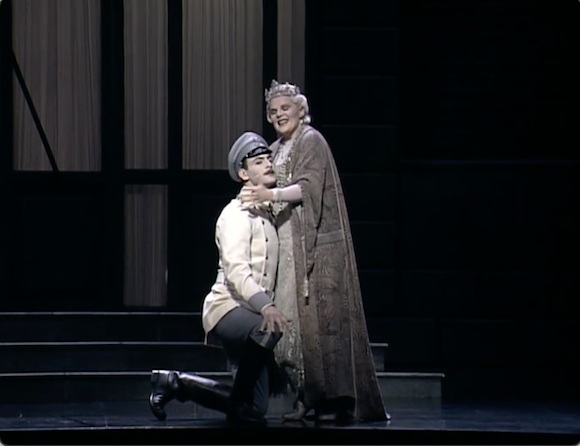
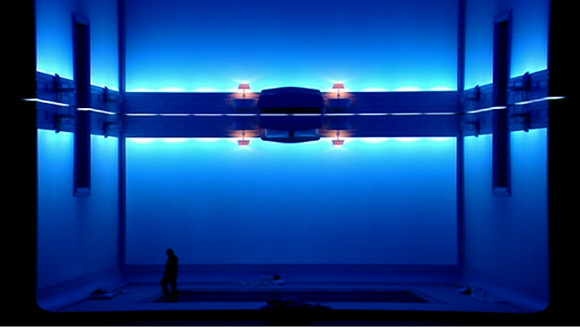
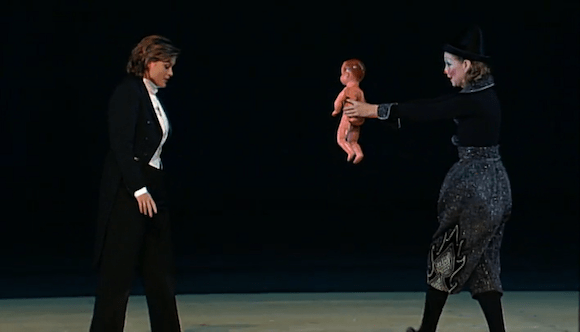
I think maybe Handel’s Rodelinda is one for the hard-core Handelians. It’s got some lovely music but it’s long (200 minutes), not very dramatic (it’s based on Corneille) and, structurally, is a succession of recitative and da capo arias. There is no chorus and I only recall two numbers that weren’t solos; the concluding quintet and a rather lovely duo between Rodelinda and Bertarido at the end of Act 2. Jean-Marie Villégier’s 1998 production for Glyndebourne rather tends to emphasise the leaning to elegance rather than drama. The basic look and feel is “silent movie era”. Sets and costumes are near monochrome and that tends to be emphasised by the lighting. At least when there is a any. Much of this production is very dark, as was fashionable at the time.
There’s this part of me that thinks I ought to like Wagner. In some ways I do. The Rhinegold was one of the first operas I saw live when Goodall was conducting at ENO and I loved it. I like most of the Ring and I’m very fond of Der Fliegende Holländer but I also see the essential truth in the two great Wagner witticisms:
Anon to Evelyn Waugh – “What was Crete (i.e. the battle of) like?”
Waugh – “Like German opera; too loud and too long”
and…
Wagner lover – “There are some amazing moments in Wagner”
Wagner skeptic – “And there are some damn dull half hours in between”
This really comes to a head for me with Tristan und Isolde. If ever fifteen minutes of plot were compressed into five hours this is it. Essentially nothing much happens; very slowly; and very loud. I think it’s only ever performed because (a) it’s Wagner and (b) that chord. Five hours is an awful lot of bum numbing to experience one moment of musicological history. Maybe this is why directors try so hard to make it look like something is going on? This surely reached utter desperation point in the Met’s HD broadcast, when I thought I was watching a game of Tetris, though the current fugly Bayreuth production runs it close. I know I’m not the only one who has this problem as witness Julia Spinola’s essay Der Kunst der Langsamkeit. I just lack the ability to put my thoughts into German Higher Bollocks. Or maybe my Imperial wardrobe detector kit is more sensitive than hers.
I’m not giving up on Wagner. I like the music in Lohengrin for example and I’d really like to see the current Bayreuth production. Most operas are improved by rodents in my experience. I don’t know Tannhäuser or Parsifal at all well so there’s some exploring to do there. I think I’m done with Tristan though.
I’m a big fan of Robert Carsen. His Orfeo ed Euridice was one of the highlights of last year’s COC season and his Iphigénie en Tauride promises to be one of the events of the upcoming season. So, as you can imagine, I had high expectations for the DVD of his 2002 Paris production of Dvořák’s Rusalka with Renée Fleming in the title role. I wasn’t disappointed. The production is pure magic. It’s almost a mathematician’s production. In Act 1 he gives us symmetry in the horizontal plane. There’s a bedroom reflected horizontally floating above the water sprites’ abode which resolves itself into the bedroom that is the setting for Rusalka’s initial encounter with the prince. In Act 2 we get the same bedroom but in a left right symmetry and the movements of the characters are also mirrored with non singing actors mirroring the singers. The symmetry continues with Rusalka balanced against the foreign princess. It’s very cool. I’m guessing that Carsen is suggesting the distance between the world of the sprites and the human world diminishing then opening up again. In Act 3 we get geometrical chaos as Ježibaba’s hut is presented at crazy angles poised above the stage and all sorts of dissolution goes on before we again get the symmetrical bedroom in which the final tragedy plays out. The general concept is supported by a superb lighting plot (Carsen and Peter van Praet) that brilliantly brings out the moods of the different scenes. And there’s no clutter. Scene follows scene pretty much seamlessly. It’s terrific stagecraft.
I guess Serse gets performed as often as any Handel opera but there only appears to be one DVD version in the original Italian available. It’s a 2000 production from the Dresdner Musikfestspiele. Michael Hampe directs a cast of, then, fairly young singers, few of them familiar to me. Christophe Rousset conducts Les Talens Lyriques and the Ludwigshafener Theaterchor. It’s a really good DVD. The costumes and sets, by Carlo Tommasi, are a sort of mid 19th century European with “exotic” touches. There’s a consistent palette of black, white, grey and silver with a little deep blue and cream intruding. It’s all very elegant. The direction is more than competent. The relationships between characters are explored and Sandrine Piau, as Atalanta gets to exploit her considerable comic talents. To cap it all off we get a few, very apt, pyrotechnic surprises right at the end.
The singing is uniformly excellent. Paula Rasmussen, a mezzo, is cast in the castrato title role. It’s a role where personally I’d prefer a David Daniels or a Lawrence Zazzo but she manages to look and sound masculine enough. The same is true for Ann Hallenberg as “his” brother Arsamene; a genuine mezzo role. Patricia Bardon sings Amastre, Serse’s discarded lover who spends 9/10 of the opera disguised as a man. Ms Bardon manages the difficult feat of acting a woman pretending to be a man convincingly which is obviously quite different from a woman acting a man. I won’t try and describe the singing performances individually because I would just end up using “stylish” way too much. These are all thoroughly idiomatic Handel performances with tasteful decoration, lovely legato and accurate coloratura. The two sisters Romilda and Atalanta are played by sopranos Isobel Bayrakdarian and Sandrine Piau. It was a real pleasure to be reminded of what a fine Handelian Bayrakdarian was right at the start of her career. Her singing is just gorgeous. Piau is great too. She has great comic timing in a role that really needs it and she also gets the most coloratura fireworks which she handles very well indeed. The guys who play guys are Marcello Lippi as girls’ father, Ariodate, and Matteo Peirone as the servant, Elviro. These are both essentially buffo roles and both men are well up to them. I don’t think I’ve heard M.Rousset and his Les Talens Lyriques before but they are as good a Baroque band as I have come across. The chorus doesn’t have much to do but it does fine with what it does have. All in all, it’s very satisfying musically and dramatically.
Direction for TV/DVD is by Philip Behrens and it’s OK. There aren’t too many intrusive close ups though it’s a 4:3 picture so some of that is a bit inevitable. Picture quality is pretty typical of TV to VD productions. Sound options are PCM stereo or Dolby 5.1. The surround version sounded very good. There are no extras on the disk and the documentation is pretty basic. It’s a Euroarts production.
There’s a ten minute trailer up on Youtube that gives a really pretty good idea of what to expect though it’s a bit short on comedy and there’s no Sandrine Piau. Here it is.
Nude actors wearing Mickey-mouse masks walk past opera singer Adina Aaron as Amelia (L) as they perform on stage during a rehearsal of Giuseppe Verdi’s opera “Ein Maskenball” (“Un Ballo in maschera” / “A masked Ball”) directed by Austrian Johann Kresnik, on April 9, 2008 in the eastern town of Erfurt. The production will have its premiere on April 12, for which Kresnik hired some 30 seniors to take part in the opera. (Photo credit – JENS-ULRICH KOCH/AFP/Getty Images)
Merlin is an early 20th century collaboration between the English banker Francis Burdett Money-Coutts and his Spanish composer/protege, Isaac Albéniz. It’s an interesting work falling some way short of being a masterpiece but, when given as fine a production and performance as it gets in this Madrid DVD, definitely of interest and worth a look.
Back in July I reviewed John Eliot Gardiner’s Paris recording of Gluck’s Orphée et Eurydice which I found musically fine, in good taste (too much so) and ultimately unengaging. Lydia pointed me to a Bayerischen Staatsoper version with Vesselina Kasarova in the title role. It’s the 1859 Berlioz version with a ballet tacked on at the end, more of which below. Musically it’s very good. Chorus and Orchestra under Ivor Bolton are excellent, Kasarova sings and acts very competently and manages an amazing cadenza in her big first act aria. Rosemary Joshua as Eurydice is perfectly adequate if a bit anonymous and Deborah York is an androgynous looking and sounding Amour which works fine for this production.
This afternoon I was listening to the CBC radio broadcast of the Canadian Opera Company’s production of Die Zauberflöte from earlier this year. During the interval there was an interview with Michael Schade, the Tamino, where it was pointed out that he had sung the role, in English, in the famous 1991 Opera Atelier production in Toronto and, also, that Russell Braun had sung Papageno in that show. It was the first opera I saw in Toronto, having moved here only a very short time before. I don’t recall who else was in that production and I can’t find a cast list anywhere. Certainly revivals of the production, which I also saw, weren’t quite so packed with future stars. Curiously, the very first Magic Flute I saw, at the Coliseum in August 1975, also featured future stars, then fairly unknown. Felicity Palmer sang Pamina and John Tomlinson sang one of the Men in Armour. It makes me wonder whether we were seeing any stars of the future at the COC this time. Perhaps not with the “A” cast where all the main roles were sung by well established singers but I might watch out for Wallis Giunta, a very talented mezzo, who sang one of the Three Ladies. Also singing as the alternate to Isabel Bayrakdarian as Pamina was Simone Osborne (I saw her in Ensemble Studio performance). She’s also one to watch. You can catch her as Gilda in Rigoletto at the COC starting September 30th.
If Thomas Hardy had written an opera libretto he might well have come up with something like Janáček’s Jenůfa. It’s a simple rural love story with domestic violence, betrayal, desertion, bastardy and infanticide thrown in. It also has an absolutely gorgeous score mixing folkloric elements, incredible lyricism and some pulsating rhythmic sections. The opera was substantially modified after it’s 1904 Brno premier but in 1989 Glyndebourne put on the original Brno version in a production by Nikolaus Lehnhoff. It’s a three acter and opens with with scenes around a mill owned by Jenůfa’s fiancé, Števa. It’s all a bit cramped and old fashioned looking; probably a function of the small stage in the pre-reno Glyndebourne. Acts 2 and 3 take place inside Jenůfa’s foster-mother’s (Kostelnička) house and here the small stage makes the fairly simple room appropriately claustrophobic. What makes this performance worth seeing though is not the staging but the performances by the three principals; Anja Silja as Kostelnička, Roberta Alexander as Jenůfa and Philip Langridge as Jenůfa’s other suitor, Laca. They are backed up by a superb performance by Andrew Davis and the London Philharmonic. Davis just has an uncanny ability to wring every drop of lyricism out of score without sacrificing drama or forward momentum and he does it here every bit as well as he did in Ariadne at the COC back in May. Other reviews of this DVD that I have read have focussed heavily on Silja’s Kostelnička. I can see why. She is not far short of a force of nature and she drives the drama, especially in the horrific second act and the final scene. I think though that Alexander’s Jenůfa is just as important. She contributes the lyricism in the singing. It’s not that she lacks drama, she doesn’t, but she has a sweet toned voice that carries that element of the music through all three acts. Langridge’s Laca impressed me too. In Act 1 I wasn’t at all sure. He seemed miscast with the role not offering much for his stylish lyrical tenor but he grew on me during the more domestic bits of Acts 2 and 3.