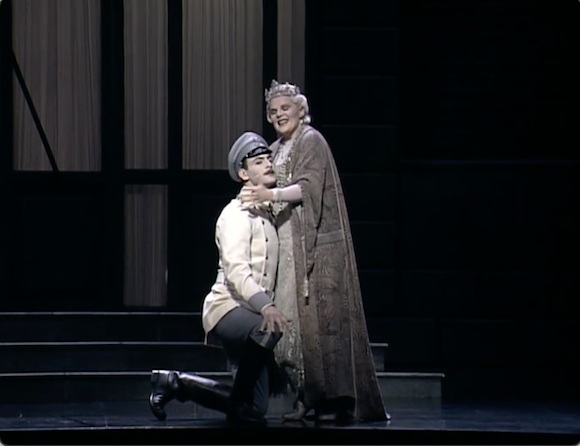
Last night I went back to the Four Seasons Centre to take another look at Christopher Alden’s Rigoletto. I was up in Ring 5 this time so quite a different viewpoint and it was the opening night cast singing. I now have a better understanding, I think, of what Alden is driving at and some of the stage action that was just puzzling first time around made more sense. Certainly the role played by Giovanna (Megan Latham) makes much more sense seen as the count’s procuress. The interpretation of Sparafucile is also interesting; part commedia perhaps and reminiscent of the quack in L’Elisir d’Amore with a sinister twist. If we take as valid Alden’s assertion that Rigoletto’s separation of personal and public life is a delusion then having all the action played out in “public” makes a certain kind of sense, though then I have to ask why, uniquely, the scene where Gilda confesses to her father what we (and he) already know, that she has been debauched by the duke, has to be between the two of them is a bit of a mystery. So, all in all, I still think it’s an interesting and very beautiful but not quite “of a whole” production. I much prefer that the COC take some chances even if not everything comes off 100% and I shall look forward to Mr. Alden’s next production here.
Musically there wasn’t a lot to choose between this cast and the one I saw on Friday. Quinn Kelsey is a very powerful Rigoletto and he was a little more restrained in the acting department than Lester Lynch. All in all a very fine performance. Dmitri Pittas was solid as the duke but I think David Lomeli has a more Italianate sound. Ekaterina Sadovnikova is a rather different Gilda to Simone Osborne. Her voice is lighter coloured and perhaps more classically suited to this role and there were none of the top end insecurities that some commented on on opening night. She did seem a bit underpowered in the duets with Kelsey but was fine singing solo. Once again I was pleased/surprised by how good the sound is up in the nosebleeds.
Bottom line, I still think this is a production worth seeing. The house wasn’t full either night I went and, in particular, there were plenty of seats last night in Ring 5. I got a second row dead centre seat as a “rush” ($22) and there were still OK seats available for that price half an hour before curtain.
Today’s lunchtime concert at the Four Seasons Centre was given by singers from the University of Toronto’s Opera Division. This is described as the university’s programme for professional singers but what that means in a city that has a professional opera company with a young artists programme and a conservatory I don’t quite know. Certainly the standard today was generally below what I’ve experienced from singers at the RCM and not close to the same league as the COC Studio Ensemble. Many of the singers sounded as if they were forcing their voices beyond their comfort zone in an attempt to sound “operatic” but were only succeeding in producing the sort of sound that persuades people they don’t like opera. Enough negativity, let’s turn to the highlights. I thought the best of the singers was baritone Josh Whelan. He stood out in an otherwise undistinguished rendering of the sextet from Lucia di Lammermoor and was very presentable in an excerpt from Menotti’s The Telephone. In the latter he was partnered by soprano Eliza Johnson who was pleasant to listen to in a rather undemanding piece. Mezzo Alexandra Beley and soprano Rosanna Murphy also sang quite nicely in a couple of excerpts from Cosi Fan Tutte though both tended toward scenery chewing which seems out of place in a piano accompanied recital (this seems to be a division characteristic). Once again I was struck by what a wonderful accompanist Sandra Horst is.
I hate to be negative about young singers but, all in all, this was rather disappointing.
Thurday members of the Ensemble Studio are performing French art songs. It looks good and I had planned to go but it now looks like I have a refereeing gig that afternoon. Maybe I can get the lemur to guest blog it.
Last night was the second performance of the COC’s new Rigoletto and the first featuring the alternate leading role trio of Lester Lynch (Rigoletto), David Lomeli (Duke of Mantua) and Simone Osborne (Gilda). The rest of the cast was as on opening night.
Musically this was a really splendid evening. Everybody sang really well. I like Lester Lynch’s idiomatic playing of the title role and he managed to combine a not inappropriate amount of scenery chewing with being thoroughly musical. Lomeli lived up to the “dragged from obscurity by Placido Domingo” hype. I think there is a true Italian tenor emerging here. He nailed his arias with lovely ringing high notes and plenty of swagger. Osborne, on role debut, was lovely. Caro nome was one of the highlights of the evening and ,in general, she sounded very secure across some pretty tough music. The chemistry between the three was pretty good although the production maybe put more emotional distance between Gilda and Rigoletto than is sometimes the case. In any event the voices blended well and seemed well balanced. Among the other roles I was particularly impressed by Kendall Gladden’s Maddalena. She has a really smoky mezzo that created a pleasing contrast with the brighter voices. She’s a pretty fine actor too so it’s easy to see why she gets cast as Carmen! I also liked Philip Ens’ Sparafucile. He was a sinister presence and a genuine bass with a thoroughly solid lower register. All in all, the casting managed to combine very good individual singers into an ensemble that had a really good balance of tone/timbre. The orchestra and chorus were at their usual high standard and Johannes Debus kept things together very nicely and didn’t distract from the singing and I do think this is very much a singers opera.
The production and design (Christopher Alden and Michael Levine) was very decorative. All the action plays out in a lavishly panelled and furnished “gaming room” looking something like the smoking room at one of the better London clubs in the mid/late 19th century. It does duty for the duke’s court, Rigoletto’s home and Sparafucile’s inn. In a sense this creates a kind of unity; all of these spaces are misogynistic theatres of corrupt power and delusion. On the other hand it requires the audience to suspend disbelief more often and more willingly than usual. It’s an odd kind of secret that can be sung mezzoforte in front of the people it’s supposed to be secret from! The male dominated Victorian aesthetic seems to produce a kind of emotional coolness too. We never quite get enough emotional charge in the Gilda/Rigoletto dynamic to fully feel his loss (i.e. I didn’t cry at the end). The final scene though is splendidly and very effectively done.(*)
So summing up, I enjoyed the show. Musically it is first rate. The production was interesting but I don’t think the concept was quite able to carry the piece emotionally. It’s not a disaster and there’s nothing to shock the traditionalist. Maybe if I had seen Rigoletto a million times before I’d be more positive. Go see the show and judge for yourself!
The production runs until October 22nd and there is a choice of the cast we saw or Quinn Kelsey, Dmitri Pittas and Ekaterina Sadovnikova as Rigoletto, the duke and Gilda.
The second Opera 101 of the season took place at the Duke of Westminster last night. The panel were tenor David Lomeli, director Christopher Alden and designer Michael Levine. Once again the event was moderated by Brent Bambury. Alden kicked off with describing his overall concept for the production which he sees as being about how people balance their public and private lives in a world of constraining and essentially corrupt power structures. We got a fair amount about the history of the production which originated with a version in Chicago that got very mixed reviews. Michael Levine also talked about his view that people today see differently from people in Verdi’s time (the argument turns on the relationship between painting and stage aesthetics) and therefore he designs to meet our visual perceptive expectations. Inevitably at this point we got into the perpetual Opera 101 debate about it being all about the singing and can we have our traditional productions back please. It actually was almost a caricature of that debate with Alden saying that if he didn’t get booed he hadn’t done his job. Sometimes I almost (almost!) sympathise with the traditionalists. It’s obvious that the aesthetic Powers That Be really despise them. I suppose I do too really.
Gears changed a bit when emphasis turned to David Lomeli and his discovery as an “unknown” by Placido Domingo. Articulate as Lomeli was (far more articulate than Alden or Levine), it didn’t ring quite true. I think there are genuine discoveries of kids who knew nothing about opera growing up but I’m not sure that can be true for someone whose grandmother sang with Di Stefano and spent seven years as a professional singer at the opera in Mexico City. He was interesting and funny on how he reacts as a singer to different production concepts. As always, I think this boils down to a singer takes what they are given until/unless they become a superstar and then they get to pick and choose. He did do a neat demonstration of how an operatic tenor treats high notes versus how a mariachi singer does. He nearly blew the lid off the pub in the process.
I got to ask Christopher and Michael if there were more obscure or neglected works (rather than reinventing war horses) that they would like to bring to the stage. I was surprised but heartened that they both wanted to do new, contemporary work. Alden said there were a couple of younger American composers he was interested in but wouldn’t name names.
I’m not a huge fan of French baroque opera but I am a huge fan of Robert Carsen which is why I had a look at the DVD recording of his 2003 Paris Garnier production of Rameau’s Les Boréades. I’m still not a huge fan of French baroque but Carsen certainly makes the most of the work on offer.
Berlioz’ Les Troyens is widely considered to be his masterpiece and it does have a lot going for it both dramatically and musically, especially when given the full on star studded treatment that it got at the Chatelet in 2003. That said, it’s dramatically rather odd, it’s very long (well over four hours) and it requires huge forces; twenty soloists, massive chorus, dancers, supers, acrobats, jugglers etc. It also has preludes, ballets and masques on a scale that seem more appropriate to the 17th than the mid 19th century. Act 4 is particularly marked in this respect. It’s perhaps no wonder that it was never played complete in Berlioz’ lifetime. The story is taken from Books two and four of Virgil’s Aeneid; the first dealing with the wooden horse and the fall of Troy (Acts 1 and 2) and the second with the Trojans at Carthage (Acts 3-5). The problem is that there isn’t much connecting them. In the first part the drama centres around Cassandre. By the end of Act 2 she’s dead and we move on to Carthage where Didon makes her first appearance. The Trojan hero Énée links both halves but he’s a pretty minor presence in the first bit.
In Acts 1 and 2 Troy is a sparse stage with a reflector above it projecting much of the action onto a backdrop of an Italianate cityscape of Troy. It’s a good idea as for most of the act there are a lot of people on stage and it’s not easy to take it all in. Occasionally the cityscape dissolves into some kind of symbolic back projection as with the the horse itself which is just a rather grim projection of a horse’s head. It works pretty well. A similar approach is used to introduce the scene where Hector’s ghost tells Énée he’s got to rebuild Troy in Italy. The camera work for the DVD switches between stage and backdrop with the usual close ups and just occasionally pulls back to let us see what the theatre audience is seeing. All in all I think Peter Maniura is giving us as good a look at Yannis Kokkos’ staging as could reasonably be done on DVD.
Vocally, the first part is all about Cassandre, here played by Anna Caterina Antonacci. She’s stunning. She gives a totally committed performance as the prophetess who everyone thinks is mad until it’s all too late. She stands out visually in a simple white dress against the rest of the Trojans who wear greatcoats of mixed military provenance and otherwise look generally scruffy giving an effect somewhere between Colditz and Les Miz. Her singing and acting are both quite mesmerizing. She is well backed up Gregory Kunde’s Énée although he doesn’t have too much to do. He manages to sound like a bel canto singer while upping the heft to cope with some pretty dense orchestration.
Here’s a clip of Antonacci which gives a pretty good idea of the overall idea.
Act 3 involves a total shift of dramatic and aesthetic gear. Now we are in Carthage where Didon (Susan Graham) is presenting the results of the first Five year Plan to what looks like a cross between a Druidic gorsedd and a meeting of the Carthage Soviet of Workers and Peasants. The plan has met its targets but their idyllic existence is threatened by the king of Numidia who wants to marry Didon and is marching on Carthage. Énée appears and offers to save the peace loving Carthaginians (nb these are not the baby burning, general crucifying Carthaginians I remember from history) by doing the fighting for them. This is followed by a longish section where Didon’s sister Anna (the very fetching Renata Pokupić) tries to persuade her that hooking up with Énée would be a smart move. This continues into Act 4 which rather drags. There’s a long, almost Wagnerian, prelude after which Didon enters, obviously head over heels in love. We can tell this from her little interpretative dance and her spending the next half hour looking like a contented hamster watching several ballets complete with jugglers and acrobats.. The entertainmet concludes with singing, dancing Nubians who could have come straight out of National Geographic c. 1950. Finally we get going again and Didon decides that maybe the Énée thing isn’t such a bad idea after all. She and Énée sing the gorgeous duet “Nuit d’ivresse”. Kunde and Graham are very fine indeed in this as you can see below. Both these acts are played out on a brightly lit stage with lots of bright whites and colours.
The act concludes on an ominous note as Mercure reminds Énée of his Italian destiny.
In Act 5 we are back dramatically and aesthetically more or less where we started. It’s dark, Trojans in greatcoats, the reflector. The ghosts of the dead Trojans remind Aeneas of his quest. He decides to obey. Most of the rest of the act is Susan Graham going through a full gamut of emotions; anger, grief, vengeance, resignation. It gets a bit over the top but she is elemental and always musical. Graham steals the show in the final three acts but she is very well supported by Pokupić’s Anna and Laurent Naouri’s Narbal as well as Kunde. Cassandra (or her ghost) get the last word but nobody is going to believe her.
John Eliot Gardiner conducts the Orchestre Révolutionnaire et Romantique. He pushes things along well without sacrificing grandeur at the needed points. The period instruments give some pleasing variation of tone colour. The chorus is the ever excellent Monteverdi Choir. No problems in those departments.
Peter Maniura’s screen direction maintains its high standard through the second half. So what of the disk package? It’s an Opus-Arte production and it was filmed in high definition. The 16:9 anamorphic picture is superb even on DVD (which is what I watched) but it is also available on Blu-Ray which should be even better, especially as the Blu-Ray is cheaper and two discs versus three DVDs. Sound is LPCM stereo or DTS 5.1 (DTS HD on the Blu-Ray). The DTS track is really good with real depth. There is even adequate documentation and an hour long “Making of” documentary. All in all, it’s what an opera DVD/Blu-Ray release ought to be.
Today was the opening concert of the season for the free concert series in the Richard Bradshaw Amphitheatre at the Four Seasons Centre. As has become standard practice it was a recital by the artists of the COC Studio Ensemble. All the members sang except for Ambur Braid who was ill and Ileana Montalbetti is singing in Elektra in Rome at the moment. I have to say it was great to be listening to live, unamplified singing again after a summer of mostly DVDs. I was most interested to hear newcomer Philippe Sly who I had not heard before. He sang one of the Count’s arias from Figaro. He has a very pleasant voice with plenty of power though I think he lacks a bit of variety and drama. He’ll learn that quickly enough in the Ensemble Studio program. The other newcomer was Mireille Asselin, who I had heard before. She sang a rather weird aria from Poulenc’s Les Mamelles de Tiresias. No lack of drama or humour in her performance! The other standouts for me were Adrian Kramer and Simone Osborne. Adrian sang “Mein Sehnen, mein Wähnen” from Die tote Stadt. His diction and acting are superb and he managed an absolutely gorgeous floated pianissimo on the final “Zurück”. Simone gave us one of Norina’s arias from Don Pasquale. She just gets better. She has quite a powerful, rich voice with really strong, sweet high notes. The progress from even a year ago is obvious. She can act too. There is no question that she is one to watch on the opera scene. Fortunately, that’s exactly what I will be doing in ten days time when I shall see her role debut as Gilda in the COC’s production of Rigoletto. The season is off to a good start.
So, continuing my Robert Carsen binge in an especially appropriate manner considering last night’s Iphigénie shindig, I bring you the DVD of Carsen’s 2004 Paris production of Richard Strauss’ Capriccio. This may be even more incoherent than usual as I am reeling a bit, in a good way, from this production.
Last night I went out to the first COC Opera 101 of the year featuring Russell Braun and Susan Graham. I would write about it but my table companion, who was studiously taking notes while I was drinking beer, has done a much better job of it than I would. So go there instead.
I think maybe Handel’s Rodelinda is one for the hard-core Handelians. It’s got some lovely music but it’s long (200 minutes), not very dramatic (it’s based on Corneille) and, structurally, is a succession of recitative and da capo arias. There is no chorus and I only recall two numbers that weren’t solos; the concluding quintet and a rather lovely duo between Rodelinda and Bertarido at the end of Act 2. Jean-Marie Villégier’s 1998 production for Glyndebourne rather tends to emphasise the leaning to elegance rather than drama. The basic look and feel is “silent movie era”. Sets and costumes are near monochrome and that tends to be emphasised by the lighting. At least when there is a any. Much of this production is very dark, as was fashionable at the time.