The Frosch report

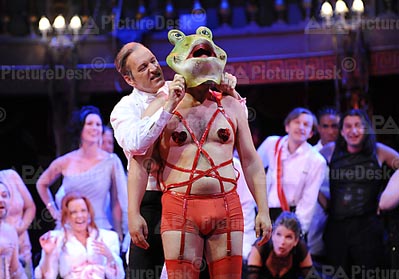
Casting for the upcoming COC production of Die Fledermaus, to be directed by Christopher Alden, was announced back in February with one notable exception. There has been no word on who will take the speaking role of the drunken gaoler Frosch in Act 3.  This part is usually played as a buffoon by a second rate comedian(1) so Toronto mayor Rob Ford would seem an obvious choice.  Unfortunately it’s a speaking part so that rules him out.  Now, apparently, we can expect a ‘crisis of capitalism’ Fledermaus but I’m not sure that leaves me any the wiser.

Continue reading

Well, grrr

I finally managed to get my hands on a DVD of a Tcherniakov production.  It’s a 2008 Berlin performance of Prokofiev’s The Gambler.  It’s also on the usually appalling Kultur label and, true to form, it’s unwatchable.  The sound is very poor Dolby 2.0, on a 2008 recording, stone the crows etc!  Worse the subtitle encoding (English only) is very weird.  My Blu-ray player won’t show them and nor will Apple’s DVD player.  Vlc will play them but sod it it if I’m going to sit in the computer room for 135 minutes with manky sound and a relatively small screen.  Not acceptable at all.  Grrr!

Flashbacks

I’ve been banished from the living room and so the home theatre by the lemur practicing for a dance recital.  As a result I’m listening, on my iPod, to Solti’s recording of The Ring, which I was introduced to nearly four decades ago.  Listening to Das Rheingold again today after a long lay off I’m struck by how utterly brilliant it is.  Gustav Neidlinger’s Alberich is a marvel.  He’s singing lyrically not snarling or barking and it sounds quite lovely.  Solti’s command of rhythm is astonishing.  One could dance to this!  And has John Culshaw’s sound engineering ever been bettered?

Still wonderful as it is it’s having much the same effect as Proust’s madeleine.  I first heard this recording (on vinyl of course) courtesy of the man who taught me Applied Maths for ‘A’ level .  He was a rather sad old chap but he introduced me to Wagner, Quad electrostatic speakers and gin.  He’s long dead of course.  So it goes.

Which way do you dress?

Last night I attended the dress rehearsal of the Canadian Opera Company’s upcoming double bill of Zemlinsky’s A Florentine Tragedy and Puccini’s Gianni Schicchi courtesy of Peter McGillivray who sings Marco in the latter. I’ve never been to s dress rehearsal before and I don’t think it’s kosher to “review” a production based on one so I’m going to concentrate on the “dress rehearsal experience” and just a few notes about the show. Continue reading

Some help from my American friends?

I believe in new opera. I think it’s vital to the survival of the genre and I like quite a lot of it. Most of what I like has come from European or British composers or John Adams. I love Reimann’s Lear and Birtwistle’s The Minotaur and Sariaaho’s L’Amour de Loin.  I’m equally impressed by Nixon in China and, maybe to a lesser extent, Doctor Atomic.  All of these, it seems to me, lie within the range of idiom of contemporary symphonic or chamber music.  I’ve had much less luck finding contemporary American opera, Adams aside, that I enjoy or even find interesting.  I loathed A Streetcar Named Desire and five minutes of Adamo’s Little Women had me reaching for the barf bucket.  It’s a combination of cloying sentimentality and music that sounds like South Pacific minus the good tunes.  It’s certainly not the sort of music one could imagine hearing at a symphony concert. Am I missing something?  What should I try to see if I want to see intelligent, musically interesting contemporary American opera?

Opera 101 – Tosca

Opera 101(I) at the Duke of Westminster last night was more interesting than I expected. Besides the usual host, Brent Bambury, we had the director of the current production Paul Curran, Mark Delavan, who is singing Scarpia, and Julie Makerov, one of two Toscas. Delavan and Makerov were engaging and funny if not specially revelatory though both revealed a taste for country music which is a bit disturbing. Most of the interest came from Curran. He’s an intense little Scot who tells it how he sees it. He grew up in the less salubrious parts of Glasgow (I’m reliably informed that there are salubrious bits!) and the first opera he saw was Wozzeck which he describes as the story of his life. I was struck by his emphasis on the role of the music in his directorial process. He described himself as a “musician first” and talked at some length about his role in making sure that the singers can sing to their best ability. He’s also no literalist. I asked him whether the very specific time and place setting of Tosca was constraining or liberating and he went on a bit of a rant which I loved! He listed off the historical inaccuracies with the Tosca libretto with encyclopaedic accuracy peppered with expressions like “complete bullshit” basically ending up at “so I feel I can do pretty much what I like with it”. He’s also not one for the pretties. He told a story about being criticized because Tosca’s dress in Act 2 was inelegant. His response “It’s a rape scene (F word not far away here we feel). I don’t think she’s asking ‘does my bum look big in this?'”. I liked his take on “Vissi d’arte” as a Jewish aria too. He’s alluding to it’s sense of a contractual relationship with God as opposed to Tosca’s over Catholicism (he’s from a very Catholic family). All in all good value.

We had a brief chat afterwards about Britten, ‘difficult’ operas and stuff. I want to see his Peter Grimes but, unfortunately, Santa Fe isn’t exactly next door.

In a couple or three hours it will back to COC for me for the third time in 24 hours. This time for the 2012/13 season announcement.

fn1. Opera 101 is a pub based series of fairly informal talks by members of the creative team for various COC productions.

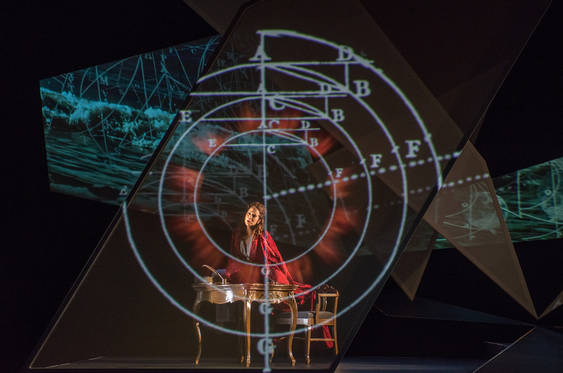
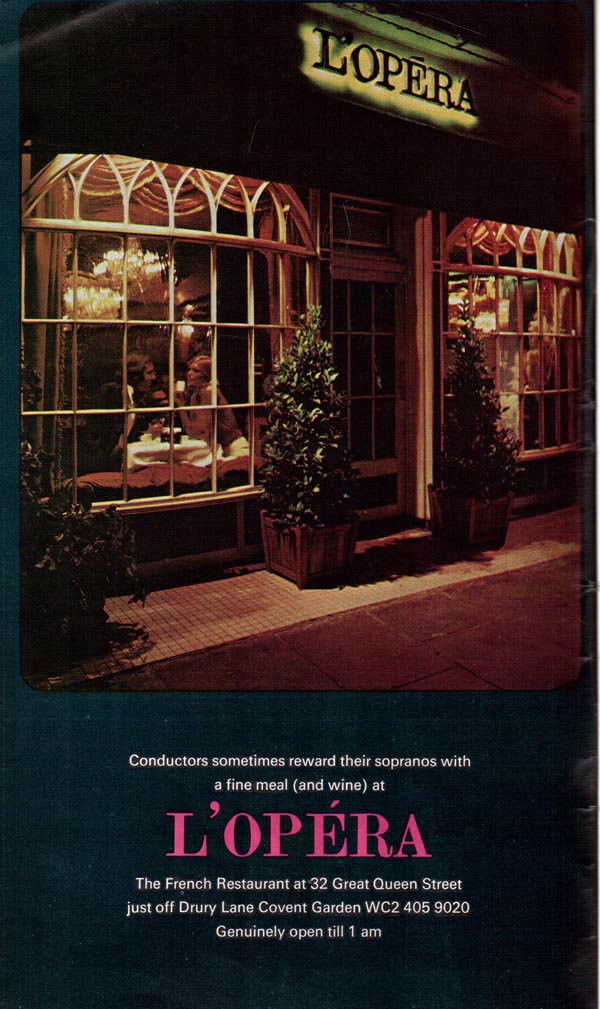
Just for fun 4/n

So, gentle readers, what do you think this image relates to?

ETA: Callum Blackmore correctly identified this as being from We come to the River by Hans Werner Henze. It’s a scan of one page of the Royal Opera House programme for 20th July 1976 when I, as a somewhat bemused 18 year old, saw David Atherton conduct a cast of thousands in that rather remarkable work.