The Giacomo Variations is the latest collaboration between John Malkovich, Michael Sturminger, Martin Haselböck and, posthumously, W.A. Mozart. In that respect it has much in common with The Infernal Comedy. In other respects, not so much. It’s just wound up a six performance visit to Montreal and Toronto and last night I caught the final performance at the Elgin Theatre.
Category Archives: Performance review – miscellaneous
Toronto’s got talent
Recitals at Rosedale is a new venture from collaborative pianists John Greer and Rachel Andrist. There will be four themed recitals, each featuring multiple singers, on Sunday afternoons at Rosedale Presbyterian Church. Last night saw a preview of excerpts from all four programs. Around 200 people showed up on a very hot and humid Saturday evening to see a pretty decent cross section of Toronto’s singing talent. The venue has a typically resonant church acoustic and tends to swallow the words a bit however carefully the singer enunciates but it’s a sensible size, holding maybe 200-300 and so avoids the problem of feeling empty even when there is actually a pretty decent crowd.
The knot is tied – Figaro’s Wedding at The Burroughes
Figaro’s Wedding music by W.A Mozart, libretto by Joel Ivany, opened last night at The Burroughes. A full house, many dressed as if attending a wedding as requested, saw an extremely effective realisation of another ambitious project from Against the Grain Theatre. This isn’t just another low budget production of a well known opera. Figaro’s Wedding is a complete rework of the piece. The music is the familiar Mozart in a very effective piano quintet arrangement by Topher Mokrzewski, albeit with cuts to suit the new libretto, The libretto is in English, cuts the chorus (and Barbarina) and reshapes the story around a wedding in today’s Toronto. Gone are aristocrats, servants and hangers on. Instead we have a young couple – Susanna and Figaro, his boss and boss’ wife – Alberto and Rosina, and the various arrangers and functionaries connected with the wedding. Oh yes, and there’s a lesbian grad student called Cherubino living in Alberto and Rosina’s basement. The story unfolds in a way that’s close enough to da Ponte for the twists and departures to add a little extra amusement for those who know the libretto well. It’s very smart, extremely funny and surprisingly singable.
The Lessons of Love
Last night Toronto Masque Theatre presented a double bill entitled The Lessons of Love. First up was John Blow’s 1683 masque Venus and Adonis and it was followed by the premier of The Lesson of Da Ji; a fusion of Western and traditional Chinese elements by composer Alice Ping Yee Ho and librettist Marjorie Chan.
On the Wing
Last night the Talisker Players and guest artists presented a series of readings and vocal pieces on the theme of winged creatures. It was a very varied programme with the readings, winningly read by actor R.H. Thomson, ranging from Albert Manguel to Peter Matthiessen. The readings also provided time for the set-up to be changed between numbers with minimum tedium.
The music was also very varied, ranging from Telemann to John Plant’s Sandpiper of 2011 with the rest being drawn from 20th century works from Pärt, Copland, Hoiby, Gideon and Foss. The ensemble changed constantly with various combinations of strings, woodwind, piano, continuo and percussion. Continue reading
Ruth
Last night Tapestry and the Wilfred Laurier University Faculty of Music co-presented a workshop of Ruth, a new piece by Jeffrey Ryan to a libretto by Michael Lewis MacLennan. It’s not exactly an opera, perhaps more like one of Britten’s Church Parables. It is quite short; one act of nine scenes, six of which were given in full last night with a read through of the three not yet set. The whole piece lasted maybe an hour. The emphasis is very much on the voices; three soloists and the choir. Last night it was given with piano accompaniment but the composer suggested that it would work for either organ and/or a small ensemble.
Besamé Opera
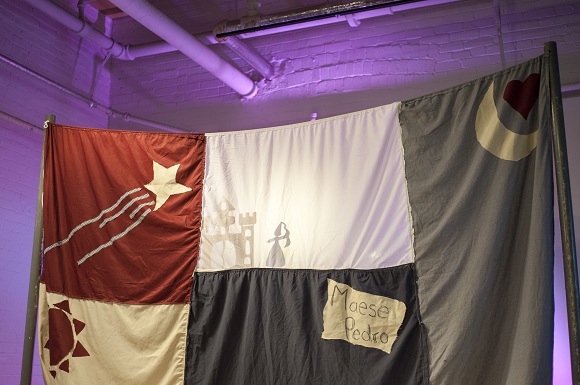
Last night Opera Five staged a double bill of two one act Spanish operas from the first quarter of the twentieth century. The first was de Falla’s El retablo de maese Pedro. This was written as a puppet opera blending a chivalric tale about the days of Charlemagne with an intervention by an increasingly angry Don Quixote. Structurally it’s an interesting piece with the story being told to a quite simple vocal line by the soprano (Rachel Krehm) playing the puppet master’s boy with interruptions by her boss (Conrad Siebert) and, increasingly, by the one man audience, Don Quixote (Giovanni Spanu). In between the action is acted out by shadow puppets accompanied by a a rather lush “soundtrack”. Finally Don Quixote loses patience with the whole thing and tears down the set before going on a rant about the virtues of knights errant and himself in particular. Staged as a sort of children;s game by director Aria Umezawa, it played very well to this company’s strengths. It was well sung, clever, funny, irreverent and enormously enjoyable. Music director Maika’i Nash once again did that thing I find incredible,m impersonating a whole orchestra on piano, this time with some help from Conrad Siebert on various percussion instruments.
Philanthropists in Music
Yesterday afternoon saw the final concert of the season for Off Centre Music Salon; the concert series organised by Boris Zarankin and Inna Perkis at the Glenn Gould Studio. This one, as the title suggests, celebrating philanthropy in music by putting together a concert of works by composers who were supported by patrons. It was very much salon style with many short sets by various combinations of performers. There was some instrumental music; an impressive performance of Khachaturian’s Toccata in E flat minor by twelve year old William Leathers, reprised later on accordion by Michael Bridge. Jacques Israelievitch and Boris Zarankin collaborated on a bravura rendition of Stravinsky’s Suite Italienne and Zarankin and Perkis gave their traditional one piano/four hands performance, this time an arrangement of Beethoven’s Egmont overture, which was received with enthusiasm.
Hell is oneself
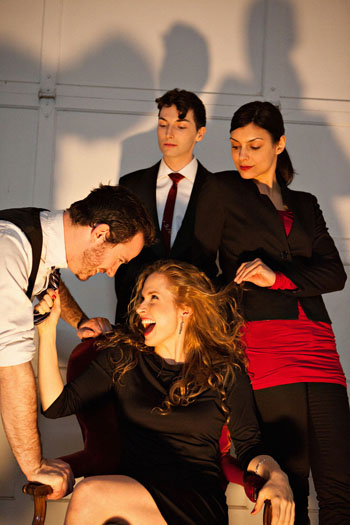
Last night I attended Soup Can Theatre’s double bill of Barber’s A Hand of Bridge followed by Jean-Paul Sartre’s No Exit; an English translation by Stuart Gilbert, of his 1944 play Huis Clos. The latter is a piece I’ve seen before and read in both English and French and I would never have imagined it could be presented as it was last night. It’s a play about three people who find themselves in a room in Hell together. They will be there for eternity, an eternal triangle I suppose, for they have been especially selected to get on each others’ nerves by continually reminding each character of that aspect of their former lives that they find least admirable. I have always seen it as an incredibly bleak play as befits one that premiered in Paris in the last months of the German occupation. I would never have imagined it as a comedy; albeit a dark one, but that’s what director Sarah Thorpe gave us. Continue reading
Smart and sexy Don Giovanni
Last night saw the first of two performances of Don Giovanni by the students of the Glenn Gould School at Koerner Hall. Koerner Hall isn’t the easiest venue to do fully staged opera since it is basically a concert hall with very limited lighting and stage facilities. Ashlie Corcoran and Camellia Coo pulled off perhaps the most inventive staging I have seen there by using a giant staircase to link the part of the gallery that wraps around the stage to the stage itself. Within this basic configuration they deployed a few bits and pieces of furniture, mostly couches. It made a very serviceable unit set for the various scenes. The production was set in the 1960s and seemed to revolve around the basic idea of Don Giovanni as a “chick magnet”. All the usual suspects are clearly attracted to him. There’s no hint of coercion in the opening scene with Donna Anna and Zerlina is a very willing seductee. The idea is reinforced in “Deh vieni” when, as Don Giovanni is serenading Donna Elvira’s maid, five or six women make their way to the staircase and down to the man himself.