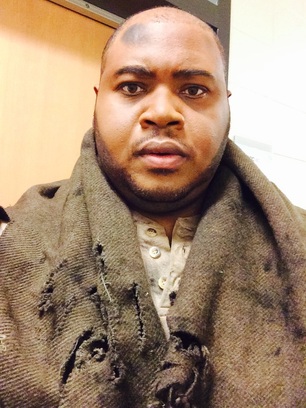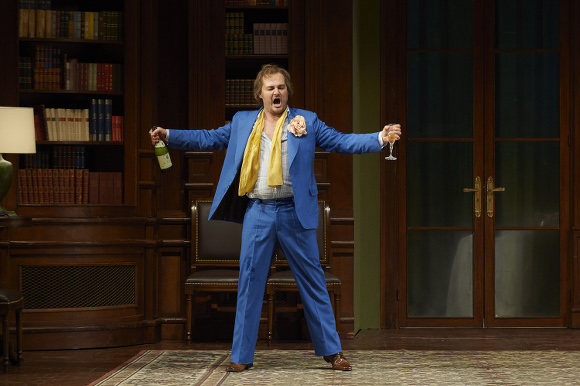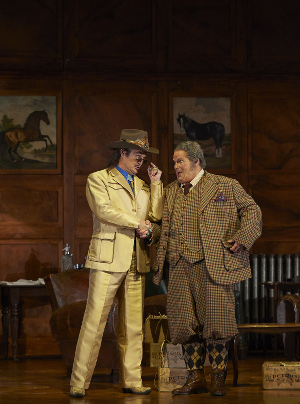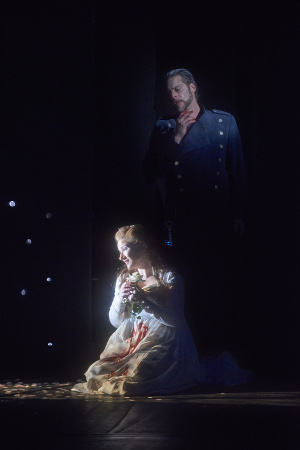
Last night saw the alternative cast for the COC’s Barber of Seville take the stage for the first time. Almaviva, Rosina, Bartolo, Basilio are all changed and, last night, owing to illness Joshua Hopkins was replaced as Figaro by Clarence Frazer which, in turn meant Jan Vakulik sang the Officer.
Category Archives: Performance review – COC
Back to Bartók
I was back at the Four Seasons Centre last night for another look at Duke Bluebeard’s Castle or, perhaps more accurately, another listen. I really enjoyed the production again and I don’t have much to add to my earlier review. It was the music that had much more impact this time. I often find that with “modern” scores I get much more out of them on a second listening and that was true here. First time round I felt so battered by the loud bits, especially the section where the fifth door (Bluebeard’s empire) is opened with it’s extra brass and JohnWilliams on acid crescendos, that my brain somewhat discounted the quieter bits. Last night I was struck mainly by the meditative nature of much of the music. The influence of Débussy, especially Pelléas et Mélisande, seems clear. The little repeating figures for the woodwinds; there’s one that’s usually given (I think) to the flutes and or oboes) and another descending figure in the bassoons, are quite haunting. It’s really quite lovely when it’s not being brutal.
I also appreciated the relationship between Bluebeard and Judith more. This isn’t Perreault’s tale of a brute and an innocent. Gubanova’s rather fierce Judith is running the show. Maybe there is an element of hubris in this Judith. Relyea’s Duke by contrast is almost an observer and commentator; acquiescing in what must be. Some of this, of course, is in the libretto. Bluebeard isn’t killed and Judith shares the fate, whatever it is, of the other wives. But here she seems to do so willingly.
I’m glad I saw this again.
Photo credit: Michael Cooper
Bluebeard’s Castle/Erwartung
Robert Lepage’s 1993 double bill production of Bartok’s Duke Bluebeard’s Castle and Schoenberg’s Erwartung was the iconic director’s first foray into opera and it has been argued tht it put the COC “on the map” as a serious international opera company. It was revived last night with François Racine directing.
A glorious romp
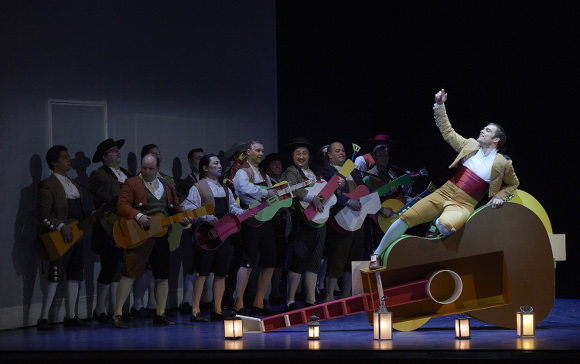
The COC’s new production of Rossini’s The Barber of Seville opened last night at the Four Season’s Centre. The production is by the Catalan collective Els Comediants, the same team who did La Cenerentola a few seasons back, with direction by Joan Font and designs by Joan Guillén. It’s a riot in a good way. It’s bold, colourful and very well choreographed. There are giant props; for example a huge guitar from which Almaviva sings his serenade and a giant pink piano which serves for all kinds of shenanigans. A lot of the “sung action” is doubled by actors in a sort of on stage projection cube. Scene changes are “on the fly” and the curtain only comes down for the interval and the end. Bold, clever, slick.
Siegmund II
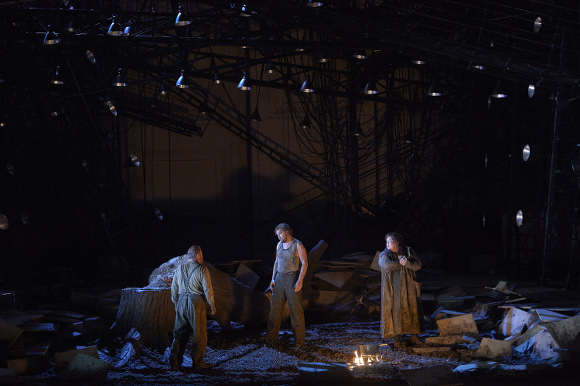
I was back at the Four Seasons Centre last night to have another look at the COC’s Die Walküre. The big news, which I heard pretty much as soon as I arrived, was that cover Issachah Savage would be singing Siegmund in place of an indisposed Clifton Forbis. This time, unlike last Saturday when he also sang, this was very much a last minute call. The reviews and the word on the street, and from my companion for the evening who had seen him in Seattle when he won the International Wagner Competition last year had been very positive so I was very interested to hear him. Clearly word had got out about his Saturday performance because when the announcement was made in the hall there was a curious ambiguous noise not at all like the collective sigh that usually greets such news.
Christine Goerke debuts as Brünnhilde at COC.
Christine Goerke made her stage debut as Brünnhilde last night in Atom Egoyan’s production of Die Walküre at the COC. She didn’t disappoint. It’s a big voice with ringing high notes that ping over the orchestra. No scooping on the high notes either. She’s probably the next great Brünnhilde and that’s probably what last night will best be remembered for. With all the Elektras in her calendar it may also be a a case of “catch it while you can”. The rest of the singing was pretty distinguished too. Johan Reuter was a firm toned, perfectly solid Wotan. Heidi Melton, from beginning to end, was a wonderful Sieglinde to listen to; accurate, sweet of tone (for a dramatic soprano) and almost matching Goerke for power. Clifton Forbis, the Siegmund, still has genuine Helden high notes and was pleasant to listen to. One might have wished for a slightly more ardent approach to the Winterstürme scene but it was more than decent. Dimitry Ivaschshenko was a genuine solid bass Hunding who sounded just right and acted more, and better, than most. Janina Baechle made the most of her cameo as Fricka. The octet of junior Valkyries, made up of mostly younger singers, injected some youthful vigour into the whole enterprise to good effect. Johannes Debus in the pit impressed as a Wagnerian once more with a tightly structured and, at appropriate points, opulent reading of the score. The COC orchestra, always admirable, as so often last night pulled out their best for Johannes. So, admirable music making.
More thoughts on Don Giovanni
So, back at the Four Seasons centre last night for a second look at Tcherniakov’s production of Don Giovanni, this time from the Third Ring. I’ve also been thinking and talking a lot about this production both with people who love it and people who don’t. There’s not a lot of middle ground.
Tcherniakov’s Don Giovanni
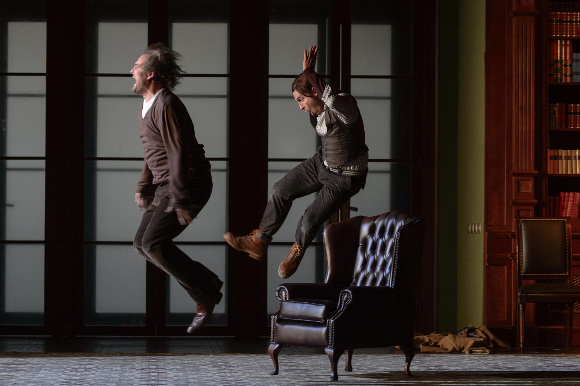
Last night Dmitri Tcherniakov’s much anticipated production of Don Giovanni opened at the Four Seasons Centre. The production is basically a known quantity. This is its fourth run overall and it was recorded for TV and DVD in Aix-en-Provence; which is a lengthy way of saying that nobody should have been very surprised by what they saw last night. Inevitably some were. Rereading my review of the DVD I find I have nothing much to add to what I said there about the first act and the overall concept so I’m going to pretty much going to repeat it here.
The guys have it
Last night saw the second annual Centre Stage at the COC. It’s described as the “Ensemble Studio competition gala”, which is pretty much what it has become. It’s a dressy occasion and busier this year than last. Bussing in the claque from the University of Toronto upped both the noise level and the “beautiful young people” content. The competition itself is fairly conventional in that all the singers get to sing two arias of their choice. What’s a little different is that the accompaniment is the full COC Orchestra and as well as the jury prizes there’s an audience choice award facilitated by some neat electronics. Then of course there’s always the issue of a place in next year’s Ensemble Studio.
Falstaff up close
The nice thing about seeing a production for the the third time is that one can focus on what one wants to because the big picture is already known. After two looks at the COC’s current Falstaff from the Rings I was glad to be able to see it from closer up and this time I also remembered my opera glasses. The details in the production and the Personenregie are really amazing. In the scene where Fortuna is offering gifts to Falstaff, the five cases of wine are Pétrus. In a way that’s doubly funny because although Pétrus is typically the most expensive Bordeaux today it was relatively unknown in the 1950s. My 1970’s copy of Hugh Johnson’s The Wines of Bordeaux talks of how, if he lived in France, he would certainly cultivate a number of petits fournisseurs in the relatively unknown and undervalued Pomerol appellation! Anyway, back to Falstaff. The money in the suitcase of money is clearly US currency. Nice touch. The ornaments in Mrs. Ford’s 1960s chic kitchen are hilarious. I particularly liked the glass elephants. The antics of Pistola and Bardolfo also came more sharply into focus. They nick anything that’s not nailed down. Are we sure Falstaff is from Norfolk not Liverpool? The handbag snatch in the restaurant scene is especially good.
The other thing I noticed was how much fun the audience was having. There was none of the “opera is SRS business” vibe going on. Rather, much unaffected laughter and laid back enjoyment. We could use more of that. So when do we get Gerry Finley back?