The Met’s Peter Grimes

I liked the 2008 MetHD broadcast of Britten’s Peter Grimes enough to buy the DVD as soon as it came out. After something of a hiatus I just watched it again.

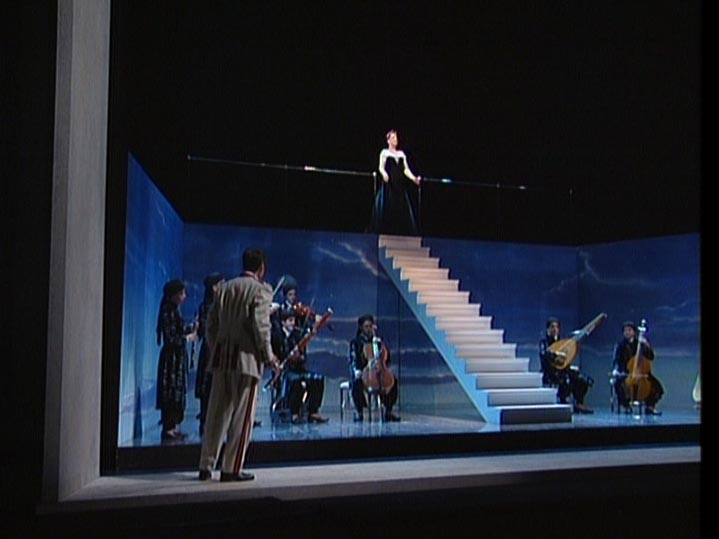
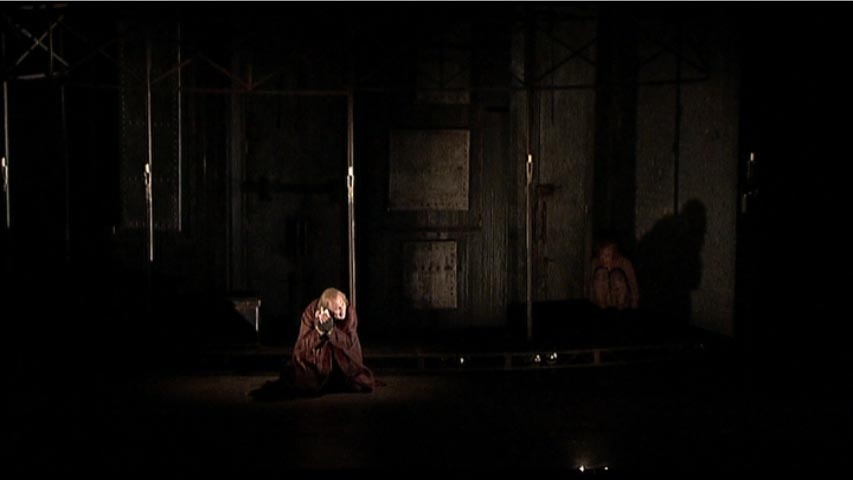
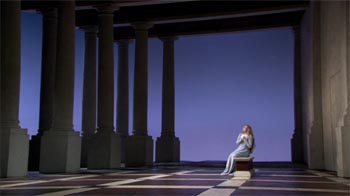
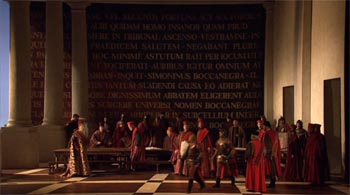
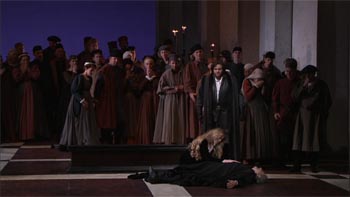
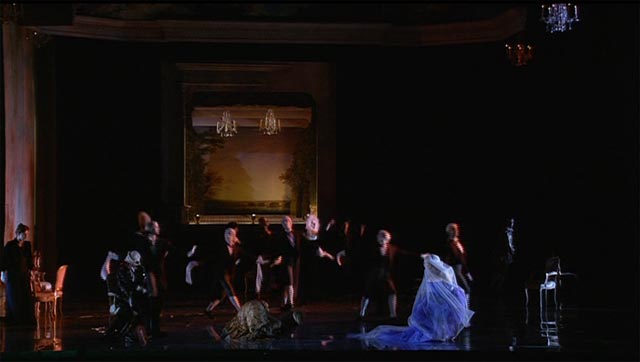
It’s an odd production. The director (Tony award winning – run for the hills) John Doyle, was the first to use, I think, what has now become a Met cliché; a wall with windows running the whole width and height of the set. In this case it can be moved forward and back but mostly it’s forward compressing the depth of the stage. The idea is to convey the claustrophobic nature of the Borough which is fair enough but mostly what it does it confine the enormous chorus to a space it barely fits in meaning there are few options but to have it face straight forward in serried ranks and sing. To be fair, there are scenes where it’s very effective; the opening inquest scene for example and “Peter, we’ve come to take you home” in Act 3. It’s much less successful in, for example, the pub scene. The production is also very dark. This always bothers me because despite eating vast quantities of carrots my night vision isn’t great. I don’t really get it.
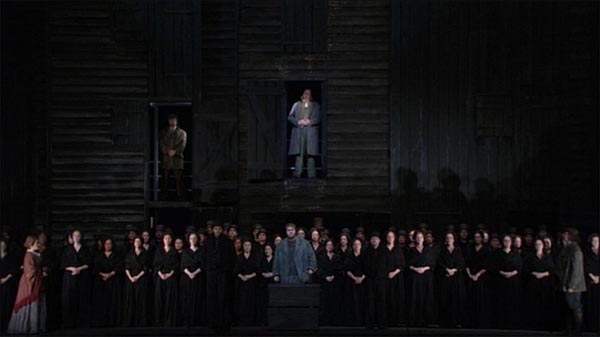
Dark as a metaphor is pretty blatant and comes at a heavy cost in terms of the production’s ability to convey anything else. Only at the end, in the final chorus, is the wall removed and the stage lit less funereally. The sea interludes are played out in front of a blank wall. No effort is made to give them visual accompaniment. The “wall” and the naked Interludes both tend to banish the sea from the production. There’s really no sense that the Borough is a fishing village and therefore the whole role that the sea plays in the psyche of people who make their living from it is lost.

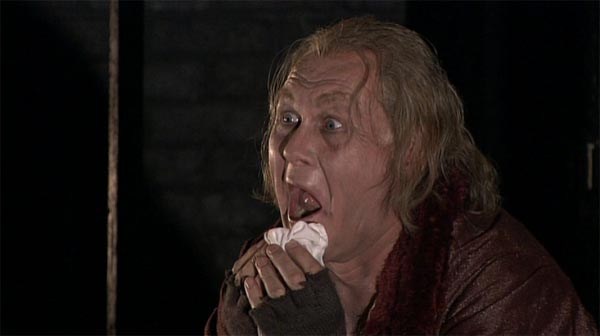
The video director, Gary Halvorson, appears either to hate the production or think that the cinema/DVD audience is too thick to get it because he relentlessly undermines it. Unable to present the dark, stark stage that Doyle has called for he gives us a compilation of super closeups and really weird camera angles; pointing up from the side of the pit, pointing down from what looks like the cheapest seats at the outermost edge of Ring 4 and so on. He also can’t accept that the director doesn’t want to distract from the music during the Interludes so we get a succession of close ups on audio members and, more especially, on conductor Donald Runnicles. This is particularly unfortunate as Runnicles conducts like a hyperactive and self regarding pterodactyl.
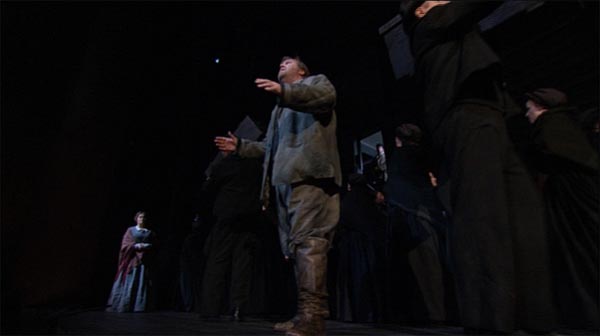
The above got over with there’s much to like in this DVD set. The performances are generally very good. Tony Dean Griffey is a highly effective Peter Grimes as well as singing very well. He’s close to Peter Pears in his almost dreamy interpretation. He lacks the intensity of Langridge or the brutality of Vickers but its a valid and compelling portrayal. Anthony Michaels-Moore almost steals the show as Balstrode. This is surely the best take on the role since Geraint Evans. The sense that he’s the one man who really wants to help Grimes but knows when enough is enough is overwhelming. There are good performances in the other male roles especially from Teddy Tahu Rhodes as Ned Keene. The women are more of a mixed bag. I still can’t really get into Patricia Racette’s Ellen Orford. She acts well and is sometimes very lyrical but at other times she seems shrill and her vibrato too much for my taste. The Auntie of Jill Groves though is really good. Even toned and with a suitably cynical but not unkind persona she nails the role. The Mrs. Sedley of the timeless(1) Felicity Palmer is also quite excellent. She’s acid without being unmusical and not at all caricature like. Donald Runnicles takes things at a generally rather leisurely pace which makes the first act in particular drag a bit but the tension does build and there’s no disputing the beauty of the orchestral playing. The chorus is excellent throughout.

Technically it’s a typical DVD transfer of a MetHD broadcast. The picture quality is very good and the DTS 5.1 sound is excellent (LPCM also available). There are subtitles in English, French, German, Italian and Spanish. There’s a track listing, synopsis and unhelpful essay printed in English (French and German versions in PDF on the disk). The interval features are typical but livened up a bit by Natalie Dessay who seems more willing to go off script than the other Met regulars (probably why she no longer seems to appear).

Bottom line, it’s good but I’m still searching for the ultimate DVD Grimes.

fn1 timeless as in I saw the, then, Ms. Palmer sing Pamina the month after I saw Vickers sing Grimes in 1975

The Infernal Comedy

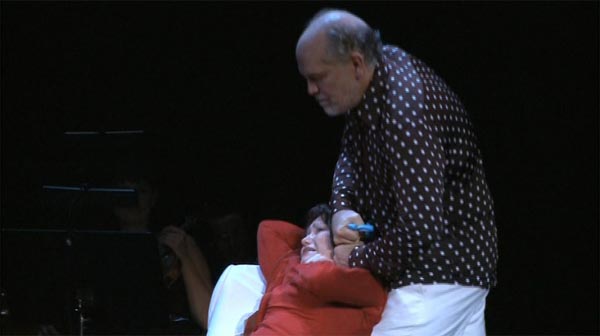
The Infernal Comedy: Confesions of a serial killer is a “Drama for one actor, two singers and orchestra” based around the story of real-life serial killer Jack Unterweger. It features John Malkovich, Laura Aikin, Aleksandra Zamojka and the Wiener Akademie under Martin Haselböck. It was written and directed by Michael Sturminger and filmed in front of a live audience in Vienna’s Kronacher Theater in 2009. It’s a really creepy piece in which Malkovich plays the dead Unterweger on a book tour promoting his posthumous memoirs. Unterweger’s string of anecdotes, puzzles and philosophising is punctuated by arias from the two sopranos from works by Vivaldi, Mozart, Weber and others on the theme of women’s mistreatment by men. During much of this Malkovich is portraying the humiliation and murder that Unterweger inflicted on his victims on the two singers. This is probably the only chance, short of a Stefan Herheim production, that you’ll get to see Laura Aikin strangled with her own bra. It’s really creepy.

The performances are really good. Malkovich, of course, is that rarity; a Hollywood star who can actually act.  Not only does act, and very well, he does it with an Austrian accent.  He is very convincing as Unterweger.  Some of his angry outbursts are really quite terrifying.  The girls sing really well and are totally committed to doing what they have to do on stage, which largely consist of putting up with considerable indignities from Malkovich/Unterweger while still managing to sing. The orchestra, on period instruments, sounds just right. The whole thing is very well filmed and has really good DTS 5.1 sound (DD 2.0 and 5.1 as well). The English subtitles for the arias are a bit odd. I have no idea what “I encore you to Lethe’s opposite bank” means! There’s a 45 minute “making of” documentary on the disk as well but it’s not very illuminating.

All in all, well worth a look.

Giulio Cesare in Australia

Opera DVDs from Australia are as rare as Canadian ones and for the same reason. The national broadcaster’s approach to the arts would put the Philistines to shame so opera broadcasts from which DVDs can be produced are passing rare. The one under review here is a 1994 production of Handel’s Giulio Cesare from the Sydney Opera House.

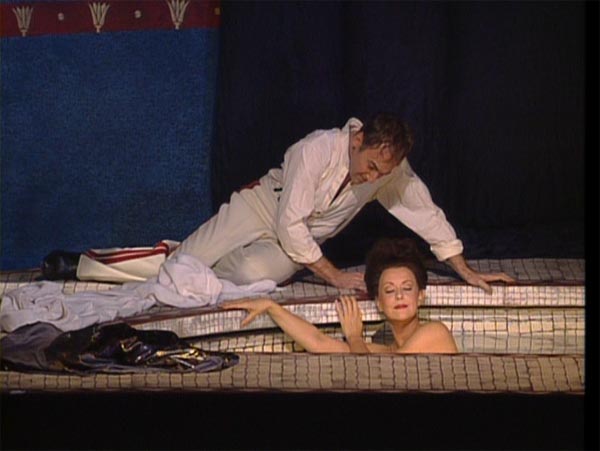
There’s a lot to like about it. The stage production by Francisco Negrin is fairly conventional but attractive to look at and contains some very effective touches. He makes good use of an apron in front of the pit and he uses the rather minor character of Nireno to some effect as a sort of silent chorus on the action. Costumes are sort of 1900ish with odd touches like breastplates and Egyptian dancers and supers in white body and face make up. Sets are mostly simple with typical Egyptian iconography. Cleopatra is naked in her bath when she receives Caesar which would probably be too much for the more staid North American houses today, let alone twenty years ago. The choreography by Gregory Nash makes very effective use of a talented group of dancers. Best if all from the point of view of watching on DVD the video direction by Peter Butler is very respectful of Negrin’s intentions and gives us a real good view of all of the action.

On top of that there is some excellent singing especially by Graham Pushee in the title role. Not everyone likes to see a countertenor in this role but Pushee makes a good case for it. He’s fuller toned than most and has excellent control of his coloratura and ornamentation. He’s also a very good actor. Overall, he may be the best in this role that I have seen. The Tolomeo of Andrew Dalton makes a good foil. He’s a reedy, nasal counter tenor of an older type but that works quite well for the weak and scheming character he portrays. The Achilla of Stephen Bennett is also top notch building to a fine climax in Act 3 with “In tal’ modi si premia”. Rodney Gilchrist as Nireno doesn’t have a lot to do vocally but he’s present and contributing so much of the time that he deserves a special mention. The orchestra under Richard Hickox uses modern instruments but doesn’t go heavy or mushy.

I was initially somewhat ambivalent about Yvonne Kenny’s Cleopatra. I’ve got used to this role being sung by much younger singers than the 44 year old Kenny and it has to be that she looks and sounds very mature for Cleopatra. That said she sings with great gusto and bold coloratura. She acts well too but she does struggle a bit to be the sex kitten who seduces the stuffy Caesar. Despite this by the third act and, especially, her really committed “Da tempeste il legno infranto” I was pretty much won over by her sheer enthusiasm. There’s something of the same problem with Rosemary Gunn’s Cornelia. It’s hard to think of Ms. Gunn as the bombshell who has half of Egypt lusting after her, despite a pretty decent performance overall..

What’s not to like? Not too much really. Elizabeth Campbell’s Sesto is a bit shrill and generally not very convincing dramatically. The biggest negative though is the technical quality of the disk which scarcely does justice to Butler’s efforts. The sound, Dolby 2.0, is OK but the 4:3 picture really isn’t all that great. There’s no way one can fit 207 minutes of opera onto a single DVD9 and have great video quality. 4:3 doesn’t help either as the stage is the sets are wide but not very high (so I guess an extra bonus point for avoiding the close up trap). The subtitles are English only and the documentation is limited to a chapter list. Bottom line, a good effort rather spoiled by el cheapo production for disk(1).

This version does have the merit of being inexpensive but it’s up against strong competition from Copenhagen and Glyndebourne. Both houses offer much more recent productions at much higher technical quality. At a price.

fn1. This performance appears to be available in a different package outside North America. It has Dolby 5.1 and DTS sound tracks and, I suspect, is spread across two disks. Certainly the track numbering n the version I watched and the way it behaves if played with vlc suggests two VIDEO-TS folders crammed onto one disk.

From corpse to corpse

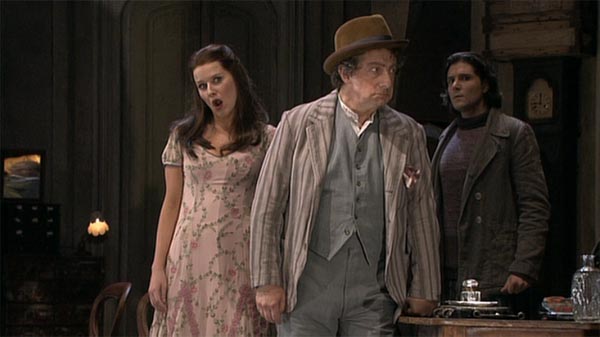
I managed to get my hands on the DVD of the Gianni Schicchi that formed the second half of the evening’s entertainment with The Miserly Knight that I reviewed yesterday (Glyndebourne 2004). It’s the same creative team of Jurowski and Arden and they reinforce the end on a corpse, start on a corpse symmetry by using the aerialist Matilda Leyser as the corpse in Schicchi. Both Jurowski and Arden stress the dark side of the work in interviews but to be honest it comes off here more as a madcap comedy. Perhaps that was inevitable when following the very dark and enigmatic Rachmaninov piece. It’s set around the time of the work’s composition and a unit set with balcony and bed and a cupboard to stuff the body in serve throughout. It’s workmanlike and effective. The blocking is very precise and effective. After all there are at least eight characters on stage throughout this piece. Arden moves and groups them with precision and my only beef is that (surprise) we miss much of her careful work because of closeupitis.

The performances are excellent. Alessandro Corbelli is superb in the title role confirming my opinion of him as one of the great comic baritones. The acid aunt Zita is wonderfully played by the seemingly timeless Felicity Palmer and the rest of the family back her up strongly with excellent ensemble work. Sally Matthews as Lauretta and Massimo Giordano as Rinuccio are the romantic interest and they are both good. Matthews manages a version of O mio babbino caro that is lovely to listen to and spectacularly insincere. She also acts very well and looks the part. Giodarno has a lovely Italianate tenor voice, acts well and is also most pleasant to listen to. Jurowski handles the score well building to some impressive climaxes where required, for example in the scene where the family are imagining all the good things the monks will get to eat from Buoso’s legacy.

The video direction isn’t as egregious here as in the Rachmaninov but it’s still annoying. The scene where Schicchi is preparing to impersonate Buoso is particularly irritating. Technical details and standard of execution are the same as for the Rachmaninov. The interviews with Jurowski, Arden and Corbelli are also equally good. I could listen to Jurowski talk about music and its relationships to other art forms and social developments for a long, long time. Just a reminder that this is also available as a double bill with the Rachmaninov on Blu-ray as well as separately on DVD.

It will be interesting to see how this compares to the upcoming COC production which will be paired with the very dark Eine florentinische Tragödie by Zemlinsky from Wilde’s play. It has a starry cast, Sir Andrew Davis conducting and Catherine Malfitano directing so we may be in for a treat.

A Knight to remember

Rachmaninov’s The Miserly Knight is a very strange one act opera and it isn’t often performed. A production by as cerebral a creative team as Vladimir Jurowski and Annabel Arden looks like a very promising idea so I was very intrigued to see what they made of it in this 2004 Glyndebourne recording.

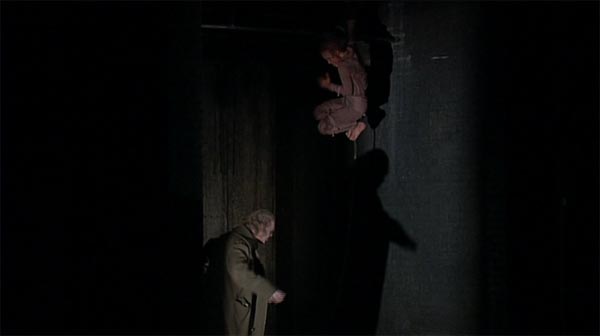
This work lasts only a little over an hour and is split into three scenes which scarcely relate to each other. In Scene 1 a young knight laments that he can’t keep up his social position on his meagre allowance. A Jewish moneylender refuses to extend further credit but suggests that he can provide the knight with poison if he wants to do his old man in. The knight refuses. Act 2 consists of a monologue in which the father, the Miserly Knight of the title, rhapsodizes over his six chests of gold in a fairly overtly sexual way for twenty five minutes. In Scene 3 the Duke orders the father to make an appropriate allowance to his son. The father refuses ultimately claiming, ironically, that his son is trying to poison him. The son rushes in and denounces his father. They have a row and the father drops dead. End of story. All this takes place to an incredibly complex score full of leitmotivs. In a real sense the orchestra is the main character, functioning as Chorus in the original Greek sense. How to bring some sense of the dramatic to this is no mean problem. Arden’s solution is to embody Greed in the form of an aerialist who is present whenever the father is present. This seems like a great idea and on the odd occasion the video director lets the DVD audience see the interaction between Greed and the father it seems to work. Unfortunately the video director, Franceska Kemp, is even more wedded than most of her ilk to superfluous close-ups and so most of Arden’s intelligent work is lost on us.

Musically this is pretty impressive. The music is not typical Rachmaninov. There are no big tunes and it looks forward to the musical language of early Schoenberg or Bartok as much as it looks back to Wagner and Tchaikovsky. In other words it’s an uncompromising early 20th century score. Jurowski gets this and conjures up superbly detailed and incisive playing playing from the London Philharmonic. He’s backed up by an excellent cast of singing actors. The star, clearly, is Sergei Leiferkus as the father. He manages a part that is usually cast for a bass but goes uncomfortably high for most basses. He can sing the music and he brings an absolutely revolting quality to his quasi sexual monologue about money and power. He’s amazing. The rest of the cast are more than adequate. I particularly liked Albert Schagidullin’s powerful baritone as the Duke. Richard Berkeley-Steele, Maxim Mikhailov and Vyacheslav Voynarovsky are solid as the young knight, the servant and the moneylender. Matilda Leyser is the aerialist portraying Greed. What little we see of her is impressive but I really would like to see much more.

Video direction aside this is pretty impressive as a DVD package. The DTS 5.1 soundtrack is superb (LPCM stereo also available). The picture is also excellent. There are French, German, English, Italian and Spanish subtitles. The extras on the disk include very useful interviews with Jurowski, Arden and Leiferkus as well as a quick look at the Gianni Schicchi with which it was paired at Glyndebourne. The documentation also includes a couple of essays that are worth reading. There’s also a Blu-ray release that includes both The Miserly Knight and Gianni Schicchi.

This is the only currently available video recording of The Miserly Knight so I think it’s worth a look despite the dreadful video direction. If that had been done properly I think this would likely have been really impressive.

Domingo’s Boccanegra

Simon Boccanegra was the work that persuaded me that maybe I did like Verdi after all. It’s a terrific score and if the plot isn’t without it’s artificialities it’s full of strong characters and strong emotions which Verdi brings to life with fabulous orchestral and vocal writing.

The most recent DVD version to appear is of the 2010 Royal Opera House production that was broadcast live on the BBC. It features Placido Domingo in his baritone incarnation in the title role. There’s a strong supporting cast with Ferrucio Furlanetto as his arch enemy, Fiesco; Jonathan Summers as the villain, Paolo; Joseph Calleja as the young rebel, Gabriele Adorno and Marina Polpavskaya as Boccanegra’s “lost” daughter, Amelia/Maria. The singing and acting are generally very strong. Placido is, of course, terrific. What more can one say? Furlanetto is a strong foil; excellent in both the prologue and the crucial final scenes. Summers is more than adequate though I might have hoped for more of a frisson when he curses himself. The real star for me is Calleja. He has a gorgeous voice and can float out a lovely pianissimo. His big aria early in the second act is particularly good but he is excellent all through the piece. The one weak link is Poplavskaya’s Amelia. It’s not bad. She acts well and looks the part but one really wishes for more beauty of tone. Pieczonka, in the Met HD broadcast, was much closer to the required vocal quality. Ensemble work throughout is excellent and there are some big set pieces! Antonio Pappano conducts brilliantly. He gets really good playing from the orchestra which is pretty crucial as there are some cruelly exposed woodwind and brass lines. He manages drama and urgency while still giving the singers room to do their thing when they need it. All in all, this is musically very satisfying.

The production, by Elijah Moshinsky, is pretty conventional. It’s a period setting with simple designs that suggest renaissance paintings. There are a few nice touches like the graffiti on the walls in the exterior scenes but mostly the look is just undistracting. There’s nothing beyond the text in the way the story is told either. Blocking is fairly basic and there’s a fair bit of “park and bark”. One senses that Moshinsky’s efforts have gone into character development rather than in trying to make any bold statement.

Sue Judd directed for TV and video and it’s a conventional TV view with too many close ups. She needs to watch some of François Roussillon’s recent work. We also get little chats from Pappano between scenes. These probably work OK first time through but I think would get pretty tedious on repeat viewing. There are short bonus features on  WorshippingWorking with Placido Domingo and Rehearsals with Elijah Moshinsky. The technical quality is very good. It was filmed in HD and the picture is clear and detailed. The DTS 5.1 sound is really excellent; detailed, very spacious and coping very well with the more congested passages. There is also LPCM stereo. This really deserves a Blu-ray release but it’s on EMI who so far seem not to have gone that route(1). There are English, French, Spanish, German and Italian subtitles. The documentation is missing from my library copy but apparently contains a track listing, synopsis and “notes”.

This is definitely worth a look and it will be very interesting to do a detailed “compare and contrast” if I can get my hands on the Sony DVD release of the 2010 Met HD broadcast with Domingo, Morris, Giodarno and Pieczonka.

fn1. EMI was recently sold to Universal; parent of Deutsche Grammophon, and Decca so I suppose anything is possible.

Searing Kat’a Kabanová

The searing intensity of this 1988 Glyndebourne recording of Janáček’s Kat’a Kabanová overcomes a rather indifferent DVD transfer to great effect.

The production by Nikolaus Lehnhoff focuses on the inner emotions, or lack of them, of the principal characters especially Kat’a and the Kabanovicka. This focus is greatly aided by the simple but colourful semi-abstract sets that bring to mind Chagall or Kandinsky in their bold use of colour. The execution of the concept is first class. Nancy Gustavson, in the title role, gives a quite breathtaking portrayal of a mental breakdown, especially intense in the confession scene. She also sings quite superbly. Felicity Palmer as her mother in law is as chilling as one could possibly wish, nowhere more so than in the final scene as she walks away from Kat’a’s body. The Varvara, Louise Winter, the facilitator of Kat’a’s fatal affair, brings some real charm to what would otherwise be pretty unrelentingly grim.

The men have less to do and the only real stand out is bass Donald Adams as Dikoj. His scene with Palmer is oddly compelling in a revolting sort of way. The other men are perfectly adequate but it’s the women who carry the show here. The other real star is the LPO under Andrew Davis. This is a hell of a score and Davis, wonderfully supported by his players, makes the most of it. I just wish the sound quality had been better.

The production for DVD is adequate. Helped by the small stage of the old theatre at Glyndebourne video director Derek Bailey lets us see what is happening and only in Act 3 does he get a bit close up happy. All in all it’s not a bad job for a 1988 TV broadcast. The picture is tolerable. It’s 4:3 with hard English subtitles. As all 100 minutes of the opera are crammed onto one DVD5 it’s perhaps surprising it’s as good as it is. Sound is Dolby 2.0 and again “adequate” is as good as it gets. There are no extras or documentation beyond a chapter listing. The european release on a different label may be a little less Spartan.

Technical reservations aside, this is well worth seeing.

Well conceived and executed Cosi Fan Tutte

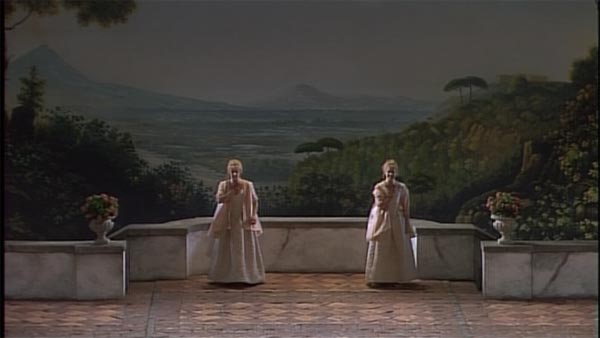
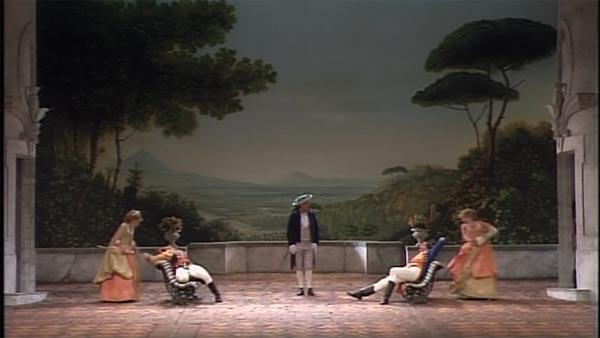
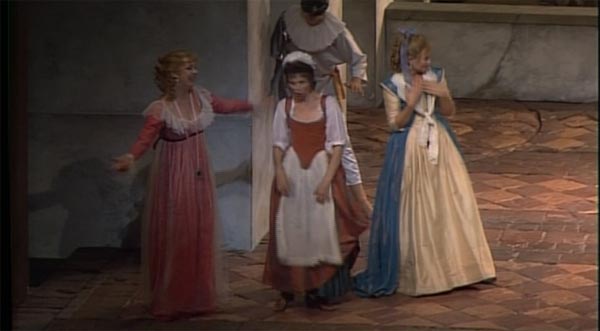
John Eliot Gardiner’s 1992 Cosi Fan Tutte is, on the face of it, very similar to the Il Nozze di Figaro he recorded the following year. Both feature period costumes and sets and no attempt is made to hide that these are stage productions in a theatre (the Châtelet). Both productions feature young, attractive singers of talent drawn from Gardiner’s orbit. However , where the Figaro seems devoid of original dramatic ideas, the Cosi is more densely constructed. Gardiner produced this himself and although he leaves the detailed stage direction to Stephen Medcalf the concept is clearly his. He sees the piece being largely about the development of the two sisters from essentially undifferentiated stereotypical unmarried girls of their class in Act 1 into fully self aware adults in Act 2. He roots this interpretation in the score arguing that Mozart wasn’t even sure which of the girls he was writing for in the first act. To support this concept he casts two similar sounding sopranos. To cast a mezzo as Dorabella is, says Gardiner, “a 20th century aberration”. In Act 1 they are dressed identically transitioning in the final scene to mirror images of each other. In Act 2 they are visually fully differentiated. This overall idea is backed up bu careful direction of the singers and painterly sets evoking the Bay of Naples. Good use is made of the auditorium as well as the stage especially in Guglielmo’s Act 2 aria “Donne mie, la fate a tanti”. So, it’s pretty to look at but there’s a good deal more to it than that.

Musically it’s of the highest quality; at least if you like period instruments in Mozart and I do. From the very first bars of the overture; taken at a pretty fair lick, I bounced to the spritely sound of the English Baroque Soloists. The singers are excellent. Amanda Roocroft is Fiordiligi and she manages a vocally sure but psychologically conflicted “Come scoglio” with aplomb. She also sings a really lovely “Per pietà”. Rosa Mannion is not far behind as Dorabella though, of course, she has rather fewer opportunities for display. Rainer Trost is a wonderfully lyrical Ferrando with a lbeautiful rendering of “Un’aura amorosa”. Rodney Gilfrey is a muscular, even macho, Guglielmo. Mezzo Eirian James plays Despina and is more convincing than many in that role especially in the doctor/attorney scenes. She’s the scheming maid to the life. Don Alfonso is played by baritone Claudio Nicolai and he’s much lighter voiced than is usual for the role. This fits with an interpretation that is nuanced rather than buffo. Ensemble work is consistently excellent.

Peter Mumford directed for DVD. I think this was specifically recorded for home use rather than for TV broadcast and, for the era, it’s really good. He uses some unusual camera angles but never gratuitously and we can see what we need to see to understand the production. There are a few moments of gratuitous artsiness with head shots fading to backdrop and so on but it’s not really troubling. The picture is 16:9 and good DVD quality though not on a par with true modern HD. The production was recorded in stereo but DGG have worked some digital wizardry to produce Dolby 5.1 and DTS 5.1. The DTS is pretty vivid and well balanced. The only extras are some trailers for other Gardiner Mozart recordings. The documentation includes an interesting essay by Gardiner. There are English, German, French, Italian , Spanish and Chinese subtitles.

All in all, this is well worth seeing for anyone interested in HIP versions of mozart or just looking for a solid, undistracting well played and sung version. It won’t do much for the Regie fans though.

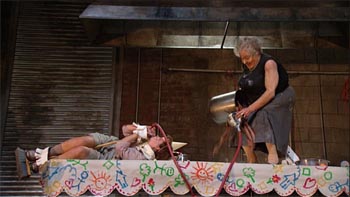
Starvation, drugs and child abuse? It must be Christmas

Humperdinck’s Hansel and Gretel was one of the earlier “Live in HD” broadcasts from the Metropolitan Opera and has been out on DVD for some time. The newness of the concept is immediately apparent in Renée Fleming’s almost awed tone as she introduces the work. She certainly sounds more blasé these days. Hansel and Gretel, given here in David Pountney’s English translation is an odd work. The libretto is much more than a Disney fairy tale. There is poverty, hunger, drunkenness, threats of beatings and murder. There is also a layer of religious sentimentality so thick it could only be 19th century and German. The score is astonishingly heavyweight given the subject matter. Humperdinck worked with Wagner and that is very, very apparent in this piece.

Unsurprisingly, modern directors have tended to emphasize the darker side of the work and Richard Jones is no exception. Hunger is the driving force here and each act is set in a kitchen. A poor peasant cottage in Act 1, a dream like banquetting facility in Act 2 and the Witch’s nightmarish cake factory cum kitchen in Act 3. Much food is thrown around and smeared over people. It’s pretty succesful as a concept if a bit one dimensional.

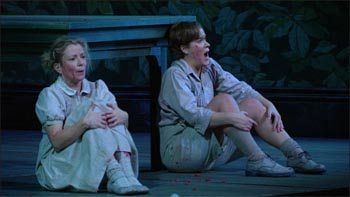
The performances are spectacular and based on some serious luxury casting. Alice Coote and Christine Schäfer as Hansel and Gretel are terrific, especially Schäfer. It’s a wonder to me that a beautiful and elegant woman like her can do grubby so well but she nails it every time (Cherubino in Salzburg, Lulu at Glyndebourne) and this is no exception. Alan Held is a booming father; as big in voice as he is in stature. Rosalind Plowright doesn’t sing prettily but she is utterly convincing as the depressed, shrewish, drug addled mother. Then there is the much missed Philip Langridge camping it up as the Witch. He’s like an incredibly messy Julia Child on speed. He’s hilarious. Sasha Cooke plays the Sandman and Lisette Oropesa plays the Dew Fairy complete with washing up joke. Vladimir Jurowski conducts the Metropolitan Opera Orchestra as if he was conducting The Ring and they play beautifully for him. The very well drilled Met Children’s Chorus also get a look in in the final scenes. Overall, the performance has a high degree of integrity and very high musical values. It’s a good bet for this work which I still can’t really bring myself to like.

Technically this is what you would expect from a Met “Live in HD”. No video director is credited (so far as I can tell) but it’s got about the usual quota of super close ups, including a completely gratuitous foot shot, which is actually a bit odd as the sets for Acts 1 and 2 are basically confined to a thirty foot cube so it would be easy to encompass the whole picture. The picture quality is good, not stunning, DVD standard. The DTS 5.1 soundtrack is excellent and is particularly good at bringing out the very precise orchestral playing. There is also LPCM stereo. It has the usual HD Broadcast extras. There are English, French, German, Spanish and Italian subtitles. The documentation (English only) includes track listings, a synopsis and a short essay. There is additional information in English, French and German in a PDF on the disc itself.

David Alden’s Ariodante

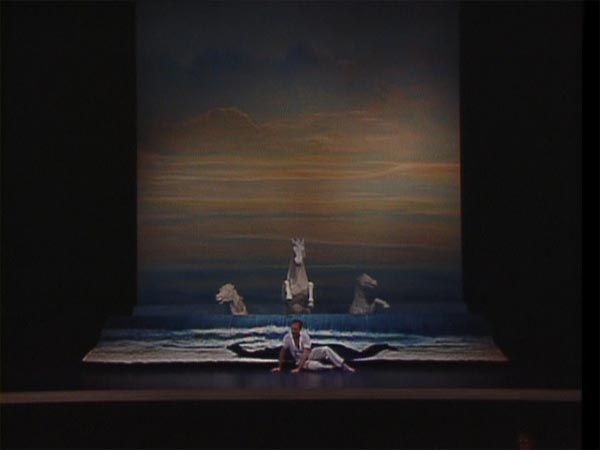
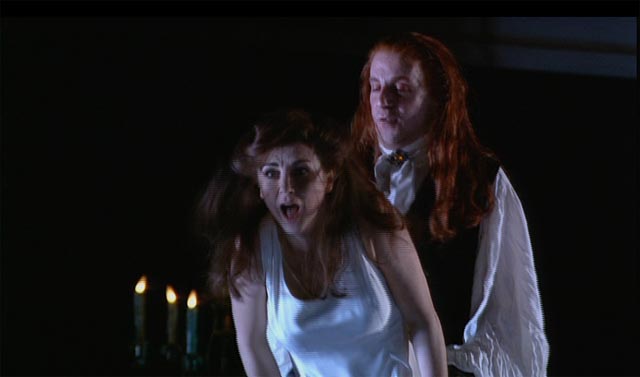
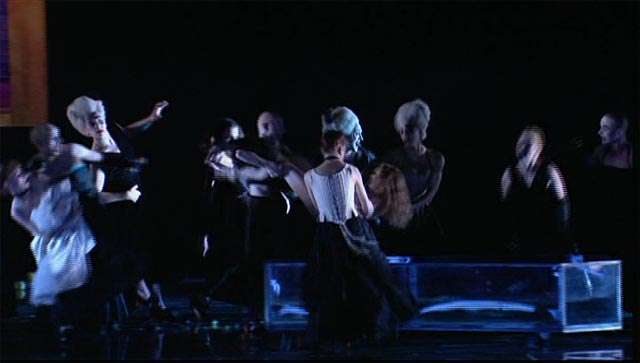
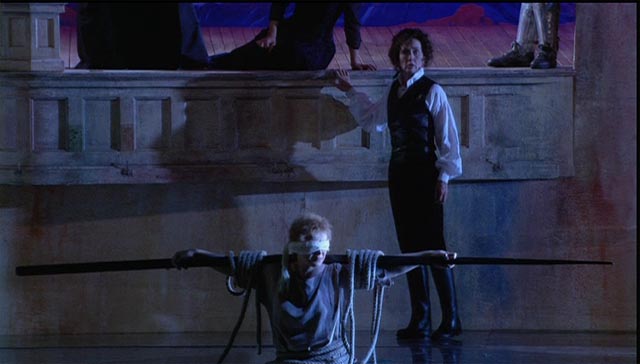
Handel’s Ariodante has, broadly, the same plot as Much Ado About Nothing. The King of Scotland’s daughter is framed as “unfaithful” by the bad guy’s disguised accomplice. Her fiancé goes off the deep end. The bad guy betrays his accomplice. She rats on him. He gets killed. All is revealed. Everybody but the bad guy lives happily ever after. In this 1996 production for English National Opera, David Alden seems to be turning it into a very dark plot with madness, intense and perverse sexual desire, hints of anal rape and a nude drowned in a tank. All in all, a pretty run of the mill Regie approach. Flippancy aside, it actually works quite well. It’s a bit of a slow starter. Act 1 is mostly scene setting and it’s not easy to see what Alden is driving at. Ariodante (Ann Murray) in particular seems to be prey to emotions that have, as yet, no obvious origin. To be honest I was quite puzzled at the end of Act 1 though there appeared to be much that was visually striking going on. At least, that’s what I’m guessing because video director Kriss Rusmanis does his level best to hide most of the stage most of the time.

It picks up in Act 2 where we get more extreme emotion but it’s clearer why. In Act 1 Polinesso (Christopher Robson) is obviously the bad guy but his real nastiness emerges in his treatment of his accomplice/lover, Dalinda (Lesley Garrett). Among other indignities, anal rape appears to be suggested before he drags her off to have his henchmen finish her off. To be fair, Dalinda’s attitude to her treatment is quite equivocal so we can add this to a long list of opera productions with sado-masochistic sub texts. Act 3, in which all is revealed is also dramatically strong besides having some of the best music.  All three acts have fairly lengthy ballets. These are strikingly choreographed by Michael Keenan-Dolan. At least the bits we can see on the DVD are. There’s a particularly effective “nightmare” sequence in Act 2 where the princess Ginevra (Joan Rodgers) is trying to make sense of what has happened to her. The sets are quite painterly with effective use of an upstage window which is used to frame subtextual elements while the main action goes on in front. So, all in all, it works pretty well though it would hardly be David Alden if nothing seemed gratuitous!

Like the drama, this got better musically as time went on. In Act 1 I was really questioning the decision to cast a mezzo in the alto castrato role and a traditional countertenor in what was originally a breeches mezzo role. It does work out. Ann Murray sings brilliantly and muscularly throughout and makes, in the end, a completely convincing Ariodante. Christopher Robson’s Polinesso doesn’t totally convince me. That voice type just doesn’t make for a particularly convincing villain but it does make more sense as his sheer nastiness comes out in his excellent acting. Joan Rodger’s Ginevra definitely gets better as things progress. I think she sounds strained in her upper register in the first act. The notes are there but it isn’t a very beautiful sound. In Acts 2 and 3 she sounds much more at ease despite having to sing while being put through not far short of torture(1).

Lesley Garrett’s Dalinda was a pleasure from first to last. The King of Scotland is Gwynn Howell. It’s the sort of bluff, thankless role that Howell seems to play rather often. He sings perfectly well and is bluff. Paul Nilon sings Lurcanio, Ariodante’s brother. he doesn’t have a lot to do but he does have one glorious duet with Dalinda in Act 3. This is closely followed by another lovely duet between Ginevra and Ariodante. I wish there were more duets and ensembles in Handel operas. They happen rarely but when they do they are usually wonderful. Ivor Bolton conducts the ENO orchestra and they sound OK for a modern band (not my first choice for Handel!). Tempi seem on the slow side. The rival DVD version of this opera comes in 20 minutes shorter. Whether that’s due to cuts or tempi though I can’t say. The ENO chorus doesn’t sound great but this may be the recording, see below.

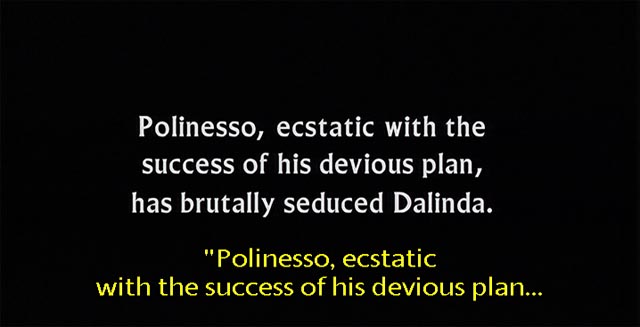
Musically and dramatically I think this is a recommendable performance. Unfortunately, as a DVD, it’s very hard to find good things to say about it. It was recorded for broadcast on the BBC and is given a treatment I’ve not seen before. I assume it’s taken from a live performance but there is no applause and no curtain calls. What we do get are silent film like “story boards” at key points like the beginning of each act.

For example “Polinesso takes advantage of Dalinda’s blind devotion to further his ambition”. Weirdly, the subtitles repeat the message. I don’t particularly like this approach but it’s not fatal. What is is the failure to show us enough of the stage to figure out the director’s intentions. I ranted about this yesterday so I won’t labour the point but it pretty much wrecks this disc. Technically it’s not so hot either. The picture is OK 16:9, no more. There are two sound tracks; Dolby 5.1 and Dolby 2.0. The surround sound version is about the worst sound I’ve ever encountered on an opera DVD. It’s mixed so that the subwoofer booms out the bass line in a most unmusical fashion. It’s horrible. The stereo track is OK though it gets a bit odd in parts of Act 3, especially the final chorus. Either that or the ENO Chorus really is having a bad night. The only sub-titles are English and there is no documentation beyond a chapter list. (This is the North American release on Image. It wouldn’t be unprecedented for the European version to have more acceptable sound).

It’s a bit of a shame. I would really like to have a proper look at this production.