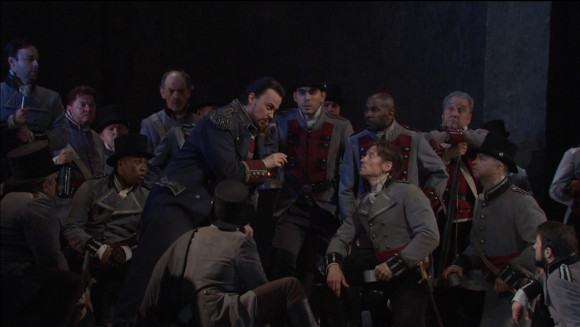
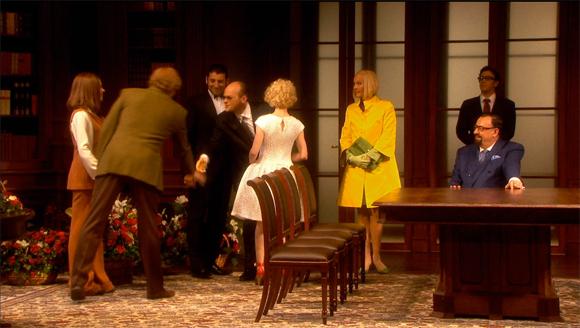
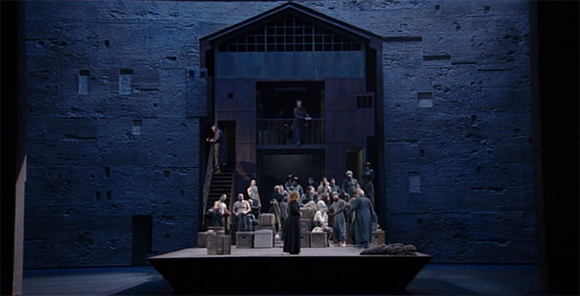
Verdi’s Il Trovatore really is a peculiar piece. It’s a bit of a musical hybrid with huge, rousing choruses interspersed with bel canto arias which I suppose is fairly typical of middle period Verdi. It has a truly silly plot (perhaps based on Blackadder’s lost novel) with gypsies, dead babies and improbable coincidences galore. It’s also notoriously hard to cast with five very demanding roles combining a need for flawless bel canto technique with lots of power. David McVicar’s production at the Metropolitan Opera was broadcast in HD in April 2011 and subsequently released on Blu-ray and DVD. I saw the HD broadcast and enjoyed it enough to buy the Blu-ray.
Category Archives: DVD review
Paramore shall welcome woe
Various thoughts about the Channel 4 film of Britten’s Owen Wingrave led to me seeking out the original BBC TV version from 1970, now available on DVD. It’s extremely interesting and worthwhile. Britten himself conducts and the cast includes many of the people involved in the first productions of many other Britten operas. They include Peter Pears (General Wingrave/Narrator), John Shirley-Quirk (Coyle), Benjamin Luxon (Owen), Janet Baker (Kate), Heather Harper Mrs.Coyle) and Jennifer Vyvyan (Mrs. Julian). The quality of the music making is superb and I found myself constantly surprised and delighted by details brought out by Britten supported by the excellent English Chamber Orchestra. At the same time, the fluent and idiomatic singing pointed up the excellence of Myfanwy Piper’s libretto. This really is Britten at his best.
Schade rocks
Today’s summer second thought is the 2004 Salzburg festival production of Purcell’s King Arthur. I really enjoyed this first time around and I think it stands up extremely well to repeat viewing. I pretty much stand by my original review but certain aspects of the production did stand out on repeat viewing. The first thing that struck me is how these English 17th century works are very much a blend of the vulgar and the sublime (one could argue that that is the defining characteristic of English culture; from Chaucer to Trooping the Colour). This production, like Jonathan Kent’s The Fairy Queen, successfully blends the two elements. There’s a really good example at the very end where Michael Schade’s panty strewn rock star “Harvest Home” is followed by a gorgeous and dignifieed “Fairest Isle from Barabara Bonney but there’s lots more; much of reinforced by the sort of special effects that a Restoration audience would have loved. There’s also some real depth in how it’s done. First up I found the Merlin dressed as banker’s wife episode very funny but just that. On rewatching I realised that much more is going on as the scene segs into Merlin explaining to Arthur that everything around him is an illusion.
Paramore revisited
Great though my admiration for Benjamin Britten’s music is I wouldn’t consider him a creator of memorable female characters. There’s Ellen Orford, of course, but one struggles to find a Tosca, Lucia or Violetta in his oeuvre. I open with this because what struck me watching the 2001 Channel 4 film of Owen Wingrave for a second time was how generally unsympathetic the female characters are. This is an opera with a female librettist (Myfanwy Piper) and the film has a female director (Margaret Williams) yet, with the exception of the fairly ineffectual Mrs. Coyle, the female characters embody an unthinking militarism and behave with extreme malevolence towards Wingrave; none more so than his “girlfriend” Kate. The filming reinforces this with close up scenes of groups of the women spitting venom at young Wingrave.
Theodora redux
Peter Sellars’ 1996 Glyndebourne production of Handel’s Theodora just gets better with every viewing. I utterly retract my original view that the music isn’t Handel at his finest. It’s very good indeed and the production and performances on this disk are fantastic. Despite not being the best recording ever (though the recent Blu-ray release is an improvement) it remains a “must see” for any fan of Baroque opera or challenging music theatre.
What makes it so compelling? I think it’s two factors. The first is the production. The contemporary American setting works with very little violence to the libretto or music and yet speaks directly to very contemporary concerns. It’s particularly effective that current reality is inverted with respect to mainstream Christianity. Added to this are some extraordinarily intense performances led by the late Lorraine Hunt as Irene, the leader of the Christians. “As with rosy steps the morn” and “Lord to thee, each night and day” bring me out in goosebumps every time. The chemistry between David Daniels and Richard Croft is also palpable and Dawn Upshaw could hardly be bettered in the title role. Even Christine Schäfer in the only competing recording doesn’t come close.
One of the notes I made while watching this the other night reads “anybody not moved by this is an emotional cripple”. It’s a fair summary.
Summer second thoughts
The heat and humidity of a Toronto summer aren’t especially conducive to dealing with most of what’s in my DVD review pile right now (Wagner chiefly!) and the live music pickings are slim as, Toronto Summer Music Festival aside, music has departed for the land of moose and loon. I thought, therefore, that I might take another look at some old favourites and see how they shape up to a second look. I thought I’d focus on works where I have seen many subsequent productions or, perhaps, on works once seen only on DVD but which I had more recently been able to see live.
Watery Kat’a Kabanová
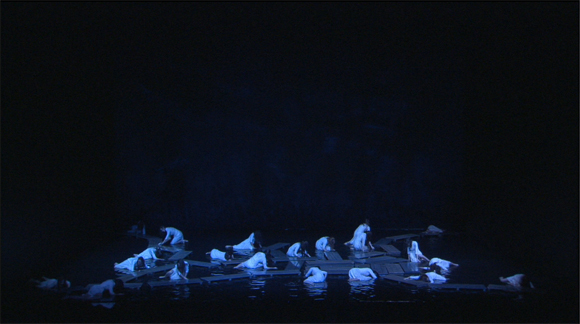
Robert Carsen’s producton of Janáček’s Kat’a Kabanová is typically simple and elegant. Recorded at the teatro Real in Madrid it features a flooded stage with a large number of wooden pieces, like palettes, that are rearranged to form the set. At the beginning of Act 1 the pieces form a pathway through the water simulating the banks of the Volga. Later they are rearranged int a square at centre stage to represent the claustrophobic Kabanov house. All this rearrangement is done by the ladies of the chorus who roll around in the water in white shifts. No breaks are needed between scenes, just the intermezzi the composer provided for the purpose. A mirror at the back of the stage reflecting the water and an elegant and effective lighting plot complete the staging.
Happy families
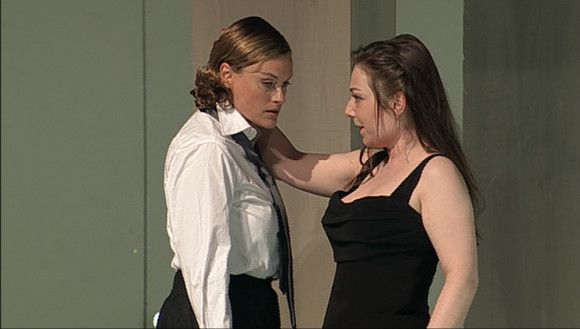
Dmitri Tcherniakov’s Don Giovanni recorded at the 2010 Aix-en-Provence festival is full on Regie. He takes the characters and story of Mozart/DaPonte and recasts them quite radically. Zerlina is Donna Anna’s daughter. Donna Elvira, Donna Anna’s cousin, is married to Don Giovanni. Leporello is a family member too. The sense is of one extended, conventional, bourgeois family in which Don Giovanni is a fatally disruptive intrusion. Tcherniakov changes the time line too. Instead of taking place over a 24 hour period the story plays out over many weeks.
The Copenhagen Ring – Siegfried
So, onto Siegfried. Now we are in 1968 but it’s a rather laid back Danish 1968. It doesn’t reference any of the canonical events of that momentous year though there is a bit of a youth vs experience vibe. Holten doesn’t let us forget that Siegfried is 18 and Stig Anderson, at 60, manages to pull off the look very well. James Johnson’s Wotan, on the other hand, is shown in decline; the elder statesman who can’t retire gracefully, like a Berlusconi or Murdoch. Mime is an ageing nobody hunched over his typewriter and still yearning for some “success”.
Musically satisfying Tristan from La Scala
I’ve been looking really hard for a video recording of Tristan und Isolde that I felt I could recommend because, frankly, nothing is worse than a badly executed Tristan as those who suffered through the Met HD broadcast a few years ago will know. In the 2007 La Scala recording I have found one I feel confident about. Is it perfect? No. A perfect Tristan is probably beyond mere mortals. I’m never sure whether I find it more astonishing that anyone can sing this music or that a composer might have imagined that he could find people who could. That said, the La Scala recording is very close to an ideal Gesamtkunstwerk.