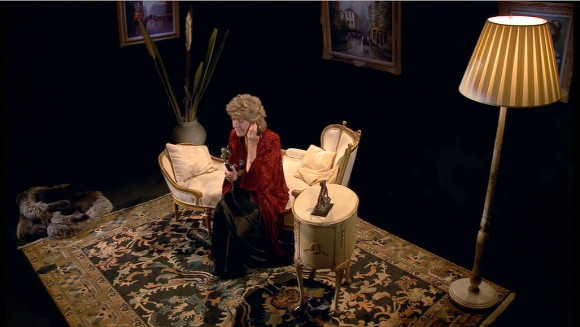
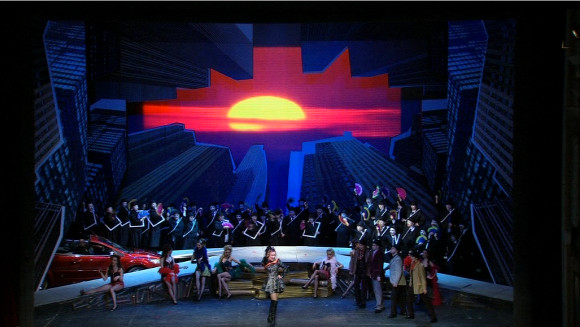
Poulenc’s La voix humaine is as a rather peculiar little piece. It’s only 40 minutes long and it features a single singer, a soprano. It’s not exactly a monologue as what we hear is one end of a telephone conversation with implied contributions from the woman’s lover, the telephone operator, the lover’s manservant etc. A lot of what happens is an artefact of the French telephone system at the time (1928) that Cocteau wrote the play that supplies the libretto with operators, party lines, dropped calls etc.
Continue reading
Category Archives: DVD review
The three countertenors
Handel’s Giulio Cesare presents an interesting casting challenge. The piece has four high voiced male roles; Cesare, Nireno, Tolomeo and Sesto. The original production featured three castrati and a soprano en travesti. I have never seen Sesto cast as other than a trouser role and Nireno and Tolomeo are invariably sung by countertenors. Cesare himself though seems mostly to go to low mezzo/contralto types. Indeed it’s seen, I think, as something of a “plum” trouser role. (Which is interesting as in the production that i will get to describing in a minute, Cesare wears plum trousers). I’ve seen both Ewa Podleś and Sarah Connolly in the role. For their 2005 production Royal Danish Opera cast Andreas Scholl as Cesare. It’s a good choice. He’s a masculine looking and sounding counter tenor and at least he is taller than his Cleopatra. It also makes for an interesting set of countertenors. Tolomeo is sung by the much less masculine Christopher Robson and Nireno by the “more a male soprano than a countertenor” Michael Maniaci. Sesto goes, conventionally enough, to Tuva Semmingsen, who seems very much to specialize in these types of role. Apart from the countertenors the piece was cast from the considerable resources of the RDO ensemble with Inger Dam-Jensen as Cleopatra, Randi Stene as Cornelia, John Lundgren as Curio and Palle Knudsen as Achilla.
300
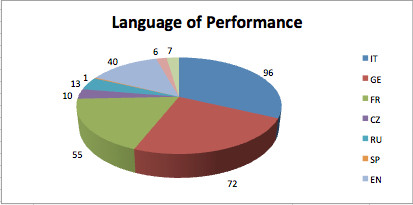
There are now 300 reviews of Blu-ray and DVD recordings in the database. (70 Blu-ray, the balance DVD) As I did at 200 I took a look at how they break out. I’ve pretty much exhausted the opera dvd resources of the Toronto public library system so recent and future reviews are more likely to be of things I’ve chosen to spend money on, bar the odd review copy from record companies.
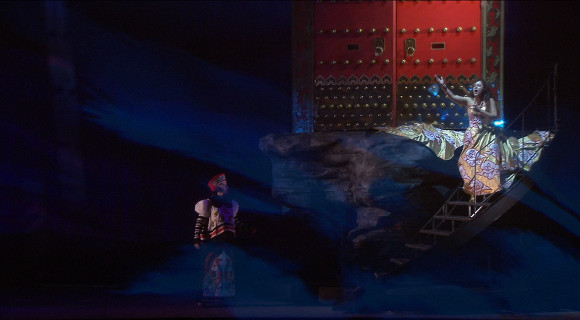
The first thing I looked at was language of performance. It’s no surprise that Italian (96) and German (72) dominate the list. French is a strong third at 55. English comes in at 40, almost all 20th and 21st century works. Other (7) is quite interesting as it mostly reflects works in multiple languages such as Tan Dun’s Marco Polo. “Other” is very much a modern category. Continue reading
Fan – tastic
It was during the recent run of Cosí fan tutte at the COC that I realised that I really needed to get my hands on the M22 recording (Salzburg 2006). Specifically it was discussing the Salzburg reading of Ursel and Karl-Ernst Herrmann with Thomas Allen and Rachel Andrist; who is the on stage continuo player in the Salzburg recording. It sounded like there might be interesting parallels. And parallels there are. In both cases the girls are aware of the “plot” (in every sense). In both cases four attractive young singers have been cast as the lovers and Don Alfonso and Despina made much older and more cynical. There I think the parallels end. Egoyan’s vision is essentially a positive one about relationships. The Herrmans, I think, are more interested in exploring the psychologically destructive power of love and desire.
Straightforward Gambler from the Mariinsky
The 2010 recording of Prokofiev’s The Gambler from the Mariinsky Theatre is a bit of a mixed bag. It’s a complicated opera about obsession and power and it needs a strong production and a director who can get coherent performances out of a large cast to fully succeed. Temur Chkhiedze doesn’t really manage it. The production is very straightforward, set in slightly abstracted versions of a hotel, a casino etc and at times it is brought to life by the clever lighting of Gleb Fishtinsky but it doesn’t do enough to establish any real purpose for the piece. It’s not helped by some very broad acting, especially from Sergei Aleksaskin’s General which is further emphasized by video director Laurent Gentot’s heavy use of close ups.
Spectacular Die frau ohne Schatten from the Mariinsky
Richard Strauss’ Die Frau ohne Schatten is a problematic work on many levels. Hofmannsthal’s complicated and heavily symbolic libretto places considerable demands on both audience and director. There are ideas about women, marriage and child bearing in the libretto that sit very uncomfortably with modern audiences. It’s also a beast to cast requiring not just a truly Helden tenor and soprano but a second soprano of almost equal heft who can handle some fairly tricky coloratura. It’s also long and requires a large orchestra. In some ways it’s surprising that it gets performed as often as it does although when done well it’s a piece of quite extraordinary beauty and power.
First, the sound quality
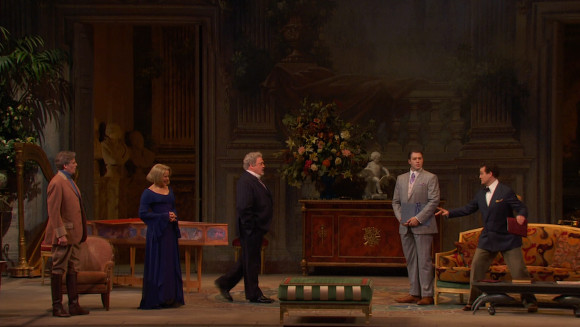
The MetHD broadcast of Strauss’ Capriccio has been issued on Blu-ray. I enjoyed the original broadcast but found watching it again on disk rather unsatisfying. The main problem is the production. It’s a John Cox effort from 1998. The period is updated from ancien régime France to just after WW1, apparently to make the people more contemporary while allowing an opulent, old style Met “all the things” production. Peter McClintock’s direction of the revival emphasizes the most obvious comedy (the ballerina falling over with her legs in the air, for example) while doing little or nothing to bring out the sheer cleverness of this opera, about an opera, within an opera. It all seems very heavy handed, in fact the word that popped into my head several times was “vulgar”.
How can peace come from so much pain?
Making a film of an opera rather than filming an opera involves interesting choices and one of the strengths of the DVD of Penny Woolcock’s film of John Adams’ and Alice Goodman’s The Death of Klinghoffer is that includes 47 minutes of Woolcock, Adams and others discussing just how one takes a rather abstractly staged opera (the original staging was, inevitably, by Peter Sellars) and turn it into an essentially naturalistic film. Of course, naturalism will only go so far with opera but this goes a long way in that direction. The soloists are filmed mainly on location and they sing to the camera. The choruses, mainly backed by documentary footage, and the orchestra were recorded in the studio but the actors sing ‘live’. The one concession to “being operatic” is having a mezzo voice one of the Palestinians though he is played by a male actor.
Love polygon
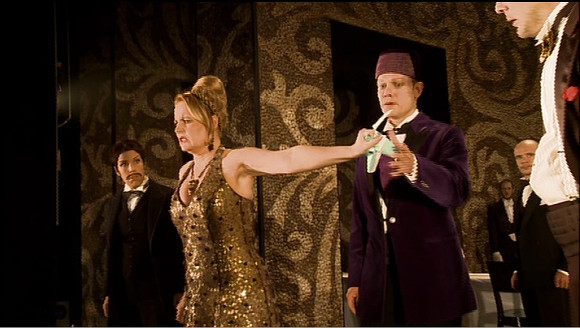
Handel’s Partenope is a bit unusual. It feels lighter than a lot of Handel’s Italian operas and it is basically a romcom, albeit one that still has a vaguely classical setting. Handel also plays with opera seria conventions by, for example, writing “heroic” arias for non-heroic texts and putting accompagnato in odd places. The number of potential match ups that need to be tracked is fairly staggering. Basically everybody is in love with, or pretending to be in love with, Partenope, queen of Partenope aka Naples. These include the invading prince of Cumae, Emilio; Arsace, prince of Corinth; Armindo, prince of Rhodes and Eurimene, an Armenia who is really Rosmira, princess of Cypress and formerly betrothed to Arsace. The only character who isn’t in love with Partenope is the philosophical captain of the guard, Ormonte, who is easy to spot as he’s a bass. At the start of the piece Partenope is in love with Arsace but Eurimene/Rosmira isn’t having that and engineers a duel with Arsace. This takes most of two acts but it’s the only essential bit of plot. In Act 3 Arsace, who really doesn’t want to fight his former fiancée finally comes up with the wizard wheeze of demanding that the duel be fought bare chested. Apparently this was perfectly normal under Neopolitan duelling conventions. maybe it’s what gave Patrick O’Brian the idea of having Stephen Maturin always duel bare chested? Anyway the modest Rosmira isn’t about to do any boob flashing (somewhat ironically as Inger Dam-Jensen, in the title role, has been bosom heaving with the best since the overture) so confesses to being, shock horror, female. Arsace and Rosmira are reunited and Partenope awards herself as a consolation prize to Armindo. Got that?
Looks better than it sounds
Massenet’s Don Quichotte is one of those works where one does a double take on learning when it was composed. It dates from 1910 but sounds like it was composed at least 50 years earlier. It’s lushly romantic and dressed up with elements of flamenco but to nothing like as good effect as in de Falla’s La vida breve. There’s also plenty of schmaltz. The intro to Act 5, for example, being highly reminiscent of the Meditation in Thaïs. The plot’s pretty thin too. Don Quixote loves the unattainable Dulcinea. He goes off and encounters some bandits who eventually take pity on him and rather than killing him give him Dulcinea’s necklace, which they have stolen. He returns it to her. She is grateful but still not interested in marrying him. He dies. Great!