Historic Ariadne

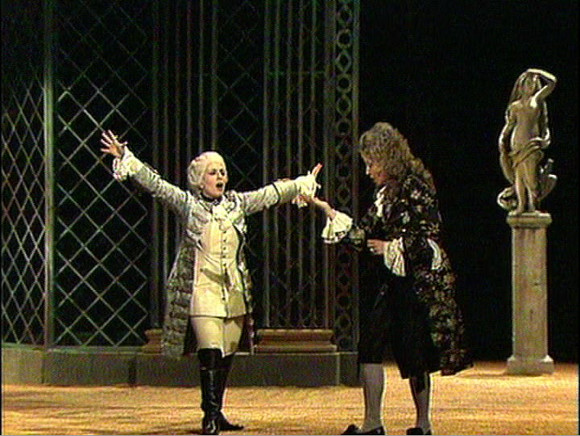
Opera videos of performances before 1980 are quite rare and are mostly films.  Recordings of live performances are extremely uncommon and often quite interesting.  A couple have just been rereleased on DVD.  The one reviewed here is an Ariadne auf Naxos from the 1965 Salzburg Festival (the other is a recording, in German, of Don Giovanni with Fischer-Dieskau – watch this space).  It’s an old ORF TV broadcast with a grainy 4:3 black and white picture and less than stellar mono sound but it does provide an idea of what audiences saw and heard fifty years ago.

1.haushofmeister Continue reading

Abstraction from the Seraglio

Mozart’s Die Entführung aus dem Serail is a problematic opera.  It’s got some great music but the libretto is pretty weak and its depiction of Turks is pretty unflattering.  Maybe it seemed edgy less than a hundred years after the Ottomans besieged Vienna but today it just seems mildly embarrassing.  Fortunately it’s a singspiel with dialogue rather than opera with recitatives so it’s fairly easy to play with the story line.  For his 1998 production Stuttgart at the Staatsoper Stuttgart, Hans Neuenfels goes much further.  He double each of the singers with an actor and pretty much rewrites the dialogue.  He also introduces an element of metatheatre.  This is a performance and everyone knows it.  For example when Pedrillo is asked how he’s going to get hold of a ladder for the escape scene he replies that he’ll use the one they always use in this opera.

1.osmins Continue reading

The other Plymouth pilgrims

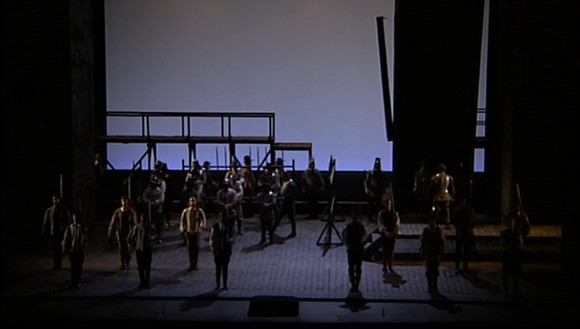
I suppose in some ways Bellini’s I Puritani is the perfect bel canto opera.  It has lots of great tunes, a wicked coloratura soprano part and an utterly ridiculous plot (my comments on the plot can be found in my review of the Met/Netrebko recording) and, of course, a mad scene.  In this recording from Barcelona’s Liceu the soprano role of Elvira is taken by Edita Gruberova, surely one of the greatest ever in this genre.  At 54 she doesn’t look ideal for the young bride to be but she can act and she gives a master class in bel canto style. What she has to yield to Netrebko in terms of looks and physical commitment she makes up for in sheer technical prowess.

1.soldiers Continue reading

Natalie Dessay showcase

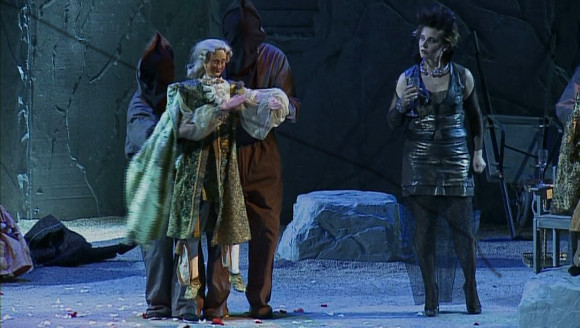
Le miracle d’une voix is a compilation of scenes from various recordings in which Natalie Dessay featured made between 1993 and 2003.  It’s especially interesting in that a couple of pieces feature more than once.  There are three Les oiseaux dans les charmilles; Olymia’s aria from Les contes d’Hoffmann and two Grossmächtigen Prinzessin from Ariadne auf Naxos.  Thrse demonstarte what I have always believed to be Dessay’s greatest strength; her ability to recreate a character to fit in a particular production.  The two Zerbunetta arias illustrate this perfectly.  In the first, a Salzburg production from 2001, Zerbinetta is a depressed, heavy drinking, prostitute who celebrates a kind of deeply sad sisterhood with Ariadne before being dragged off by a very sleazy Russell Braun.  In the second, from the Palais Garnier in 2003, she’s a bubble headed tourist in bikini and wrap who pesters poor Ariadne all around what looks like a Mediterranean building site.  They are completely different characterisations but both highly effective.  The same is true of the three Olympias who range from very conventional doll to inmate in some sort of asylum or home.

1.zerbinetta Continue reading

Pergolesi double bill

Pergolesi’s relatively popular comedy La serva padrona was originally intended to be performed as an intermezzo for his opera seria Il prigionier superbo.  It’s therefore fitting that recordings by substantially the same forces, though recorded two years apart, should be released as a package.  The recordings were made at the Teatro G.B. Pergolesi in Jesi in 2009 and 2011 respectively.  Both performances were directed by Henning Brockhaus and feature the Accademia Barocca di I Virtuosi Italiani conducted by Corrado Rovaris.  The works are presented on separate disks rather than the having the two halves of the intermezzo inserted in the intervals of the more serious work as they would originally have been performed.

1.metalce Continue reading

La Monnaie, a python and the Holy Grail

There’s a bit at the end of the first act of Parsifal where Gurnemanz looks at Parsifal and says “you haven’t understood anything have you?” or words to that effect.  Watching Romeo Castellucci’s 2011 production for Brussels’ La Monnaie theatre my sympathy was very much with the Pure Fool.  This is one of the most incomprehensible productions I have seen.  Act 1 is very dark.  Most of the time only a tiny fragment of the stage is lit.  The first thing we see is a snake in its own tiny patch of light.  Then we are in a forest and the Grail Knights appear to be part of the forest.  Whether they are just wearing suits of leaves or are actually plants is unclear.  Kundry, in a white hoodie, and Parsifal in street clothes are recognisably human.  Titurel and his squires wear overalls and hard hats.  One of them carries a chain saw.  The “swan” appears to be a lit up tree branch though later it appears as a very decomposed skeleton.  The Grail Scene is played out with a white curtain, with a small black comma on it, across the entire stage.  The curtain is withdrawn and we see fluorescent lights above the greenery, which takes up much less space than one has so far imagined.  Is Monsalvat a grow-op and the knights marijuana plants?

1.snake Continue reading

Make him cry blood

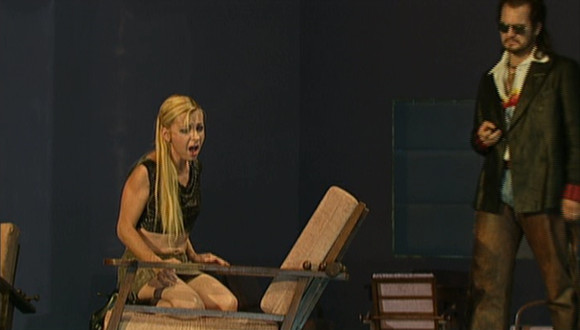
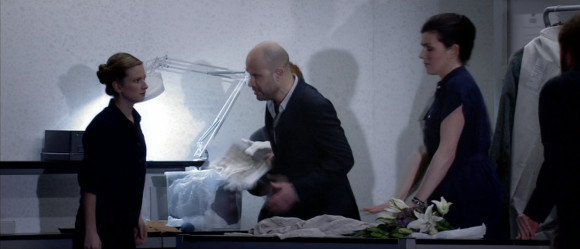
Written on Skin; music by George Benjamin, text by Martin Crimp, was first seen at the Aix en Provence festival in 2012.  The following yewar it was given, in the same production by Katie Mitchell and with substantially the same cast, at Covent Garden. Both versions were televised and now the ROH version has been released on DVD and Blu-ray.  It’s an unusual, complex and rewarding work.  21st century angels decide, for reasons not entirely clear, to return to the 13th century to create and participate in a human drama.  The medieval humans are The Protector; a rich man of mature years utterly confident of his privileged position and his own righteousness, and his wife Agnès; younger, illiterate, downtrodden.  Into their world comes The Boy; one of the angels in fact, who will create for The Protector an illuminated book; a precious object celebrating his wealth and worthiness.  Inevitably, The Boy and Agnès fall in love and The Protector’s revenge, whipped up by the angels, is quite revoltingly violent.  It’s essentially a simple and classic plot but Crimp shapes it skilfully with carefully placed anachronisms and by using the device of having the characters, sometimes, narrate their own actions in the third person.  Benjamin’s score is in a modern idiom.  He’s not afraid of atonality and he uses a very wide range of colours to create a score that ranges from meditational to almost unbearably violent.  Certainly words and music work together here to great effect.
1.angels Continue reading

Ciro in Babilonia

Ciro in Babilonia is an early work by Rossini composed for the lenten season when only works on biblical/religious themes were permitted.  This doesn’t really fit that description.  Sure, the story of Belshazzar and the writing on the wall gets a brief look in but it’s almost interpolated in the story, from Herodotus, of Cyrus’ capture, together with wife and child, by Belshazzar.  It’s a tale of arrogant kingship, religious faith and marital devotion.  Typical opera seria stuff really.  It’s a bit thin plot-wise though which probably explains its relegation to obscurity.  This first modern production was created at Caramoor, then translated to the Rossini festival at Pesaro, where it was recorded in 2012.

1.caption Continue reading

The way by swan

No Madelaines were harmed in reviewing this DVD.  It’s a 1992 recording from the Wiener Staatsoper of, of course, Lohengrin and its main claim to fame is that stars Placido Domingo (note no further jokes about water fowl despite the prominent role of Heinrich der Vogler).  It’s one of those DVDs from the 80s and 90s that are a bit frustrating.  The singing is very good indeed.  Domingo is superb and the rest are at least very good plus Abbado conducts with real flair but the production is dull as ditch water and the video quality is awful.

1.hornets Continue reading

Fit for a king?

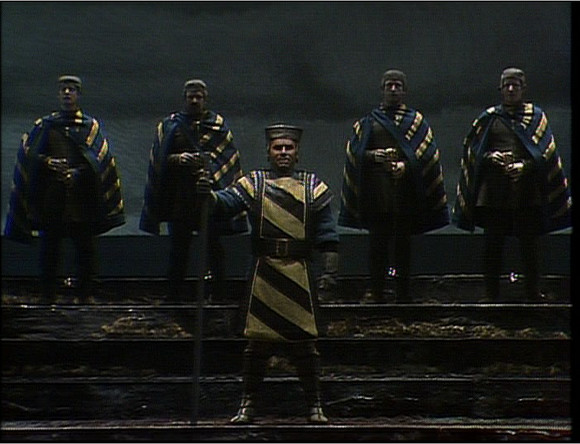
There have been over thirty operas dealing with Montezuma, last emperor of the Aztecs from Vivaldi in 1733 to Bernhard Lang in 2010.  The second such premiered in 1755 and was rather remarkable.  The idea originated with Frederick II of Prussia who decided to fit in an opera before his next war against the Austrians.  He wrote a French prose libretto which was turned into an Italian text by his court poet Giampietro Tagliazucchi and then set by his court composer Carl Heinrich Graun.  It’s pretty clear that Frederick identied himself with the idealized enlightened monarch Montezuma, the ultimate noble savage, and his betrayal by forces loyal to the Habsburgs and Catholoicism.  The ideas earlier expressed in Anti-Machiavel are very much to the fore as are Frederick’s own rather odd ideas on fate and his own mortality(1).  Basically this Montezuma is deposed and executed and his world goes up in flames.

1.frederick Continue reading