Rienzi

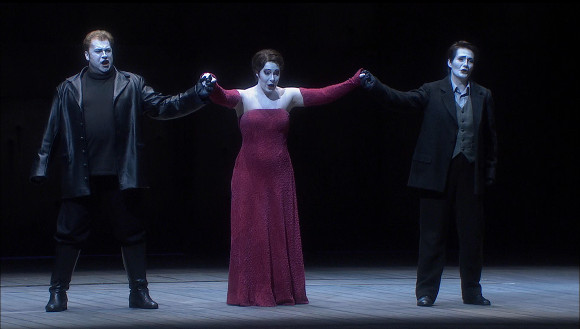
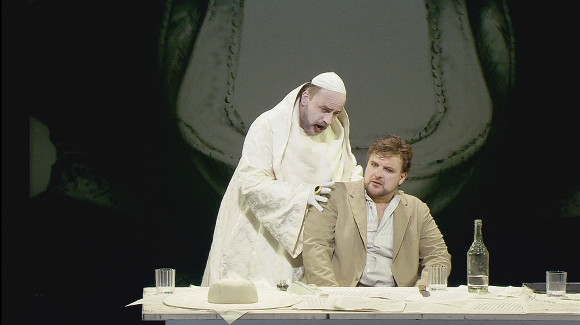
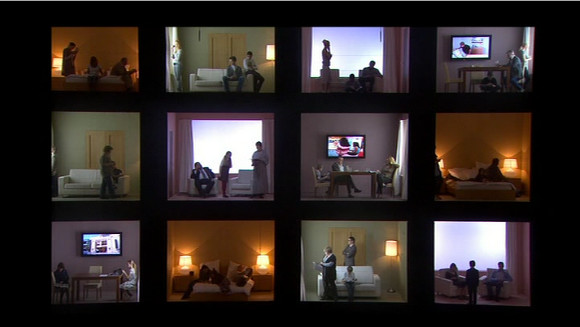
Wagner’s Rienzi is really quite an interesting work.  It follows the conventions of the French grand opera rather than the more integrated structure of most of the later works, although as presented in Toulouse in 2012 some of those elements, for example the ballet, have been removed in the interests of cutting the work down to manageable size.  Even with the Toulouse cuts it runs three hours.

1.trio

Continue reading

Hyper traditional Figaro

The 2009 production of Mozart’s Le nozze di Figaro from Madrid’s Teatro Real had me doing a bit of a double take.  It’s all pouffy wigs, breeches and heaving bosoms.  In fact it’s so traditional that it wouldn’t be out of place in Winnipeg or Omaha but comes as something of a surprise in a major European house.  In the “Making of” feature, included as an extra, director Emilio Sagi suggests that the opera is so “perfect” that only a “hyper-realist” approach is appropriate.  It’s an interesting idea but “hyper-realist” here turns out to mean a bunch of established opera conventions that bear as much of a relationship to “reality” as, say, a James Bond film does.  There is one minor directorial intervention.  A air of buxom extras appear in almost every scene.  I’m not entirely sure why.  Perhaps they are the Wonderbra of the production as their sole purpose seems to be to uplift the cleavage quotient.  For the record, the piece is presented uncut so Basilio and Marcellina get their big arias in the last act.  The traditional approach, I know, has its adherents.  I’m not one of them.  I could have used a few ideas!

1.act1

Continue reading

Tarkovsky’s Godunov

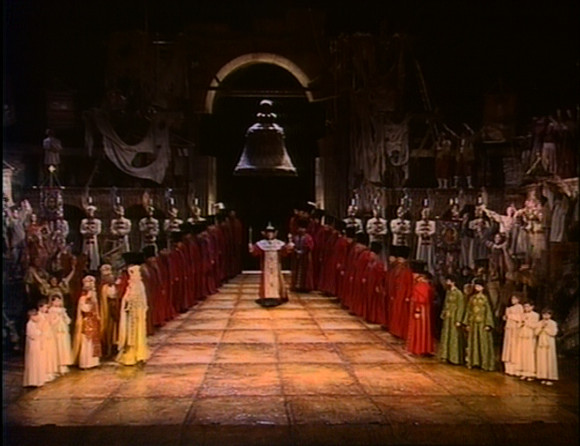
Andrei Tarkovsky’s 1983 production of Mussorgsky’s Boris Godunov for Covent Garden was restaged in 1990 by the Kirov in St. Petersburg with, Tarkovsky by this time no more, Stephen Lawless directing.  It being Tarkovsky I had expectations of something really interesting (perhaps a four hour silent opera?) but it’s not really.  In fact Tarkovsky seems to have been intimidated by the form or foiled by its technical limitations into producing a lavish but ultimately not very consequential production.  The AMOP crowd would thoroughly approve I think.

1.bell

Continue reading

Vecchio Chris

Richard Jones chose to set his 2009 production of Verdi’s Falstaff in Windsor in 1946.  I suspect it’s driven by similar reasoning to Robert Carsen’s 1950s production.  Falstaff plays out very nicely as a conflict between an older order of things and a more thrusting kind of bourgeoisie and 1940s/50s England works well for that.  The “just after the war” setting also allows Jones to present Fenton as a G.I. which adds another twist to Ford’s distrust of him.  Although the jumping off point for Jones and Carsen is the same the results are quite different.  Jones seems to be operating in the traditions of English farce, à la Brian Rix, or maybe Carry on films,which works pretty well.  Falstaff is a farce rather than a comedy of manners.  So, besides the obligatory entrances and exits, couples caught in flagrante etc we also get a certain geometric precision in the blocking that borders on choreography.  In Act 1 Scene 2, for instance, the ladies rather military perambulation in a garden of very precisely aligned cabbages is doubled up by Brownies and a rowing four countermarching.

1.cat

Continue reading

Gruberova as Lucrezia

Edita Gruberova in recent years has pretty much cut her repertoire down to a handful of bel canto roles; Elisabetta in Roberto Devereux  and the title roles in Anna Bolena, La Straniera, Norma and Lucrezia Borgia.  The last of these was recorded in Munich in 2009 in a production by Christof Loy for the Bayerisches Staatsoper.  It shows that Gruberova still very much at the height of her powers but the production is less satisfactory.

1.logo

Continue reading

Mock turtles know all the rest

Unsuk Chin’s Alice in Wonderland premiered at the BayerischeStaatsoper in 2007 in a production by Achim Freyer.  It’s a curious work.  It cleaves fairly closely to Carroll but the beginning and ending are altered to make it clear this is all a dream.  In between those two short scenes we get all the familiar stuff; Cheshire Cat, Caterpillar, Tea Party, Croquet Lawn, Trial etc.  It’s all staged on a steeply raked stage with a sort of set of “advent calendar” openings.  Lines of light are used to suggest scale changes and the characters (almost) all wear mesh masks and have puppet selves too.  It’s a look that won costume designer Nina Weitzner an award.  Everybody seems to be wearing an aerial wire and there’s a fair bit of flying about.  It looks, on the face of it, visually inventive and psychologically convincing.

alice1

Continue reading

It’s in the blood

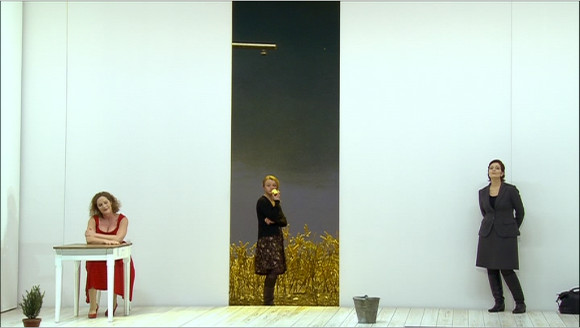
I guess previous times I’ve seen Janáček’s Jenůfa I haven’t really noticed the role that the idea of “bad blood” or inherited depravity plays in the plot but it’s there almost as starkly as in certain works by Zola and Buchan.  Perhaps one of the strengths of Christof Loy’s very clean 2014 production for the Deutsche Oper is that it tends to show up such details.  It’s certainly a very low key setting.  All the action takes place in a plain white room with minimal furnishing.  Costuming is modern (sort of); maybe 1950s or so.  Sometimes one gets a hint of rather more going on on the edge of the stage but Brian Large’s typically close up video direction makes it hard to be sure.  So, at least on disk, it’s all about the characters and their interactions and they are drawn pretty clearly.

jenufa1

Continue reading

Palestrina and the prattling prelates

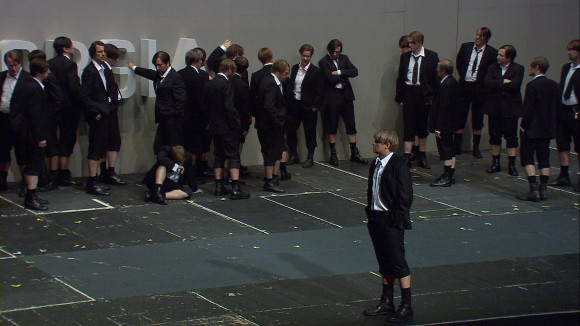
Pfitzner’s Palestrina has had some pretty extravagant claims made for it.  Bruno Walter said “The work has all the elements of immortality”.  I’m not so sure.  The music is very appealing but it’s structurally problematic.  It’s ostensibly about Palestrina and the struggle to convince Pius IV that polyphony had a legitimate place in church music but while the first and third acts are just that they frame a second act that’s about the various squabbles at the Council of Trent, of which the question of music was but one.  I think it’s meant to be a satyr on church politics of the time but it feels heavy handed, overly long and introduces a vast number of minor characters.  These are not only confusing but probably make the work unstageable for all but the very richest houses.  There are over 40 named solo parts but only one is a woman (and she’s dead) so major Bechdel fail here too.  I think if one took a chainsaw to Act 2 a pretty decent opera might come out of it because the human story is quite affecting and the music is distinctive and rather good.  Although premiered in 1917 it’s stylistically anti-modern and would likely appeal to a lot of people who are not normally drawn to 20th century opera.

1.borromeo

Continue reading

All girls like honey wine

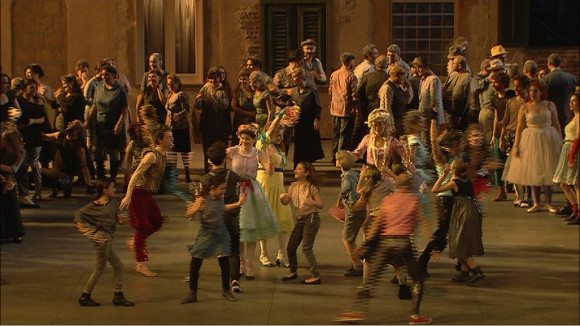
Richard Strauss operas do tend to have somewhat weird plots but perhaps none more so than his early and seldom performed piece Feuersnot.  We are in mediaeval Munich on St. John’s Eve when apparently large bonfires and, one suspects, other things, are traditional.  The children are gathering firewood and the magician Kunrad is stalking the mayor’s daughter Diemut.  To her, apparent at least, disgust and the scandal of the townspeople, he kisses her.  She gets her revenge by pretending she’s going to winch him up to her room but leaves him stranded halfway where he is mocked by the other girls.  He calls on the spirit of his mentor, an even greater magician, to help him extinguish all the lights and fires in the town.  This bit is very Wagnerian because who was mistreated by the people of Munich?  And who is his equally mistreated heir?  You’ve got it in one right?  Anyway, the townspeople rather whimsically persuade Diemut that it’s her maidenly duty to get the lights turned back on.  After all, people have sacrificed a lot more than a quick shag to the needs of the energy industry.  All it’s missing is a wordly crustacean really.
1.crowd

Continue reading

Wozzeck in Moscow

In 2010 Berg’s Wozzeck was produced in Russia for the first time since 1927.  The production, at the Bolshoi, was directed by Dmitri Tcherniakov.  Few people familiar with his work will be surprised to learn that Tcherniakov does not see Wozzeck as a  down trodden and impoverished soldier.  In fact he doesn’t see him as downtrodden and impoverished at all (unlike, say Calixto Bieito who transplants the action to a chemical plant but leaves the power relationships pretty much intact).  Rather, Wozzeck is a sort of 21st century salaryman leading a life of modest prosperity but crushing boredom with Marie and their son in a city inhabited entirely by other such families.  What’s missing is anything that resembles sensation or “life”.

1.calendar

Continue reading