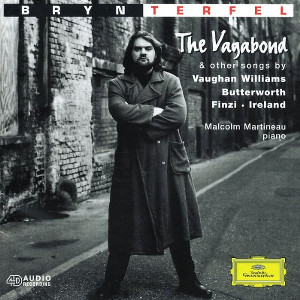
I usually only review CDs on first release but I came across one on the weekend that I need to rave about. I guess it’s not exactly a secret that I’m a huge fan of early 20th English art song. So, when I found a CD with most of favourites sung by one of my all time favourites it was pretty much bound to be a hit. It’s a 20 year old recording by Bryn Terfel and Martin Martineau and it’s called The Vagabond and other songs. The disc includes Vaughan Williams Songs of Travel, Finzi’s Let Us Garlands Bring, both of Butterworth’s Housman cycles and three settings of John Masefield texts by John Ireland. The young Bryn’s voice is a touch lighter than today but it’s still a brooding dark thing though with delicacy enough for, say, Is my team ploughing? Martineau is a most skilled accompanist and the recording, made in Henry Wood Hall, is very good indeed. I can see this getting played a lot!
Category Archives: CD Review
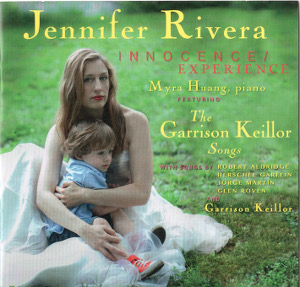
Innocence/Experience
American mezzo-soprano Jennifer Rivera, with pianist Myra Huang, has recently released a CD of songs by contemporary American composers titled Innocence/Experience. There are four , fairly contrasting, sets of songs by different composers. The first group are settings of texts by Garrison Keillor with music by Robert Aldridge. The texts are predictably sentimental and the music is rather retro. It sounds like it might have come from a musical comedy in the 1940s. It’s not inappropriate for the texts but seems a little out of time. It suits Rivera’s voice though. Her strength is definitely in the lower register where there is a pleasing smokey tone.
New Voices
New Voices is the latest CD from the Brooklyn Art Song Society. It features songs by Glen Roven, Michael Djupstrom, James Kallenbach and Herschel Gerfein. What most struck me was the retro feel of all four composers’ works. We are in a tonal sound world with occasional jazz/folk inflections and the piano line is clearly written to support the voice. One might be listening to, say Ned Rorem. I say this because it’s such a contrast with the songs being written by contemporary Canadian composers with their chromaticism, experimental and frequently changing time signatures and often almost adversarial relation between voice and piano. Which one prefers, of course, is a matter of taste.
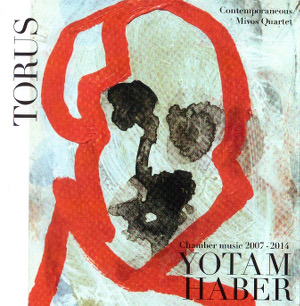
Torus; chamber music by Yotam Haber
Yotam Haber’s album Torus is a bit off the beaten track for me but there’s some art song on it (for some value of art song) and it has Mireille Asselin singing on one track so I thought I’d check it out. There are five pieces, written between 2007 and 2014, on the album. The first two are vocal numbers. We were all is a setting (for some value of setting) of Cherries by Andrea Cohen. It’s unlike conventional art song in that fragments of text are broken up, repeated and interwoven in driving repetitive pattern something like some of Steve Reich’s music. The other vocal piece is rather different. On Leaving Brooklyn is a setting of Julia Kasdorf’s After Psalm 137. It has a declamatory vocal line set over a sort of minimalist accompaniment. This is the one with Mireille singing.
I Dilettanti
I Dilettanti is an album from Catalan countertenor Xavier Sabata accompanied by members of the Greek baroque group Latinitas Rostra with Markellos Chryssicos at the harpsichord. The works on the disk are all from the late 17th and early 18th century and are by, as the title might suggest, people who aren’t primarilyknown as composers such as the singer Vincenzo Benedetti and the nobleman/adventurer Emanuele d’Astorga. The format of the pieces too is relatively unfamiliar. All but two tracks are chamber cantatas, probably intended for domestic entertainment rather than theatre or concert hall. The exceptions are two arias from Ruggieri’s Armida Abbandonata though as they are presented here, like all the other works, just basso continuo accompaniment they don’t sound obviously different.
Thank you for flying Current Air
When I saw Brian Current’s Airline Icarus this summer in a staged version by Tim Albery I thoroughly enjoyed it but had this nagging feeling I wasn’t completely getting it. First time through with the CD I had the same reaction. It was only when I printed out Anton Piatiogorsky’s libretto and listened with that in front of me that I began to feel I was finally understanding this somewhat enigmatic work. I realized it’s a structural thing. The first two parts of the piece are essentially realistic. It’s a black comedy involving a sort of anti-love triangle between a businessman (Geoff Sirett), a flight attendant (Krisztina Szabó) and a businesswoman (Carla Huhtanen) played out along with the terror of an academic (Graham Thomson) flying, ironically, to Cleveland to deliver a paper on the Fall of Icarus. It’s inventive and funny but then something happens. It’s very ambiguous but Current’s notes tell us that it’s inspired by the 12 -15 minutes between KAL007 being hit in the wing by a Soviet missile over Sakhalin in 1983 and its eventual destruction. The mood changes with a nervy ensemble piece about hubris and technology followed by an ecstatic aria from the pilot (Alexander Dobson) before a deceptive return to “normality” and fade out. It’s quite disturbing in its lack of resolution.
Jabberwocky
This is maybe the first time a classical CD “single” has come my way. There are just two tracks, each clocking in at six minutes and sixteen seconds and both are versions of Elliot Goldenthal’s 1975 work Jabberwocky. The first is a setting of the the well known Lewis Carroll poem for bass-baritone and woodwind quartet (bassoon, clarinet, oboe and horn). In the second the singer is replaced by a second bassoon.
An AIDS Quilt Songbook
I just listened to my new copy of An AIDS Quilt Songbook:Song for Hope and I’m in a bit of a state of shock. It’s nearly 80 minutes of music featuring many of America’s best singers and musicians singing songs inspired by AIDS along with some poetry readings. Participants include Yo Yo Ma, Joyce DiDonato, Tony Deane-Griffey, Matthew Polenzani, Isobel LeonardSharon Stone and many more. All profits go to amFAR; the Foundation for AIDS Research. www.amfar.org
To Die, to Sleep
Berlin based Canadian countertenor Michael Taylor’s album To Die, to Sleep is a collection of baroque arias recorded with the Quebec baroque chamber ensemble The Dansant. The 15 arias are drawn from assorted Handel operas, mostly Orlando, from Vivaldi’s Orlando Furioso and Graun’s Montezuma (the Frederick the Great opera). There are also some instrumental tracks with short pieces by de Murcia, Handel and Gabrielli. As you might guess from the title the material is more contemplative than bravura which might disappoint the fireworks fans but makes for very pleasant, relaxed listening. Mr. Taylor has a distinctly full sound for a countertenor and is clearly very much at home in this repertoire. The accompaniment, on period instruments is interesting and tasteful. It’s worth a listen. It’s available on iTunes (C$9.99) or from countertaylor.com.
Rob Kapilow’s Christmas offering
So it’s that time of year when Christmas records start appearing. The latest to come my way consists of musical settings by Rob Kapilow of Chris Van Allsburg’s The Polar Express and Dr. Seuss’ Gertrude McFuzz. Yes, it’s American and aimed at kids and if you were to place it on a spectrum of Christmas music that ran from Frosty the Snowman to Carols from King’s it would be decidedly closer to the former. Continue reading