
 What Brings You In is an album of music for violin and electronics that consists mostly of work that was composed for performance as part of an art installation or a site specific performance or as therapy rather than a conventional concert hall experience. It features violinist Leslie Ting and various collaborators on percussion and live electronics. It’s one of the most “experimental” records I’ve listened to. There are five tracks and I’m going to describe each piece as best I can. Conventional music vocabulary; melody, harmony, rhythm etc isn’t much help! Continue reading
What Brings You In
1
 Invocazioni Mariane is a new CD from counter-tenor Andreas Scholl and his long time collaborators the Accademia Bizantina and their conductor Alessandro Tampieri. It consists of 18th century music from Naples; all of which is in some way connected with the Virgin Mary and is mostly drawn from oratorios or similar pieces designed to be performed during Holy Week. Back in the day, with women not permitted on the stage in Naples (or the Papal States) the high parts would have been sung by castrati. That, of course, is where Scholl comes in.
 It’s an interesting idea for a CD; couple the well known (and original) orchestral version of Richard Strauss’ Vier letzte Lieder with the less well known piano version (the first three songs are arranged by Max Wolff and Im Abendrot by John Gribben). It’s exactly the sort of bold, slightly off the wall idea one might expect from Asmik Grigorian. So how well does it work?
 I’m not entirely sure how to categorise Nicholas Weininger’s All Is Mere Breath. I guess, essentially it’s an oratorio inspired by the COVID pandemic when “breath” was very much on people’s minds. It’s written for three soloists; soprano, mezzo-soprano and baritone, men’s chorus and instrumental ensemble. It mostly sets texts from the Old Testament with the soloists singing in English and the chorus in Hebrew. It concludes with the Hebrew prayer “Oseh Shalom”. It begins though, in Hebrew, with the opening of Lamentations; “How she sits alone, the city once great with people.” which I guess sums up how many of us felt in 2020. when I remember walking down an utterly deserted Bay Street in the middle of a work day. The selection of texts really does reflect “desolation” which covers quite a bit of the Old Testament really.
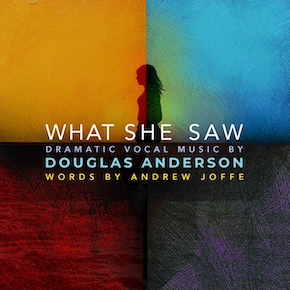 What She Saw is a new album of vocal music by New York composer Douglas Anderson. There are two works on the record. There’s a cycle of eleven Cassandra Songs for mezzo-soprano and piano and a monodrama for mezzo-soprano, piano and percussion called Through/In.
 Breathe is a new recital CD from Korean soprano Hera Hyesang Park. It’s a generous 79 minutes of music; most of it with orchestral accompaniment. There’s one piece for soprano and cello octet and also a few numbers where she’s joined by mezzo-soprano Emily D’Angelo.
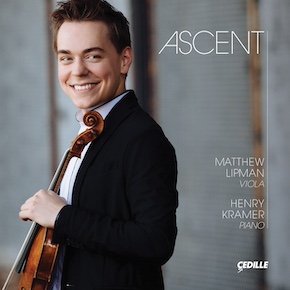 Having been impressed by violist Matthew Lipman at the two OPUS IV concerts earlier this week I decided to check out his CD, Ascent, which consists of a number of works for viola and piano with pianist Henry Kramer (currently faculty at Université de Montréal).
 Not so long ago if one wanted to do interesting electronic music things one needed a studio full of enormously expensive equipment, access to which was likely restricted to a fortunate few. Now with a few relatively inexpensive mikes, a laptop and some speakers one can create all kinds of cool stuff and perform it in almost any venue. The recording ‘m going to talk about here was made a few years ago but it’s good and pretty typical of what I’m talking about.
 Problematica is an upcoming solo CD with some interesting twists from Canadian cellist+ India Gailey. I can’t call it a solo cello CD because Gailey contributes vocals as well as some truly virtuosic cello playing and there’s lots of electronics and electronic processing involved. There are also some unusual presentation options. There are seven works by younger Canadian composers on the disk and recording engineer John DS Adams of Stonehouse Sound makes a major contribution.
 L’Étoile du Nord is an 1854 opera written by Meyerbeer for the Opéra-Comique. It follows on from a series of successful grand operas for L’Opéra de Paris. To some extent it’s an attempt to create something lighter than the early works but the composer doesn’t quite seem able to let go and the work combines comic and serious elements in a way I cannot describe as successful. Format wise it’s pretty much an opéra-comique with no ballet (though some folk/social dancing) and spoken dialogue.
  operaramblings