Unknown's avatar

About operaramblings

Toronto based lover of opera, art song, related music and all forms of theatre.

We’re Late!

werelateThe Happenstancers latest concert We’re Late! happenstanced on Saturday evening at Redeemer Lutheran.  It was a typical Happenstancers sort of event with chamber music works for various forces split up into their movements with the components then rearranged to make an interesting line up.

Lukas Foss’ Time Cycle provided the opening piece which also provided the title for the concert as a whole.  It’s a setting of Auden for soprano and chamber ensemble and begins “Clocks cannot tell our time of day”.  Which was pretty much the theme for the evening.  This was followed by Toshi Ichiyangi’s Music for Electric Metronomes which had the whole ensemble banging things rhythmically and making stylsed gestures.  Then came the first of three parts of rather a good musical joke; John Cage’s 4’33” arranged into three movements for different forces. which as might be expected cropped up at intervals during the show.  For the record the movements were scored for piano and percussion, conductor and oboe and percussion.


Continue reading

High musical values in the COC’s Fidelio

The COC opened its 2023/24 season on Friday night with Matthew Ozawa’s production of Beethoven’s 1805 attack on corruption and tyranny; Fidelio.  Ozawa gives it a contemporary American setting with all the action playing out on a sort of multi-level rotating cage.  It’s pretty effective and efficient in allowing scenes to succeed each other quite seamlessly.

23-24-01-MC-D-0445

Continue reading

OK, it’s official

I’ve known for ages that Ian Cusson was working on an opera for the COC main stage and that it was a bout a Métis werewolf legend.  It’s the sort of thing that gets me howling at a full moon.  Anyway it’s all now official and talkaboutable.  It’s called Empire of the Wild and the libretto is by Cherie Dimaline based ion her 2019 novel of the same name.  It’s a co-commission of the COC and the NAC in Ottawa and there’s no date given for the premiere yet.  (And yes I do have a bit of “I’ll believe it when I see it” given that COC commissions seem to disappear mysteriously often enough to provide the plot for a werewolf novel).  I think it’s a great subject for an opera and Ian’s record of writing for vopice and the opera stage is good so, yeah, I really want to see this.  So keep your fingers crossed it actually happens!  All the details are in the press release which is here.

cussondimaline

UoT Opera in the RBA

UoT Opera presented a show of mostly Mozart arias/scenes in a semi staged fashion directed by Mabel Wonnacott in the RBA on Wednesday.  Although each scene was credited in the programme the parts weren’t specified and since I don’t know this new group of students I’m only gong to name names where I’m sure!

COC 9.27.23-23

Continue reading

work.txt

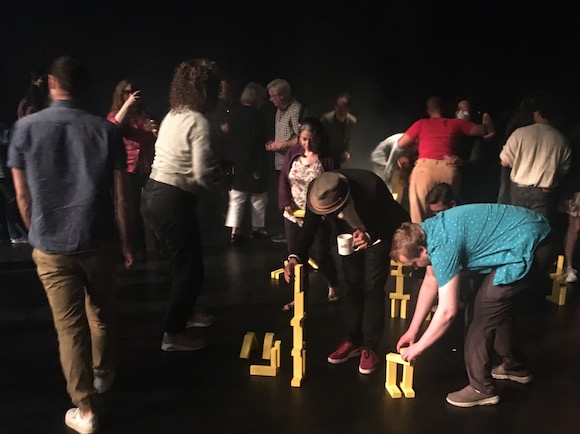
work.txt by Nathan Ellis is an interactive, participatory theatre piece that explores work. art and the end of the world.  There are no actors, except for the audience and whoever is pushing the buttons that move things along.  There’s a computer screen.  It instructs the audience what to do, what to say, what to sing.  It asks for volunteers.  But the volunteers don’t know whether they will be given a task that lasts seconds or whether they will play a major role in the unfolding drama.  One volunteer becomes the principal protagonist of the show.  They alone have a name.  But I’m jumping ahead.  First we must create the city where millions go to places called “workplaces” to do stuff called “work”.  We do this with Jenga blocks.  It’s fun and looks cool.  But back to our protagonist.

building

Continue reading

Mon amant de Saint-Jean

monamourdesaint-jeanThis is a really interesting and unusual album.  French mezzo-soprano Stéphanie d’Oustrac teams up with a small baroque ensemble, Le Poème Harmonique (accordion, theorbo, strings, bassoon/flute) led by Vincent Dumestre to present a selection of music that ranges from traditional songs through 17th century opera/oratorio arias to cabaret music and modern chansons.

The music is grouped into Three “life stages”; Jeunesse, Les vieux airs and Les amours passée; a sort of lifetime of music.  I was really excited after the first four numbers because they were touching a whole bunch of things I really love; jazzy cabaret on played freely on baroque instruments, traditional music sounding a bit like a band like Malicorne, a freedom of vocal expression etc.  It did quieten down a bit after that with arias by Cavalli and Monteverdi sung in a properly period appropriate way but also other music freely interpreted by all the musicians.  It finishes up in a fun way too.  There’s a very silly song; Les canards Tyroliens, which features yodelling and coloratura ducks. Then there’s a tango and a plangent rendering of the title track.

Continue reading

Der Wald

RES10324 Smyth Der Wald coverDame Ethel Smyth’s one act opera Der Wald is certainly of some historical interest.  It was the first opera by a woman given at the Metropolitan Opera.   That was in 1903 and 113 years would pass before the Met did another one; Kaija Saariaho’s L’Amour de loin in 2016.
It’s about an hour log and in English (sort of).  Musically it’s pretty good but the libretto is rather awful.  The plot concerns a forester and his fiancée, a deer hidden in a well (and anyone who has seen Tosca knows what a good idea that is!), a vengeful aristocrat who happens to be the mistress of the local lord and a peddler.  In a nut shell, the hero Heinrich chooses to be executed for poaching rather than “serve” the lady Iolanthe.  I suppose that’s no dafter than a lot of opera plots but throw in a sort of archaic English that makes the libretto sound like it was written by a drunk Pre-Raphaelite and ’tis pity ’tis so twee. Continue reading

Ensemble Studio in the RBA

As tradition dictates the opening concert of this year’s free concert series in the Richard Bradshaw Amphitheatre was given bt the singers and pianists of the COC’s Ensemble Studio.  It was reasonably well attended but the days when people queued around the block for this concert are long gone, which is symptomatic of the general state of the classical music world post COVID.

First up was Queen Hezumuryango with Sesto’s aria “Svegliatevi nel core” from Handel’s Guilio Cesare.  All the fire required for a revenge aria was there and some interesting dark colours in the lower end of the voice.  I’m not convinced though that it’s a voice I would cast in this role.  The darkness of the voice, appealing as it is in many ways, is likely not what Handel; writing for a soprano, had in mind.

Korin Thomas-Smith; last seen by me in his Norcop prize winner recital, gave a very smootgh and polished version of Malatesta’s aria “Bella siccone un angelo” from Don Pasquale.  I want to see more of him in opera because he’s a very fine Lieder singer.

COC Noon Concert-45

Continue reading

In Time

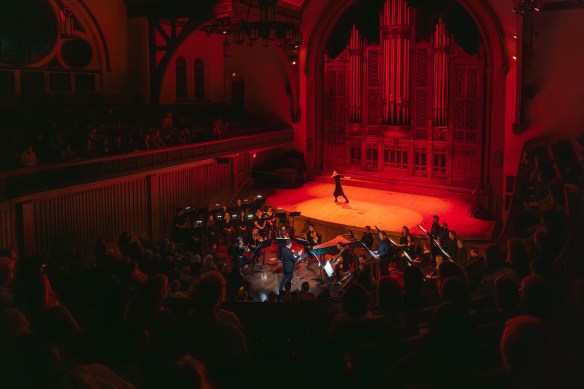
Friday night saw the first concert of the Toronto Mendelssohn Singers’ 2023/24 season at Jeanne Lamon Hall.  It was an intriguing programme both in the choice of music and in the use of dance in the presentation.  The bookends were two works written in 1707 by two 22 year olds; JS Bach and GF Händel.  The sandwich filling, as it were, was To the Hands by Caroline Shaw.

Bach’s Christ lag in Todesbanden BWV 4 takes us on a journey from dark to light with each movement or verse being a variation on the basic Lutheran hymn from which the text is taken.  It uses choir, strings, harpsichord and rgan to good effect.  The bonus here was a black clad Laurence Lemieux dancing an expressive, if somewhat lugubrious, choreography on the stage behind the musicians.

DSC01976-Enhanced-NR-Edit

Continue reading

Das Floß der Medusa

DasFloßderMedusaProbably pretty much everyone is familiar with Géricault’s painting Le Radeau de la Méduse, depicting scenes of horror after a shipwreck.  The story behind it is much less well known.  The year is 1816 and a French expedition is off to reoccupy Senegal which had been occupied by the British during the recent wars.  The flagship of the expedition is the frigate La Méduse, which carries the governor and his staff and so on.  Well ahead of the rest of the flotilla, and out of sight, La Méduse runs aground and is eventually abandoned.  The governor, the officers and other nobs take to the boats towing the rest of the crew (154 men and boys) on a hastily improvised raft.  Finding progress too slow after 24 hours they cut the raft adrift.  When the raft is finally spotted fifteen men are still alive. A fitting allegory for the Bourbon restoration perhaps. Continue reading