

So here goes the usual annual round up of the best things I’ve come across in a very busy 2023.
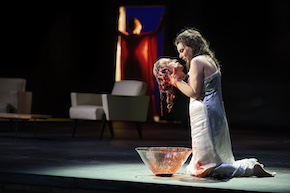
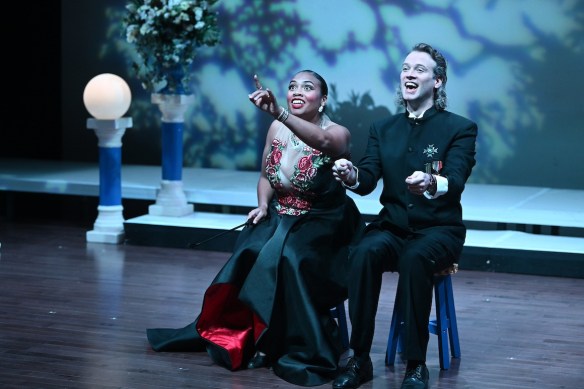
Opera – It’s been a rather thin year for opera in Toronto. The indie scene has been slow to make a comeback and programming at the COC has been ultra conservative. There have been some worthy efforts at both UoT Opera and the Glenn Gould School but nothing quite up to “best of” standard. So my first pick is Salome at the COC; largely for Ambur Braid’s performance of the title role with bonus points for Atom Egoyan’s Seven Veils spin off. I was also very impressed with Opera Atelier’s take on Handel’s La resurrezione. It’s one of the best things they have done in a while with a particularly moving performance by Meghan Lindsey as Mary Magdalene. The one really notable indie show of the year was Against the Grain’s chamber scale version of Bartók’s Duke Blubeard’s Castle with Gerald Finley and Charlotte Hellekant. Continue reading
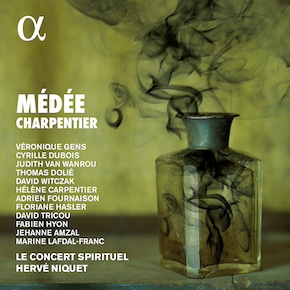 Cherubini’s Médée of 1797 is undergoing something of a revival at the moment albeit in an Italian version. But there’s an earlier and less known version of the same story with a libretto by (as opposed to based on) Corneille. It’s Charpentier’s Médée of 1693. It’s a tragédie lyrique with all the expected elements; an allegorical prologue in praise of Louis XIV, a classical subject, five acts, gods, spirits and demons and lots of spectacular theatrical effects. The Lully formula in fact.
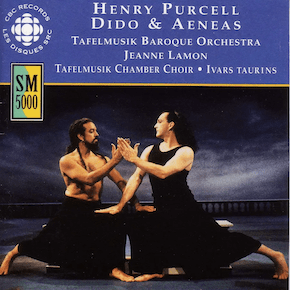 To round out this mini survey of the early discography of Purcell’s Dido and Aeneas I’m going to fast forward a bit to the 1995 recording by Tafelmusik. The most striking thing about this version is the very small instrumental ensemble; two violins, viola, violincello and harpsichord led by Jeanne Lamon. One quickly gets the feel for how they are going to perform with a very fast and rhythmically sprung overture.
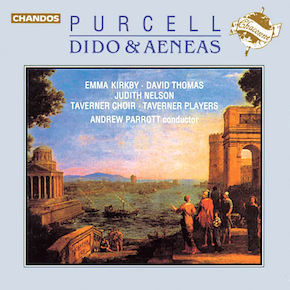 And so we come to the third in our historical sequence of recordings of Purcell’s Dido and Aeneas. We are talking about Andrew Parrott’s recording with the Taverner Players and Choir recorded at Rosslyn Hill Chapel in 1981. It’s a record that I bought when it first came out and has been a point of reference for me ever since.
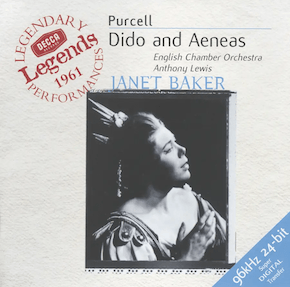 So, to continue our look at the recording history of Purcell’s Dido and Aeneas we turn to the 1961 Decca recording with Janet Baker in the title role. This has won so many awards and featured on so many “best of” lists that it might reasonably be considered to serve as some sort of “gold standard”. It’s certainly very good but I’m more interested in looking at what it says about the evolution of performance practice of Dido and Aeneas than in adding to the praise for Dame Janet’s performance.
 Purcell’s Dido and Aeneas has a long and dense history in the recording studio. The first recording dates back to 1935 and the vast stream of recordings since serve as a kind of barometer of the changes in style in performing 17th century music. I haven’t listened to every recording but I can look at four key moments in the discography and compare them. I’ve also listened or watched a fair number of fairly recent productions. The video review page has six entries for this work; all 1995 or later. There are also five reviews of live productions and reviews of several related shows. But for the purposes of this mini-project I’m going to look at four recordings that take us from the early 1950s to the mid 1990s. The four recordings are:
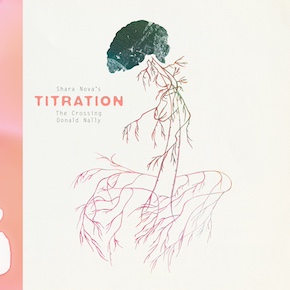 Titration is a song cycle for unaccompanied choir by American composer Shara Nova. On the CD it is performed by The Crossing and their conductor Donald Nally. It’s an interesting and unusual, indeed quite unconventional, piece but it is oddly compelling and has won a fair bit of recognition including a Gramophone “Critics Choice” award this year.
 operaramblings