David Cangelosi, who is in town to sing Spoletta in the COC’s upcoming Tosca has an interesting blog post about the buzz in the business about the COC. Check out the comments. I’d bet my mortgage (if I had one) that “Alan H” is Alan Held who will sing in the Zemlinsky/Puccini double bill in the spring. It’s good news indeed that he has more work here booked. FWIW, Lawrence Brownlee said similar things to me about the COC in a conversation late last year when he was in town singing in La Cenerentola. Like Cangelosi I’ve been impressed by the current management’s willingness to experiment both with new repertoire and bold productions. Keeping the seats full in the face of an audience with a significant ultra-conservative section and local newspaper critics who are both ignorant and conservative will be tough but I hope they stay the course.
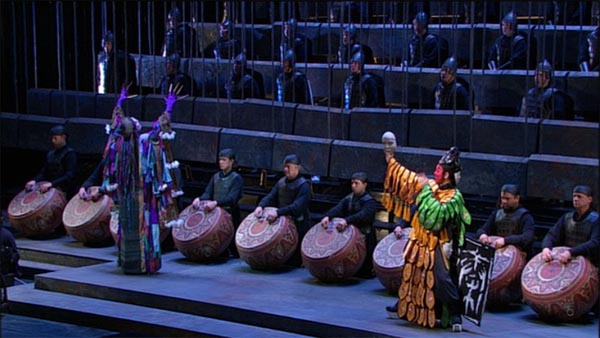
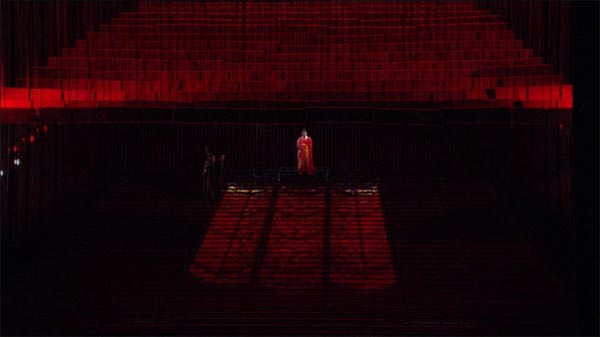
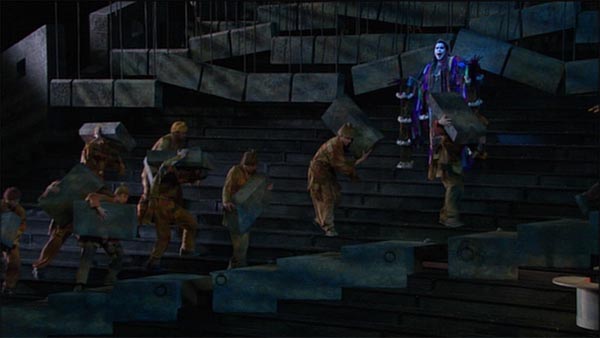
The design and production team that created the production of Tan Dun’s The First Emperor at the Metropolitan Opera in 2006, broadcast in HD in January 2007 and subsequently released on DVD, deserve the highest praise. Set designer Fan Yue, costume designer Emi Wada, lighting designer Duane Schuler, choreographer Dou Dou Huang and director Zhang Yimou (of Raise the Red Lantern fame) create some absolutely stunning images making full use of the great breadth and depth of the Met stage. Unfortunately the libretto and the music aren’t nearly as good and despite extremely committed performances from soloists, chorus and orchestra the work never quite gels.
So what is The First Emperor? It’s a two act opera based on the life of the emperor Qin unifier of China, builder of the Great Wall and ultimately buried with the famous terra cotta soldiers. In Tam Dun’s version of the story he, besides conquering China, is looking for the ultimate anthem to celebrate his life which will be produced by his childhood companion Gao Jianli. There’s a love triangle involving Gianli, the princess Yueyang and the general Wang. In true operatic style they all end up dead and Gianli’s revenge is that Qin’s anthem turns out to be the lament of the slaves building the Great Wall. It includes the line “When will our suffering end?” which was about what I was thinking by that point.
The problems, as so often with modern opera, start with the libretto. There is no poetry, literal or figurative, in it. It’s banal in the same way that most of the libretto of Doctor Atomic is banal. Mostly the vocal line is set in a dull declamatory style though the princess gets some passages with some coloratura interest and the chorus gets some Peking Opera like writing. What goes on behind, and almost independently, of the vocal line is all over the map. Sometimes it’s derived from the Peking Opera and sometimes from Chinese folk music; the mix at times sounding like the soundtrack for a Chinese propaganda film. At times it recalls the dissonances of modern European art music and at others it sounds like watered down Andrew Lloyd Webber. Write at the beginning the emperor asks “Is this music?”. I’m not sure he gets an answer. It’s got some good things going for it. There is some really good writing for percussion and the opening sequence using a Peking Opera trained singer, Wu Hsing-Kuo, as the master of ceremonies is weirdly affecting (this is the bit that got played over and over as the test track for subsequent Met HD broadcasts). All in all it doesn’t really cohere.
The performance is pretty good though. The stand outs are Wu Hsing-Kuo and Elizabeth Futral as the princess. Placido Domingo is, of course, solid as the emperor but really he doesn’t have much to work with. Good solid work too from Paul Groves as Jianli and Michelle deYoung as the shaman. The Orchestra and Chorus do wonderfully well coping with some highly unusual demands. For example, there is a passage where the orchestra downs instruments and engages in a sort of pitched shouting. There’s a whole core of Chinese percussionists too. The composer conducts with great fire.
Direction for video by Brian Large isn’t bad. It’s heavy on the close ups but there are enough setting shots to give us context. The picture is very good by DVD standards as one might expect but one really wonders(1) why this didn’t get a Blu-ray release for if any of the Met HD productions would have benefited from the extra video quality it’s this one. Sound is solid DTS 5.1 with LPCM stereo as an alternative. There are English, French, Italian, German and Spanish sub-titles. The documentation (English only) includes an essay on Tan Dun’s musical style and a synopsis. There is further English, French and German documentation included in PDF format. There is also a 20 minute rehearsal bonus track and a short interview with Domingo.
fn1. One doesn’t really wonder. For whatever reason it’s an EMI release and they don’t do Blu-ray.
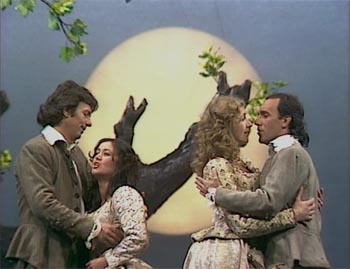
Peter Hall’s 1981 Glyndebourne production of Britten’s A Midsummer Night’s Dream was quite celebrated in its day. How does it wear, thirty years later? The bottom line is it looks and sounds a bit tired.
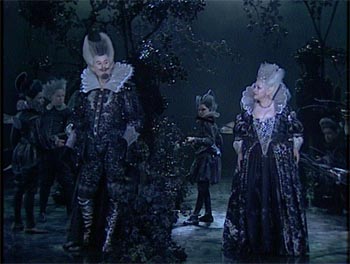
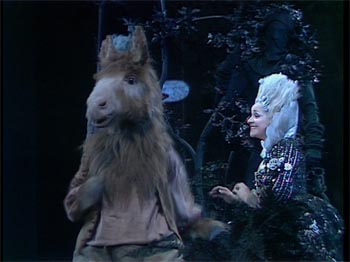
The production was innovative in its day. The scenery in the forest is inhabited by supers who make it, in a sense, “enchanted” and the lighting is interesting (at least so far as one can tell on the DVD). The problem is it never manages to generate any sense of menace from the world of the Fairies without which, to me at least, Dream (Britten’s version or Shakespeare’s) is insipid. Part of this lies in the old fashioned counter tenor sound of James Bowman and part in the very childlike fairies. As a result the first act starts very slowly and the Hermia (Cynthia Buchan) and Lysander (Ryland Davies) scene fails to spark. The “I swear to thee” duet is really slow and a bit lack lustre. Things do liven up a bit with the entry of Demetrius (Dale Duesing) and Helena (Felicity Lott). All in all Act One is a bit of a snooze.
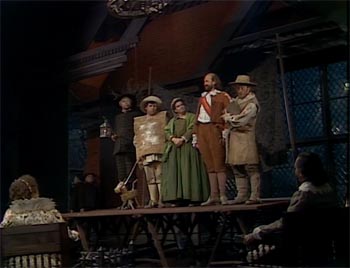
Act Two is better and the cat fight between Hermia and Helena is funny but there is still little element of menace. Oberon can’t even make “This is thy negligence” threatening and even the scenes with Bottom having an ass’ head don’t really have any bite. The Act Three lovers’ quartet is lively but Act Three really turns on whether the Rude Mechanicals are actually funny. That takes close to a miracle from both director and singers and a miracle just doesn’t happen here. Both Bottom (Curt Applegren) and Flute (Patrick Power) have their moments but it never gels. Throughout it’s fairly static with only Damien Nash’s “cheeky chappy” Puck creating much movement. So, lack of both menace and humour rather undermines some interesting design elements.
Musically this is pretty mixed too. Especially in the first act the orchestral playing seems oddly unfocussed. It’s partly a matter of tempi. Bernard Haitink is eight minutes slower overall compared to the composer’s studio recording for Decca. He also fails to get the rhythmic attack and dynamic range out of the LPO that Britten gets from the LSO. (Part of the problem here may be the soft recorded sound versus John Culshaw’s excellent Decca recording). The overall effect is a bit insipid. The singing is OK but really only Duesing and Lott stand out vocally. Ileana Cotrubas as Tytania is oddly anonymous.
Dave Heather directed for TV and video and it’s a typical early 1980s directed for TV effort. I don’t think the whole stage (and this is the old, small Glyndebourne stage) is visible even once. The picture is 1981 quality too. It’s soft by DVD standards. There is flickering on the subtitles. Don’t watch from too close on a modern TV. The Dolby 2.0 sound is barely average. There’s no real depth and at times the orchestra seems to be muffled. It’s not remotely as good as the sound on the 1966 studio recording. There are English, French and Spanish subtitles, no extras and minimal documentation.
I haven’t seen the only other Dream currently available but it’s a recent Robert Carsen production from Barcelona with Harry Bicket in the pit and David Daniels as Oberon plus video direction is by the excellent Francois Roussillon. I’d certainly advise taking a look at that before buying this one.
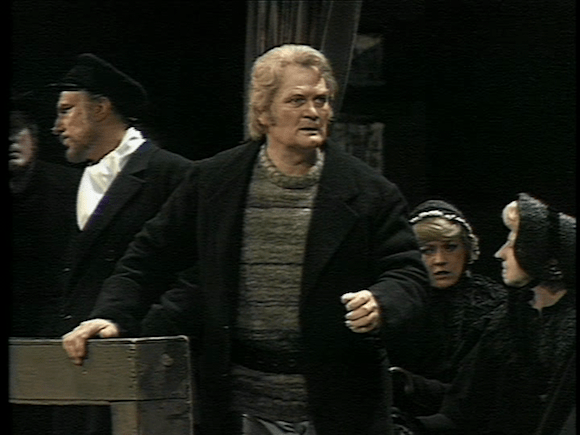
When the Royal Opera House mounted a new production of Britten’s Peter Grimes in 1975 with Canadian heldentenor Jon Vickers in the title role it was controversial. Whatever else one could say about it Vickers’ interpretation of Grimes was very different from that of Peter Pears for whom the part was written. Britten, it was said, hated it. I saw it that summer and was pretty impressed but then seventeen year olds impress easily. I certainly never expected that the young baritone singing Ned Keene would end up as a knight and Chancellor of the university where I began my degree a few weeks later. When the production was revived in 1981 there were some significant cast changes. Norman Bailey had replaced the retired Geraint Evans as Balstrode, Philip Gelling was in for Thomas Allen as Ned Keene and one John Tomlinson had taken over as Hobson the carter. The incomparable Heather Harper remained as Ellen Orford. It’s the revival cast that was recorded and broadcast by the BBC and which is available on DVD from Kultur in the Americas and Warner Video elsewhere.
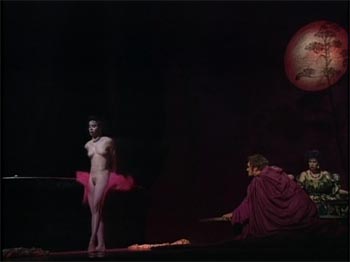
Sir Peter Hall’s production of Strauss’ Salome caused a bit of a sensation when it was first seen at the Royal Opera House and when it was broadcast on Channel 4 because Lady Hall, Maria Ewing, finishes up naked at the end of the Dance of the Seven Veils. How well does it wear after twenty years? First a couple of caveats. My DVD copy is the Kultur release of a few years ago. It now seems to be available from Opus Arte and it’s possible, indeed likely that some of the sound issues have been fixed in that release. If anybody has seen the Opus Arte version please let me know in comments. Anyway, the Kultur release has rather muffled sound with the voices balanced well back from the orchestra and no real solidity to the sound stage which is a pity in this particular work and obviously affects my view.
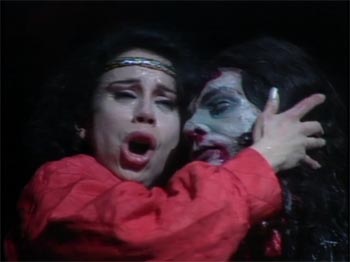
The production is really pretty conventional. There are lots of greens, greys and blue. It’s quite dark and the set is stagey and conventional. Almost all the visual interest revolves around Ewing’s Salome though Michael Devlin’s scantily clad and palely made up Jochanaan is quite arresting too. Narraboth (Robin Legate) is an unremarkable actor and Herod (Kenneth Riegel) and Herodias (Gillian Knight) look uncomfortably like a couple of drag queens. The latter though does manage a pretty effective hissy fit. For the sound reasons mentioned above it’s hard to be sure whether the rather insipid vocal performances by Devlin and Leggate are really their faults. There’s also no change in acoustic when Jochanaan is singing from the cistern which is odd. Riegel and Knight do better at projecting themselves beyond the orchestra and turn in OK performances.
All that said, one feels from beginning to end that this was set up to be the Maria Ewing show. One really can’t fault her acting which is quite compelling and manages by turns to be chilling, hypnotic, seductive, perverse, frenzied and orgasmic. The choreographer (Elizabeth Keen) does a pretty good job of creating credible dance moves for someone who clearly isn’t a great dancer though there’s no doubting her commitment to what she does. Vocally she gets away with a voice that’s really not big enough for the role. Somehow she manages a lot of projection from not so much volume and her vocal acting is good. It’s an extreme case of Ewing pretty much making things work when really they ought not to. The orchestra under Edward Downes sounds OK but also suffers from the recording.
The recording, directed by Derek Bailey, is about what one would expect from a 1992 TV broadcast. The picture quality is acceptable but not great 4:3 with hard coded English subtitles. Sound, as mentioned, is barely adequate. There are no extras and no documentation.
This is probably worth having a look at as a record of an iconic performance by Ewing but I can’t imagine anyone would choose it as the definitive Salome.
And just for fun, here’s a non-operatic bonus; a set of pictures of my copy of the 1938 edition of Wilde’s Salomé with pochoir illustrations by André Derain.
I’ve been wondering about whether to bother with the Decker production of La Traviata when it gets its MetHD broadcast in April since I own the Blu-ray of the original Salzburg 2005 production. So, it seemed like a good time to take another look at the disc.
I like this production more every time I see it. The overall concept of a Violetta who knows she is dying and is pretty consciously counting off the days works really well. The set is basically a curved wall with a clock and some sofas. There’s a lot of empty space and that’s entirely deliberate and serves effectively to reinforce Violetta’s alienation. The use of the chorus is interesting too. This is no jolly band of party goers. Rather, the chorus comes across as quite feral; a pack of wild dogs in evening dress. The character of the doctor does double duty too. He haunts the set almost throughout and from the very beginning. It’s hard not to think of him as Death though I don’t think Decker ever came clean on whether it’s supposed to be that explicit. When Violetta sings of “sterile pleasure” it’s quite clear what she means.
In Act 2, the country idyll is symbolised by flowery drapes over the sofas and, crucially, the clock. It’s the only time the clock is hidden. Violetta and Alfredo romp in flowery dressing gowns and underwear. The Germont senior arrives and as Violetta’s hopes dissolve she rips the flowery drapes away revealing both the clock and herself. The countdown has begun again. Back in Paris, the chorus is more cruel than ever playing out a vicious pantomime of Violetta before becoming a crowd of leering onlookers as Alfredo stuffs money into Violetta’s dress and mouth. The entry of Germont senior parallels actions of the doctor/Death earlier in the piece. There’s no break at the end of Act 2. The doctor very slowly forces the chorus off stage taking the clock and the pantomime Violetta with them to leave the stage completely bare. The rest of the action plays out with the characters widely spaced across this vast empty space.
It’s all very well thought through and consistent. There are many, many deft directorial touches (probably far more than we see on disc – see below) and the overall effect is very powerful.
It’s pretty much a dream cast. Netrebko in 2005 was just about perfect in every way for Violetta and she throws herself into the role with abandon. She’s not at all afraid to take physical risks and she sings really well. Her voice has power and brightness and her coloratura is spot on. She can also be lyrical and affecting when needed. Her interpretation is absolutely at one with Decker’s. Her “sempre libera” is quite chilling and there is real intensity in “Addio del passata”. Rolando Villazon’s Alfredo is a very good match. Salzburg caught him, too, at his very best and he doesn’t put a foot wrong. I’d go on at more length but this really is the Netrebko show! Thomas Hampson as Germont senior is a bit more of a conumdrum. Is he sincere or is his whole persona an elaborate bourgeois facade? Hampson doesn’t really tell us though he sings with his customary refinement and intelligence. Luigi Roni as the doctor deserves a special mention too. He only has a few lines to sing but his overall presence is huge. Carlo Rizzi conducts a polished performance from the Wiener Philharmoniker.
So where’s the fly in the ointment? Surprise! It’s the video direction of Brian Large. Emptiness and space are central to this production and Large can’t bear to give us space. We do get just enough framing shots to allow us, with a bit of imagination, to figure out what the director is doing but mostly it’s relentless close ups. He produces a particularly pointless example of switching back and forth between close ups in “Che e cio?” when he seems to think he’s filming Wimbledon. It doesn’t help that the framing shots we do get are, unaccountably, taken from high stage left. So grrr (and not the word I have written on my notepad because my mother may read this).
Technically the disc is very good. The picture is 1080i HD (maybe just a hint of ghosting on low light level shots) and the sound is very vivid DTS HD Master Audio 5.1 (LPCM stereo optional). Subtitles are IT, FR, EN, ES, DE, IT and CH. The documentation is a bit more generous than usual with a track listing and a synopsis in EN, FR and DE. There’s a useful and entertaining “making of” documentary which suggests that directing Villazon and Netrebko is easier and a lot more fun than directing Hampson! (Some people are perhaps just too smart).
So after all that how do I feel about seeing the Met production? If I could see it live I’d be there in a moment. Can I bear to see it butchered by another inept video director? I don’t know. It should be a good vehicle for Natalie Dessay though.
Pretty much all of this production is available on YouTube if that’s your thing. Here’s an excerpt.
Herewith a personal take on the best things that came my way operatically in 2011.
Live performances
It was a pretty good year for live opera in Toronto. I’m certainly not going to complain about two Robert Carsen productions in the same calendar year. Good though the Gluck was though top honours in the fully staged opera in a real theatre go to the COC’s Ariadne auf Naxos. Neil Armfield’s production was fairly conventional but the music making was superb. Adrienne Pieczonka, Jane Archibald and Alice Coote headlined with strong support from Richard Margison and a whole bunch of past and present Studio Ensemble members. The orchestral playing too was absolutely first class and Sir Andrew Davis conducting looked like he was enjoying it as much as the audience. Later in the year I think we had a bit of “a star is born moment”. Christopher Alden’s Rigoletto was challenging enough that I wanted to see it a second time so took the chance to get a cheap ticket for the B cast. Thus I got to see the extraordinary chemistry between two very fine young singers; David Lomeli and Simone Osborne. Go see them if you get a chance. Actually, nothing at the COC seriously disappointed in 2011 (well maybe the The Magic Flute had a bit of a 200th performance of my career feel to it.) It looks like we are moving at last into an era when Toronto gets consistently high class singers and conductors in decent or better productions. It’s a shame there are only seven productions per year.
As for smaller venues, highlights included Against the Grain’s funky La Boheme in the highly outlandish setting of the Tranzac Club and Queen of Puddings’ world premiere of Ana Sokolov’s Svadba – Wedding; an hour long piece for six unaccompanied female voices. There were also any number of excellent free lunchtime concerts in the Richard Bradshaw Amphitheatre.
DVD
The surprise highlight of the year for me was the restored print of the 1961 Rosenkavalier from Salzburg. Everything about it is surprising and wonderful and undermines a great deal of received wisdom about opera in that era. Other personal discoveries were the Salzburg King Arthur (who knew Germans could be funny?) and Calixto Bieito’s truly disturbing Wozzeck starring Franz Hawlata at his very considerable best.
Personal epiphany
I started the year thinking I didn’t really like John Adams much. I had hated the Met broadcast of Doctor Atomic and while I liked some of the non-operatic stuff rather more I wasn’t a fan. After watching Nixon in China twice in 24 hours (COC on the Friday night followed by the Met broadcast on the Saturday) and attending a lunchtime concert of arias introduced by the composer and sung by Peter McGillivray and Betty Wayne Allison I was converted. I even went back and watched the Amsterdam production of Doctor Atomic on DVD. I still think Doctor Atomic has its weaknesses but Nixon in China is pretty much a masterpiece.
On-line stuff
I started this blog as a way of keeping up writing analytically while I wasn’t working. It’s helped keep me sane. Through this and Twitter and other on-line stuff I’ve met some really cool people in 2011; some in meatspace including Lydia of Definitely the Opera, Cicely Carver from COC, couturier Rosemary Uhmetsu and up and coming soprano Simone Osborne. On-line folks who have helped this year along are really too numerous to mention individually but thanks anyway!
Other stuff that happened
I met Lawrence Brownlee and Leonardo Vordoni in the cinema at a MetHD broadcast! I discovered that baritone Brett Polegato (one of the funniest people in opera) has a little grey cat called Lady Jane Grey just like my little grey monster.
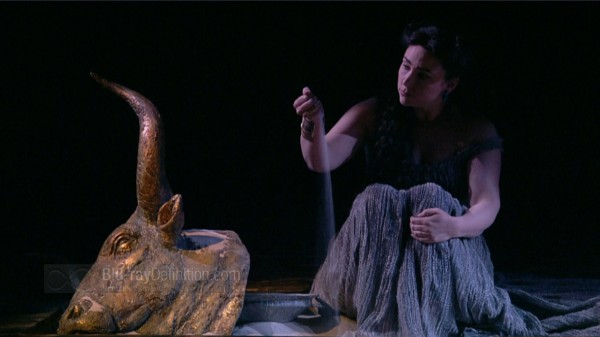
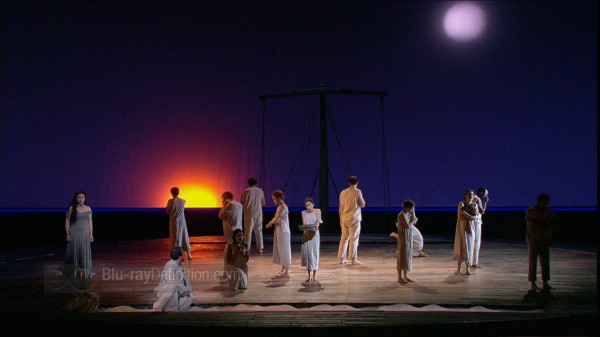
Harrison Birtwistle’s The Minotaur premiered at the Royal Opera House in 2008 and got a DVD and Blu-ray release on Opus Arte not long after. It’s the sort of work I’m susceptible to. It’s a truly integrated music drama based on a classical, indeed universal, theme carried off without any kowtowing to current ideas of trendiness. I’ve watched it a few times now and like most modern works of substance it reveals more with a bit of time and effort.
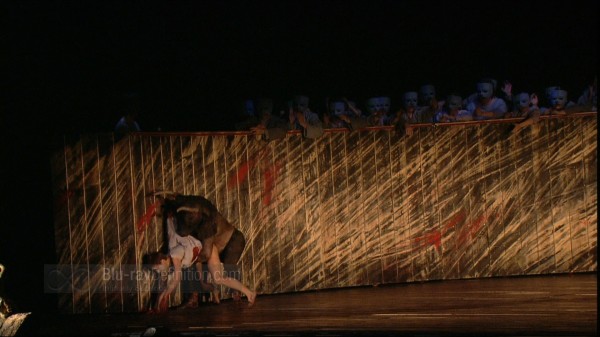
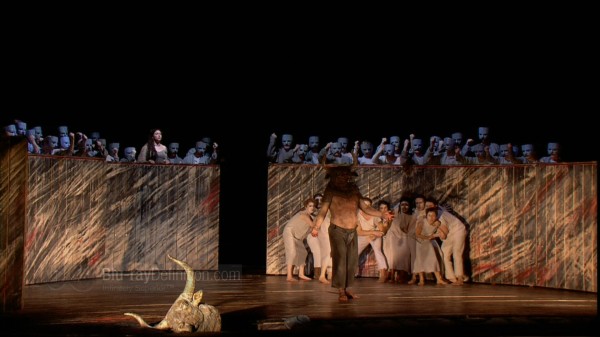
Librettist David Harsent’s take on the Minotaur myth is not at odds with versions many people will be familiar with (though whether in this day and age I’m not at all sure it’s safe to assume, as Harsent does, that “people are going in with a basic knowledge of the story”) but it does add some interesting ideas. His Minotaur, Asterios in this story, is articulate as a human only in his dreams and his dying moments. At these times he sings in English. As the awake monster in the Labyrinth he is restricted to inarticulate grunts. Also original is Harsent’s take on the relationship between Theseus and Ariadne. He sees this as a thoroughly corrupt relationship based on mutual need but riddles with disgust rather than love and so looking forward to the abandonment on Naxos. It works rather well. With those concepts in place we get a pretty straightforward account of the standard myth with some thoroughly brutal scenes of Asterios killing (and in one case raping) the Innocents in the Labyrinth to the blood curdling encouragement of a masked chorus of spectators. Another non-canonical addition at this point is the introduction of the truly horrific Keres who appear to feast on the bodies and the souls of the victims. It all leads up naturally to the death of Asterios at the hands of Theseus.
Birtwistle’s score is dense, multilayered and uncompromising. It’s clearly Birtwistle and makes no concessions to the current trend to try and make opera sound like a Broadway show. It’s not an easy listen but it repays a bit of effort and contains many interesting and deft ideas. For example Ariadne is paired throughout with the alto saxophone. Sometimes it takes up her singing line and carries it forward, sometimes it doubles her line and so on but nowhere does the saxophone interact with any other character. There’s a similar relationship between Theseus and the more conventional woodwind elements of the orchestra.
The design and direction; Alison Chitty and Stephen Langridge respectively, are very well integrated and are brilliantly supported by the lighting design of Paul Pyant. The result is some quite striking stage imagery that supports the changing moods of the piece really well. They also give us the mask that Asterios wears. It’s a framework affair so depending on the lighting Asterios can be fully beast or his human face under the mask can be made more present. It’s subtle and effective.
The performances are pretty much flawless. John Tomlinson, as Asterios, excels in a piece created for him. Christine Rice as Ariadne manages some really difficult music and a really long sing (she’s on stage nearly all the time) equally well. Johan Reuter (Theseus) has slightly off English intonation but sings powerfully and acts well. There are some excellent performances in the minor roles. For my money the best of these is the First Innocent of Rebecca Bottone who manages to look incredibly fragile but totally convincing during what is perhaps the most visceral scene of all where she is raped and killed by Asterios. There are very good cameos too from Amanda Echalaz as Ker and Philip Langridge as Hiereus. Antonio Pappano conducts and gets the necessary out of both orchestra and chorus.
The video direction is very good indeed. It appears to be a joint effort by Leo Warner and Mark Grimmer. The balance of setting shots and close ups is judicious and the close ups aren’t too close. They eschew silly camera angles. The picture on Blu-ray is 16:9 1080i and very good indeed. Sound is DTS 5.0 HD Master Audio and presents a vivid sound picture with good depth and breadth (PCM stereo also available). There are English, French, German, Spanish and Italian subtitles. The documentation includes a useful essay on the music and the disk has a 32 minute “Making of” documentary that is more informative than most of its kind.
All in all, this is a very impressive work, beautifully realised on stage and well presented on disk.
For the record the Opus Arte trailer and the whole piece are available on YouTube but the AV quality is appalling.