Unknown's avatar

About operaramblings

Toronto based lover of opera, art song, related music and all forms of theatre.

Flashbacks

I’ve been banished from the living room and so the home theatre by the lemur practicing for a dance recital.  As a result I’m listening, on my iPod, to Solti’s recording of The Ring, which I was introduced to nearly four decades ago.  Listening to Das Rheingold again today after a long lay off I’m struck by how utterly brilliant it is.  Gustav Neidlinger’s Alberich is a marvel.  He’s singing lyrically not snarling or barking and it sounds quite lovely.  Solti’s command of rhythm is astonishing.  One could dance to this!  And has John Culshaw’s sound engineering ever been bettered?

Still wonderful as it is it’s having much the same effect as Proust’s madeleine.  I first heard this recording (on vinyl of course) courtesy of the man who taught me Applied Maths for ‘A’ level .  He was a rather sad old chap but he introduced me to Wagner, Quad electrostatic speakers and gin.  He’s long dead of course.  So it goes.

Cool and refined Barbiere

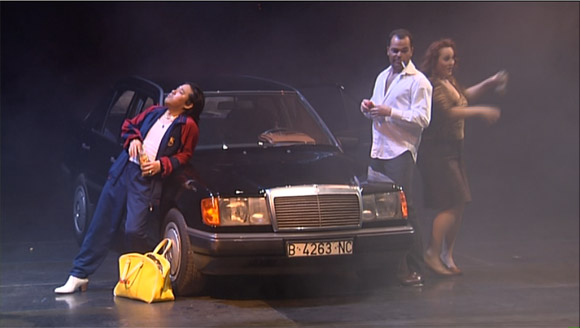
Emilio Sagi’s 2005 production of Il Barbiere di Siviglia is incredibly elegant and restrained. It looks like something by Robert Carsen.  The sets are all constructed and transformed in full view and just about everything is black and white until the final scene.  There is a lot of background action and commentary from a talented group of dancers who give a very Spanish feel to the piece.  The final scene bursts into vivid, even loud, colour and the finale is just gorgeous to look at. The direction of the actors is well thought out too though they do seem to sing from on top of furniture a lot of the time.

Continue reading

Boobs in Venice

Johann Strauss’ Eine Nacht in Venedig is a pretty slight piece.  In fact it makes Die Fledermaus look like Parsifal.  It’s set during Carnival.  There’s a visiting duke who is out to bed the last woman in Venice he hasn’t already slept with, the young wife of a doddery senator, but she’s being impersonated by her maid and her foster sister for reasons of their own while she gets off with her nephew.  The duke fails to seduce anyone.  Ash Wednesday arrives and everybody, on the surface, returns to her proper partner.  All this serves as an excuse for lots of boob and thigh flashing, some big dance numbers and lots of, by Fledermaus standards, rather dull music. Continue reading

Reflections on the COC 2011/12 season

So another Toronto season has come and gone.  I thought it was a pretty satisfying one taken as a whole.  There weren’t any total disasters and there were several productions of the highest class.  I made it to all seven shows and saw three of them twice; Rigoletto (because, among other things, it was double cast), L’Amour de Loin (because it was so good!) and Semele (because it was the production chosen for the Ensemble Studio).  I also attended the final dress rehearsal of The Florentine Tragedy/Gianni Schicchi double bill. Continue reading

It is a curious story

Miriam Khalil

Last night was the first night of a four night run for Against the Grain Theatre‘s production of Britten’s The Turn of the Screw.  These are the folks who did La Bohème at the Tranzac and The Seven Deadly Sins in an art gallery.  Last night’s space was only marginally less unconventional.  We were in some upstairs space at the Helen Gardiner Phelan Playhouse reached via the back entrance and lots of stairs.  It was a sort of loft set up so that the performance space was a narrow strip bounded at each end by a door and at the sides by three banked rows of seats.  There was seating for maybe eighty people so it was intimate, even claustrophobic.  Add to the space a few simple props, lights and a fog machine and you have the raw materials for Joel Ivany’s production. Continue reading

An engaging Semele from the COC’s Ensemble Studio

Mireille Asselin and Phillipe Sly

Last night saw the annual main stage performance by the COC’s young artist programme, the Ensemble Studio.  This year it was Handel’s Semele in the production which I saw a couple of weeks ago.  The main roles were cast from the Ensemble Studio with the the exception of the countertenor role of Athamas which was played by Ryan Belongie, an Adler Fellow.  The title role was split with Mireille Asselin singing the first two acts and Ambur Braid coming in for the third act.  This seemed like a sensible solution given the size of the role and the two singers’ strengths. Continue reading

It’s a mystery

Given all the myriad versions of Le Nozze di Figaro in the DVD catalogue (eighteen currently available) why would anyone bother with a bog standard version in 18th century dress and with a cast that probably aren’t household names in their own households?  Who (apart from the Toronto Public Library) would buy such a thing?  Anyway, that’s pretty much what you get on the 1994 Lyon recording.  To be fair, there’s nothing wrong with it.  If you saw it live in Winnipeg or Edmonton you probably would feel that you had had an OK night at the opera but why a DVD release?  It’s a mystery!

Ariodante in Spoleto

Musically, the 2007 Spoleto Festival recording of Handel’s Ariodate is very good indeed.  Unfortunately the production, at least as rendered on DVD, is a bit of a snooze.  Director John Pascoe has chosen to set the piece in 1957 to celebrate the 50th anniversary of the festival.  The court of the king of Scotland is supposed to evoke the “glamour” of the court of the young Elizabeth II.  There is also a partially twisted mirror that is supposed to remind us of the deception and self-deception intrinsic to the plot.  I only know this because of the bonus interview with Pascoe as  video director Matteo Ricchetti completely ignores it.  There’s also a recurrent appearance of an image of Ginevra (Handel having fortuitously stumbled upon le nom juste for a character supposed to remind us of Margaret Windsor) framed by the garter ribbon and motto.  Subtle. Continue reading

Very satisfying double bill

Last night I saw the Canadian Opera Company’s double bill of Zemlinsky’s A Florentine Tragedy and Puccini’s Gianni Schicchi.  I had a pretty good idea what to expect having attended the dress rehearsal a couple of weeks ago.  I said then that I thought that there was something in this show for everyone, even the most traditionalist, and I would still hold to that view if I hadn’t read the very silly review by Arthur Kaptainis in the National Post.  Apparently there are people who can’t cope with a simple change of time setting and there are editors who let them write for real newspapers.  It’s very puzzling.  So let’s just say something for anyone with a smidgeon of imagination or dramatic instinct. Continue reading