Unknown's avatar

About operaramblings

Toronto based lover of opera, art song, related music and all forms of theatre.

Upcoming shows

totFirst up is Toronto Operetta Theatre’s annual holiday offering.  This year it’s Lehar’s Land of Smiles and the cast includes Adam Fischer, Curtis Sullivan, Ernesto Ramirez and Lara Ciekiewicz.  Guillermo Silva-Marin directs and Derek Bate conducts.  There are eight performances between December 27th and January 5th including a gala performance and dinner/dance on New Year’s Eve.  Venue is the St. Lawrence Centre for the Arts and tickets are available here.

Continue reading

Die tote Stadt

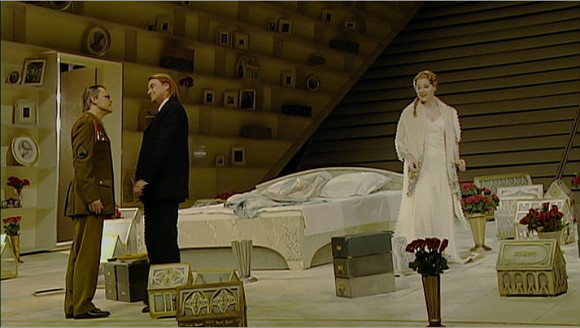
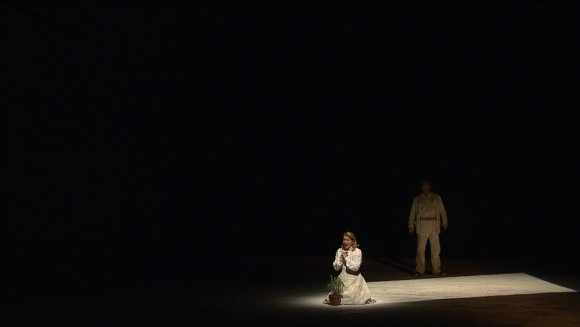
My acquaintance with Korngold’s Die tote Stadt has been pretty much limited to recital and competition performances of Glück, das mir verlieb, better known as Marietta’s Lied and, apparently, the last opera aria to become a hit single and Fritz’ act 2 piece Mein Sehnen, mein Wähnen.  So, I was quite glad to get my hands on a complete recording of this lushly lyrical and rather weird piece.  The “dead city” of the title is Brugge and the story concerns a wealthy man, Paul, who has turned his house, and his life, into a shrine to his dead wife Marie.  He encounters a dancer, Marietta, who very closely resembles his late wife.  What follows is wild and chaotic and is, ultimately, revealed to be a dream.  Paul realises that only in the next world can he be reunited with Marie.

1.room Continue reading

AtG’s Messiah

Expectations could hardly have been higher for last night’s first performance of Against the Grain’s new production of Handel’s Messiah.  By and large they were met.  It’s become quite the thing to stage Handel’s oratorios and, for the most part, that’s fine.  They are really operas in disguise and work well when liberated from the concert setting.  Messiah is trickier.  Rather than a linear narrative there are a series of Biblical texts selected by librettist Charles Jennens to promote a literal and conservative evangelical Christianity.  There is no obvious staging solution.  One possibility is to invent a narrative and spin the story around it as Claus Guth did at Theater an der Wien in 2009.  AtG’s Joel Ivany’s solution is to stage it as a choreographed performance and use movement to bring depth to the words.  Here he is aided and abetted by choreographer Jennifer Nichols who has created a movement language tailored to the abilities and limitations of the singers.

Continue reading

High tech Orfeo marred by artsy video direction

La Fura dels Baus mounted a spectacular production of Gluck’s Orfeo ed Euridice at the Festival Castell de Peralada in 2012.  The concept has the orchestra in costume, on stage and fully involved in the action.  There are lots of video projections and spectacular lighting effects.  In fact at times the whole thing resembles a son et lumière.  There’s also lots of aerial action.  It’s all rather exciting.  Great work from director Carlus Padrissa.

1.orfeo Continue reading

Chestnuts roasting on an open fire

margison090122Well there wasn’t actually an open fire at Koerner Hall last night, though one would have been very welcome on a very cold Toronto evening, but there were plenty of old chestnuts at the Great Songs of Italy concert given by the Ontario Philharmonic Orchestra under Marco Parisotto with tenor soloist Richard Margison.  The concert consisted of a mixture of opera extracts; vocal and instrumental, a couple of Neapolitan songs and Tchaikovsky’s Capriccio Italien.  It was a bit like eating one of those giant Toblerone bars all at once but I don’t suppose anyone really expected it to be any different and the audience for the most part loved it.

Continue reading

Let trumpets blow

A new recording of Britten’s Gloriana is to be welcomed, even when it’s less than perfect.  It’s an unusual work for Britten.  It’s very grand.  The orchestra is large and the music doesn’t seem to be as transparent and detailed as much of his work.  This is especially true in Act 1 where I almost wondered whether Britten was sending up “grand opera”.  It’s also a grand opera sort of plot.  The libretto is based on Lytton Strachey’s Elizabeth and Essex and deals with the late life romance between the queen and the young Robert Devereux, earl of Essex and deputy in Ireland.  It has some fine moments; notably the lute songs in Act 2 and the choral dances in Act 2.  Act 3 is also dramatically quite effective; dealing with Essex’ abortive rebellion and execution.  Curiously, in the final scene, Britten resorts to a lot of spoken dialogue, as he does briefly with Balstrode’s admonition in Peter Grimes.  It’s almost as if he has no musical vocabulary for the highest emotional states; a sort of anti-Puccini.

1.duel Continue reading

Prima Donna

So I got my hands on the DVD documentary about Rufus Wainwright and the genesis of Prima Donna.  There’s not all that much of the music on the disk but there’s enough to get a general impression.  There’s also plenty of material for helping one judge where Wainwright is coming from and how he might approach a second opera.

0.tosca Continue reading

The Rape of Lucretia

Britten’s Rape of Lucretia, which premiered at Glyndebourne in 1946, is an interesting work in a number of ways.  Musically it marks a distinct break from Peter Grimes and anticipates the later operas in a number of significant ways.  It’s written for much lighter forces than Grimes; string quintet, wind quintet plus harp, percussion and piano and there’s no chorus (in the conventional sense).  It’s also not a “numbers” piece.  There are no set pieces here.  The orchestral writing is spare and somewhat dissonant with that absolute clarity that is so characteristic of Britten.  Sometimes this almost distracts from the drama on stage.

1.chorus Continue reading