
 Against the Grain Theatre have announced an ambitious 2018/19 season. There are two main stage shows. The first is Bound, which had a first workshop outing in December 2017. It’s still a work-in-progress but there have been significant developments. Kevin Lau has been commissioned to inject his contemporary themes, music and ideas into the original music by Handel. Instead of piano there will be a chamber orchestra led by AtG Music Director Topher Mokrzewski with digital sound artist Acote. The cast will include soprano Miriam Khalil, countertenor David Trudgen, tenor Andrew Haji, and baritone Justin Welsh. This workshop will be presented in Longboat Hall at The Great Hall (1087 Queen Street West) on November 19th, 20th and 21st, 2018. For me, the acid test will be whether the dramaturgy and the text has been tightened up.
Against the Grain 2018/19 season
Reply
 Things are starting to liven up again in the Toronto scene. Here’s a look ahead to the balance of September and the first half of October. This week sees a performance of Weill’s Little Mahagonny by VOICEBOX at Gallery 345. That’s on Tuesday 25th at 7.30pm and will be followed by a wine and cheese reception. Tickets are available at Eventbrite.
 That headline is taken from the eighth movement of Jonathan Dove’s 2016 work for orchestra and children’s chorus; A Brief History of Creation, which takes us in thirteen movements from the stars to man via, inter alia, rain, sharks, whales and monkeys. The text, by Alasdair Middleton, is clever, engaging and singable. The music is eclectic. There are elements of atonality but also intense lyricism. It’s by turns shimmery, frantic, doom laden and meditative. It engages beautifully with the text and Dove has a very sure sense of what is and is not reasonable to ask of a children’s choir. Some short text sections are left as spoken (with a very authentic Mancunian accent). All in all, it’s a witty and enjoyable piece that doesn’t outstay it’s 45 minutes or so.
 The demise of Toronto Masque Theatre was never likely to lead to the retirement of Larry Beckwith from the Toronto scene and it hasn’t. He’s back with a new concert series called Confluence that describes itself as a “a new interdisciplinary, cross-cultural multi-media (many-hyphened) project”. There’s a Pay What You Can kick off next Sunday, 16th September, at St. Thomas’ Church at 383 Huron Street at 2.30pm where there will be performances and readings featuring many of the season’s artists plus food and drink.
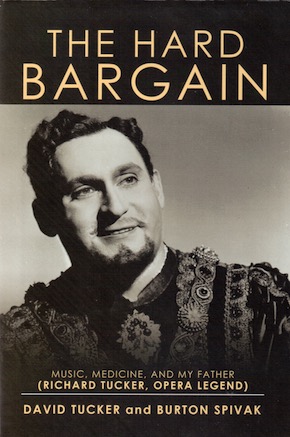 There are some unusual books coming my way these days. The latest is an autobiography (more or less) of David Tucker; the middle son of the late Richard Tucker; a fixture at the Met for thirty years until his death in 1975. I found it fascinating but I’m not entirely sure whether that’s because it’s a good book or because of the many places where it has a lot of personal resonance for me. Both I suspect. I also found myself having very ambivalent feelings about David (and perhaps even more so Richard) Tucker but I don’t think it’s the purpose of a reviewer of an autobiography to make moral judgements about his subject. The reader can do that for him/herself.
 operaramblings