The Greek Passion

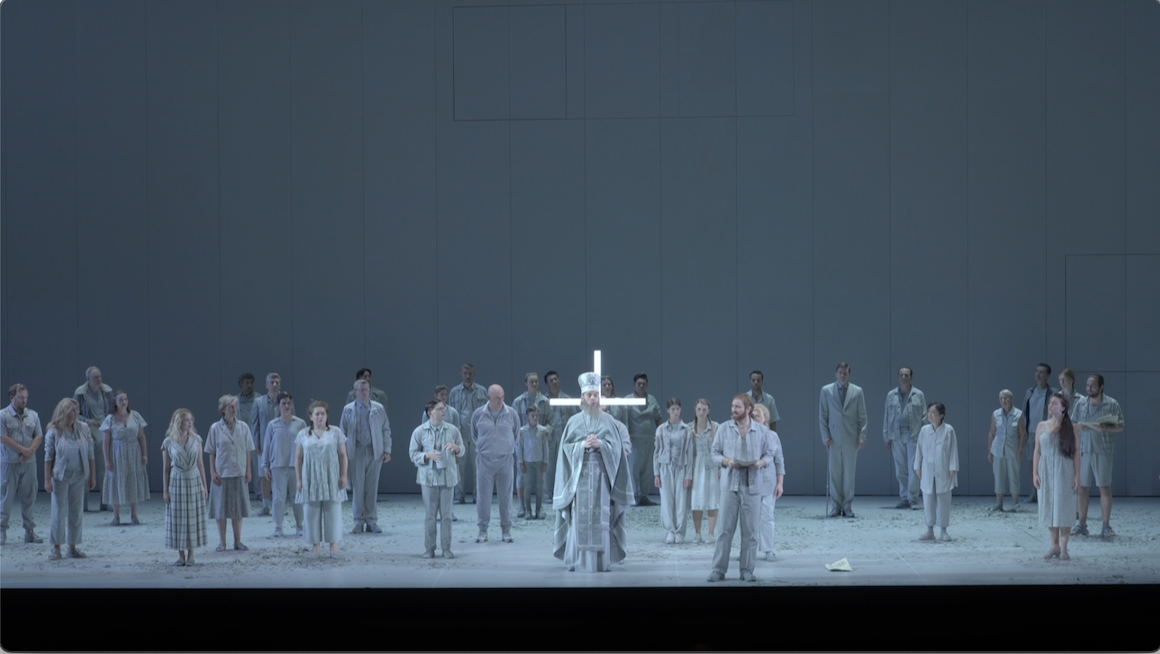
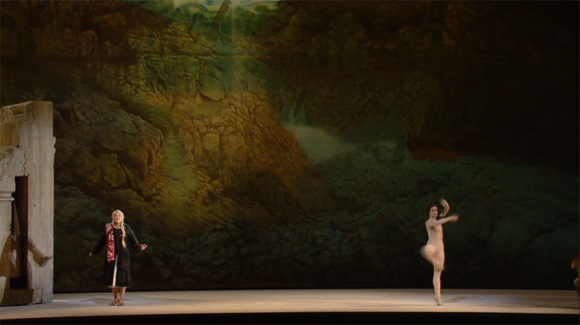
Bohislav Martinů’s The Greek Passion is a 1961 opera based on the novel Christ Recrucified by Nicos Kazantzakis.  The English language libretto is by the composer.  It was staged in the Felsenreitschule in Salzburg in 2023 in a production directed y Simon Stone and recorded for video.

1.casting

Continue reading

The Gods look down

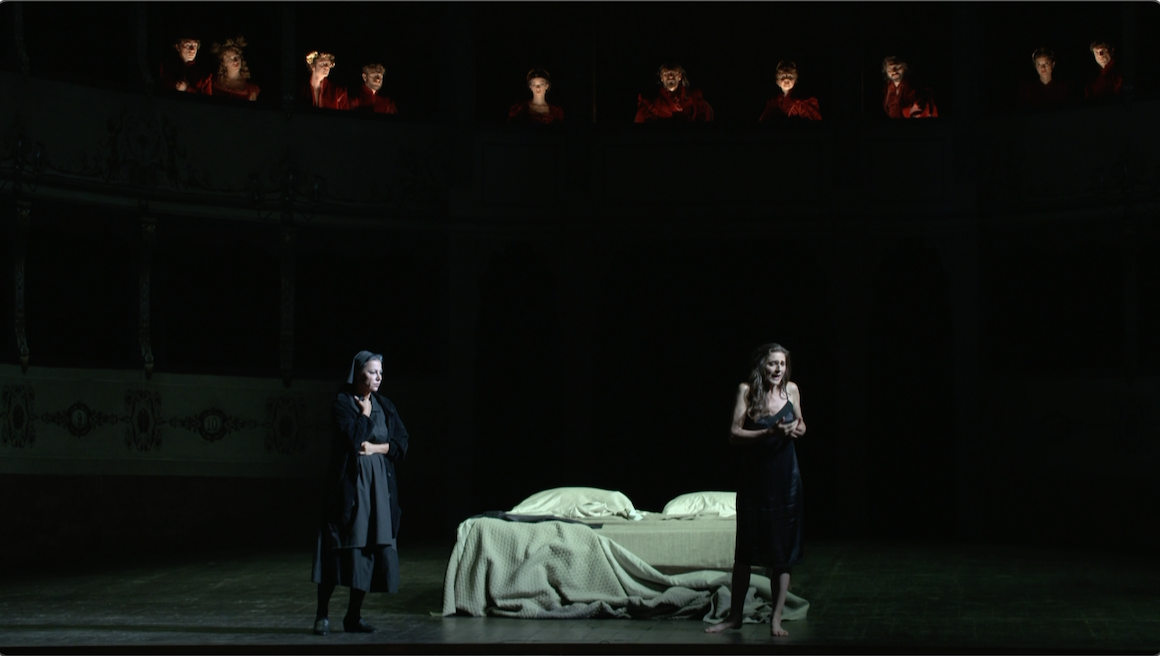
Robert Carsen’s 2021 production of Monteverdi’s Il ritorno di Ulisse in patria was recorded at the Teatro della Pergola during the Maggio Musicale Fiorentino. The theatre, opened in the 1660s and very much a “renaissance theatre”, is very much part of the production; the loge boxes are used during the prologue, entrances are made through the unusual parterre (individual chairs not rows of seats) and the gallery behind the stage is used by the gods to observe the action below. Monteverdi used three distinct styles of music for gods, royals and lesser folk, Carsen mimics this by giving the three orders distinct costume and acting styles. The gods (and there is the full pantheon, not just the ones who appear in the opera, each with his or her distinctive emblem), costumed in opulent crimson 16th century style costumes, act in a stylised manner. The royals get smart modern dress and naturalistic acting while the others are scruffier and act more broadly.
1.penelope

Continue reading

Sex and violence

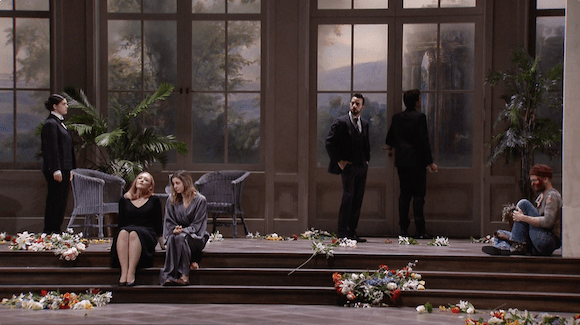
There’s a certain logic in Christof Loy following up his 2019 production of Korngold’s Das Wunder der Heliane at the Deutsche Oper Berlin with Riccardo Zandonai’s 1914 piece Francesca da Rimini. Both pieces deal with overt, somewhat perverted, sexuality as the means of a woman achieving some sort of agency and both have lush, hyper-romantic scores.  Loy claims his next project will be Shreker’s Der Schatzgräber for the same house so there’s apparently more to come.

1.room Continue reading

The Merchant of Venice

André Tchaikowsky’s The Merchant of Venice was written in the years leading up to his premature death in 1982 but, despite interest from ENO in the 1980s, it did not get a full performance until David Pountney decided to stage it at the the 2013 Bregenz Festival with Keith Warner directing.  It’s hard to explain the neglect though Pountney ascribes it some degree as the fate of the emigré  (the composer being a Polish Jew domiciled in the UK).  The Merchant of Venice is a really solid piece.  It’s got all the elements; a strong story, a really interesting but not overly intimidating score and really good writing for voice (it really is singable).  It’s the right length at around two and a half hours and it doesn’t call for unreasonable orchestral or vocal forces.  John O’Brien’s libretto even manages to overcome some of the objections to staging Shakespeare’s play.  While one might consider the Shakespeare piece to be antisemitic, O’Brien’s libretto is much more clearly about anti-semitism.  There’s also a clear homoerotic element in the Antonio – Bassanio relationship and perhaps too in Portia – Nerissa.

mov1

Continue reading

Slapstick stick slapping

If you have ever wondered why a slapstick comedy is so called then look no further than Gilbert Deflo’s production of Prokofiev’s L’Amour des trois oranges recorded by L’Opéra de Paris in 2005.  There’s a great deal of smacking with sticks; most of it by Barry Banks who gleefully whacks just about any bottom, male or female, that comes within range.  The production is also slapstick in the generally understood sense of broad physical comedy.  There are elements of commedia del arte and lots of circus; jugglers, clowns, fire swallowers, all wrapped up in a sort of 20s vamp aesthetic.  It’s wildly chaotic in a rather fun way though it’s all a bit overwhelming and probably worked better in the theatre than on DVD.

1.Princess Clarice Continue reading

A journey through space and time?

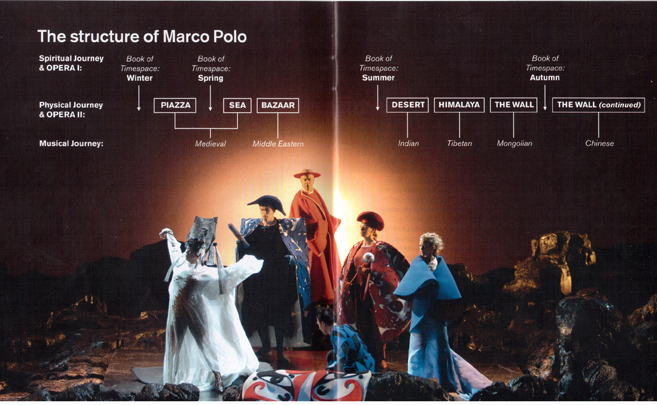
Tan Dun’s Marco Polo is hugely ambitious. He uses Marco Polo’s legendary journey as a metaphor for Space and Time.  He fuses a range of Western musical styles with Chinese, Tibetan and Indian instruments and vocal styles.  Although most of the work is sung in English there are sections in Italian and Chinese and other bits in a sort of random polyglot.  The cast includes a range of real, allegorical and psychological figures.  Marco and Polo are in fact two characters; one representing action and the external and the other the psychological and internal.  Kublai Khan, Dante, Shakespeare, Sheherazada and Mahler put in appearances and much of the narrative is carried by a Chinese opera singer playing the part of Rustichello; “the questioner”.  To be honest, despite having read the booklet, watched Reiner Moritz’s “Making of” documentary and studied the chart below, most of the time I had no idea what was actually happening.  It’s really all too abstract and involved to really work as music drama.

Continue reading

Bartoli’s Semele

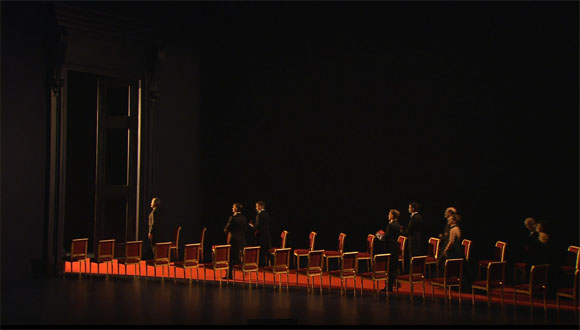
Robert Carsen’s clean, refined production of Handel’s Semele originated in Aix, was recorded in Zürich and eventually made it’s way to Vienna and Chicago.  In many ways it is classic Carsen.  It’s elegant and uncluttered, is strong on the detailed Personenregie, has a consistent design concept but isn’t really pushing a concept driven agenda.  It’s also quite funny without descending to priapic donkeys.  Also there are lots of chairs.

Continue reading

Ballet/Opera Fusion

Handel’s Acis and Galatea is a peculiar piece in some ways.  It was written to be performed at Cannon’s, the Edgware residence of the then Earl of Caernavon, presumably for his guests.  Apparently the performance style was to have the singers sing from music stands in front of a painted backdrop.  So, a sort of oratorio with curtains.  It’s not uncommon to stage Handel oratorios as opera these days.  Theodora is done quite often and even Messiah has been staged so it’s no great surprise that Acis and Galatea should be given a similar treatment.  In fact Wayne McGregor’s 2009 Covent Garden production stages it as an opera and a ballet simultaneously combining the resources of the Royal Ballet and the Royal Opera.

Continue reading