
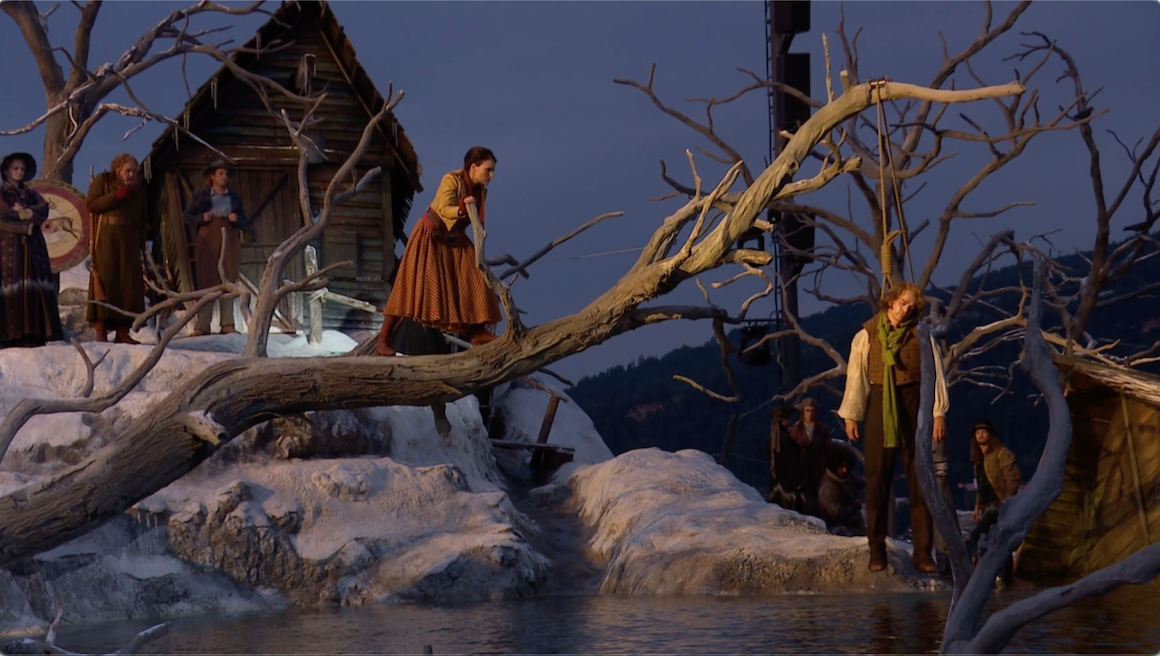
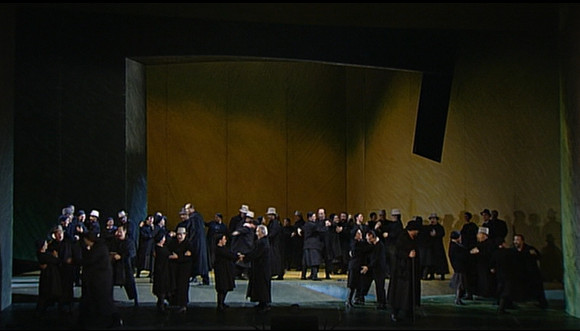
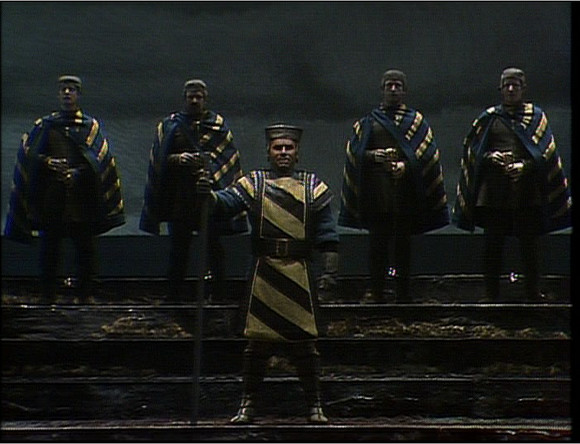
Productions on the lake stage at Bregenz are usually spectacular but rarely stray very far from the traditional/canonical. The production of Weber’s Der Freischütz, directed by Philipp Stölzl and recorded in 2023 is quite radical though. I think there are three main elements to this quite ambitious reworking. One is to give Samiel a much enhanced role. Here he is both MC and puppetmaster; controlling the action, including playing with time, and addressing the audience directly. The second element is to emphasize that this is taking place in the aftermath of the Thirty Year War and, to add to the misery of that, the village has suffered severe flooding. This sets up a duality between Agathe as the one who still, despite everything, trusts in God and Ännchen who believes God has forsaken them. This tension serves to make the two girls perhaps the most important figures, after Samiel, in the piece.
 Kamp! – Songs and Satire from Theresienstadt is a 2016 album recorded by Amelia DeMayo, Curt Buckler & Sergei Dreznin (piano) under the auspices of the World Jewish Congress. It’s a collection of 25 more or less satirical songs written in the Theresienstadt camp/ghetto by the likes of Leo Straus and Ilse Weber. They are presented here in English translation and in a breezy cabaret style which is very apt and which I liked very much.

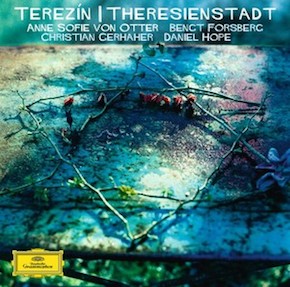 Terezín/Theresienstadt is a CD of music composed in the concentration camp at Terezín in what was then Czechoslovakia. Virtually the entire Czech intelligentsia; certainly those of Jewish or Communist persuasion, were imprisoned in a kind of “show camp” to demonstrate to the world that the Nazis weren’t as bad as made out. Nine of the ten composers featured on the disc ended up on a “Polentransport”; a one way ticket to Auschwitz. No story is more poignant than that of Ilse Weber, a nurse in the hospital. She chose to accompany the sick children of the camp on their final journey and reportedly sang to them in the gas chamber.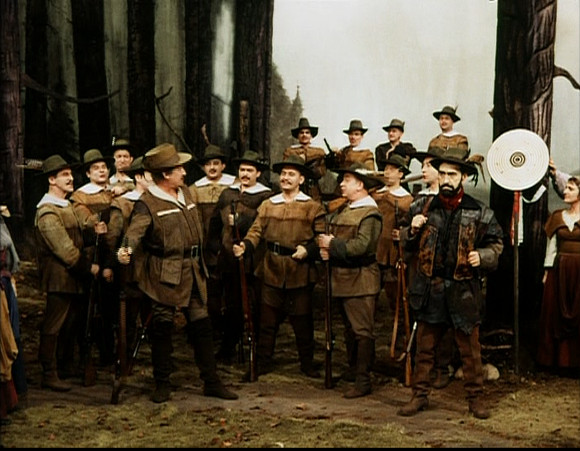
 operaramblings