 Leslie Barcza has spotted some interesting information about the Canadian Opera Company’s involvement with the Lyon/Metropolitan Opera Parsifal. The full story is over on his blog.
We’ve already got one you see
5

Leslie Barcza has spotted some interesting information about the Canadian Opera Company’s involvement with the Lyon/Metropolitan Opera Parsifal. The full story is over on his blog.

Ileana at the Stella Maris competition
It’s that time of year again. With a few months left in the opera season in Toronto today saw the first “farewell” concert by a departing member of the COC Ensemble Studio. It was a solo recital by dramatic soprano Ileana Montalbetti, quite possibly the best sounding thing ever to come out of Saskatoon. Ileana is the only full on dramatic soprano I’ve seen in the few years I’ve been following the Ensemble Studio and, as ES boss Liz Upchurch pointed out, they are rare so it’s always interesting to see another one come along. Fair to say too, I think, that it’s not the voice type that is treated most kindly by a piano recital in a fairly intimate space. That said, it was a very enjoyable performance.
Ileana kicked off with O Sachs! Mein Freund! from Die Meistersinger. Any reservations I have about dramatic sopranos and piano recitals come redoubled in spades where “big” opera arias are concerned. The kind of volume and tone needed to sing against a large orchestra in a big theatre tends not to sound too lovely when throttled back with only a piano for support and, honestly, I don’t think this piece was a great idea.
Things improved enormously in the next section though. This was the song cycle Ekho Poeta; Pushkin texts set by Benjamin Britten and written for the Rostropoviches. It’s a rarity; a Britten song cycle I don’t recall hearing before, and it’s very good. It was a much better vehicle for Ileana who displayed plenty of power, well controlled vibrato and pleasing and varied tone colours especially in the middle register. Her high end was much sweeter here than in the Wagner too. Where she needed a lot of attack, as in the rather spiteful Epigramma she could certainly produce it. Being Britten, the piano part in these pieces was really quite demanding too so kudos to pianist Rachel Andrist for excellent and sympathetic musicianship.
The second half of the programme was all Strauss. It started with Arabella’s final aria, which I enjoyed more than the Wagner but about which I have similar reservations as a recital piece. Then we got a selection of songs from Op. 37, Op. 48 and Op. 32 before finishing up with Zueignung from Op. 10. This was all good stuff with more excellent control and very good German diction. The final number was particularly lovely. For an encore we got a spirited rendering of Sweet Polly Oliver in the Britten setting.
I think Ileana is a very considerable talent and I’m sure she’ll do well in the wider operatic world. Liz Upchurch and the COC certainly seem to think so. Liz “leaked” that Ileana will be back in an as yet unannounced major role. Putting two and two together and making something like e^iπ and adding in a dose of wishful thinking I’m wondering if there is any connection between Ileana’s first piece today and the long rumoured Toronto debut of a certain ex-pat Canadian baritone.
Also, à propos not much, it was nice to see a certain world famous dramatic soprano in sneakers and sans make up watching from the standing room section.
Just back from the HD broadcast of the Met’s Götterdãmmerung.
Musically, I was really quite impressed. I thought Luisi’s take on the score was original, valid and enjoyable. His tempi were generally quite quick and there was a taut, sinewy quality to the strings that really brought out the shape of the music. No romantic wallowing here! I really liked the Gibichungs; Wendy Bryn Harmer as Gutrune, Iain Paterson’s Gunther and, especially, Hans-Peter König’s Hagen. All were well sung and characterful. Jay Hunter Morris as Siegfried and Deb Voigt as Brünnhilde were really exciting in the Act 1 love duet and Deb nailed the Immolation scene, almost managing to overcome the staging. So much for the music, what about the production?
I guess Richard Jones’ 2009 Munich production of Lohengrin isn’t to everyone’s taste but I found it quite compelling. He’s set it in the 1930s and Elsa is building a house; a symbol for rebuilding the state and society of Brabant torn apart by the loss of her brother and general internal disorder. In the prologue we see her designing the house on a drawing board and then it gets built by stages culminating in a topping out ceremony as Elsa marries Lohengrin. At key points of the action the symbolism is manifest. Telramund kicks over half finished walls in the scene where he accuses Elsa and Lohengrin, having defeated Telramund in the duel, joins Elsa for a spot of bricklaying. After Elsa breaks her oath to Lohengrin he burns the house down so the final scene is played out on a more or less empty stage. There’s some really skilled stage handing going on to support all that! For contrast, and to facilitate the practicalities of the concept, some of the scenes are played out in front of a plain flat decorated solely with some coats of arms and a door. The alternation of very stark and very busy is intriguing. Inevitably there are times when the concept is stretching possible interpretations of the libretto right to the limit and the duel between Lohengrin and Telramund is a bit lame but mostly for me it worked.
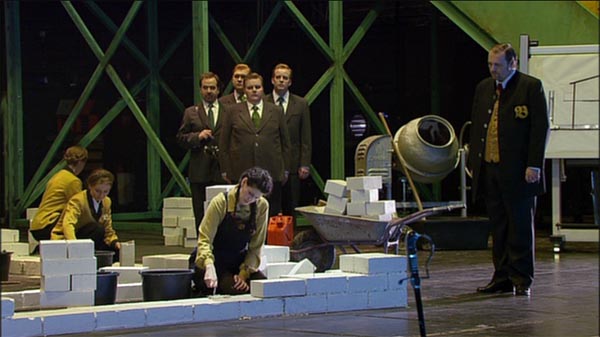 Within the overall concept Jones has obviously given a lot of thought to the relationships between the characters. The Personenregie seems almost obsessively detailed and he seems to have taken his cast along with him because the acting is first class. Every look and gesture, especially from Wolfgang Koch as Telramund and Anja Harteros as Elsa, carry a depth of meaning. It’s very impressive.
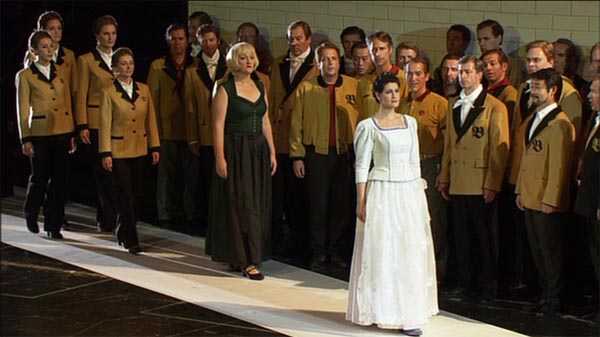 The singing performances are very strong across the board. Again, for me, Koch and Harteros are the standouts. Harteros is really lovely to listen to even when she’s cranking out the decibels and Koch was never less than musical even in his angry outbursts where the temptation to shout or bark must be strong . Michaela Schuster as Ortrud and Jonas Kaufmann in the title role are pretty much as good. Schuster gets a bit strident but that’s not inappropriate to the role and Kaufmann has moments when he is just gorgeous to listen to. His hushed and unearthly “In fernem Land” was gripping. Christof Fischesser was a solid Heinrich and Evgeny Nikitin (a superb Dutchman in Toronto a few months later) made more of the Heerrufer than some might. All of this is very well supported by the orchestra under Kent Nagano.
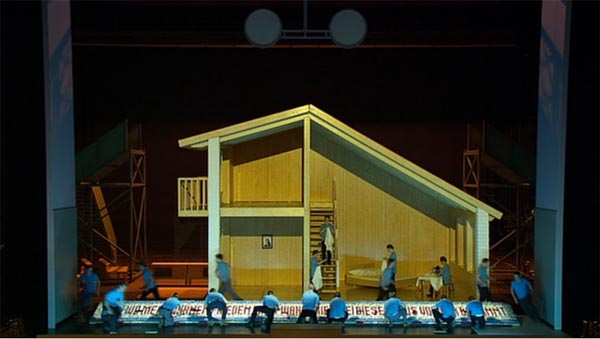 The production for DVD is pretty good. Karina Fibich directs for video. She gives us a pretty good idea of the overall set and blocking and rations her closeups. It’s hard to argue with going to close up when there are just one or two singers in front of a flat. She gets a bit overambitious in the more crowded scenes and experiments with camera angles that are quite confusing. Sometimes the shot even seems to be behind the action. Overall though it’s a decent presentation and it’s backed up by a sharp 16:9 anamorphic picture and solid DTS 5.1 sound (LPCM stereo as an alternative). There are English, French, Spanish and Chinese subtitles. There are no extras but the trilingual booklet (English, French, German) includes a synopsis and a short essay about the production.

I had very mixed feelings about today’s HD broadcast of Siegfried from the Metropolitan Opera. Early reviews and comments by friends had been largely negative about the staging and there was a widespread view that “the machine” was intrusively noisy. As it turned out I was pleasantly surprised. For once Gary Halvorson’s relentless close ups were a boon. From what little we could see of them, the first and second act sets were both uninteresting and gimmicky. The 3D leaf scattering, the crudely pixellated woodbird and the laughable Wurm were just among the sillier features. To be fair , the beginning of the third act made effective use of the set but that was the only place that it did work well. So focussing on the singers made a lot of sense.
Here’s the clip from Siegfried that was shown during yesterday’s Don Giovanni broadcast.
Is it just me or does Mime look disturbingly like James Levine?
I was really impressed when I first watched the DVD version of Wagner’s Der Fliegende Holländer recorded at Bayreuth in 1985. It’s been some time since I last watched it so another look seemed in order. The production, directed by Harry Kupfer debuted in 1978 to both applause and brickbats. The concept is that the Dutchman exists only in Senta’s imagination. She is fixated on the Dutchman as her route out of the repressed bourgeois environment she is trapped. It’s a tormented, even hysterical, version of Senta that finds a fine interpreter in Lisbeth Baltslev.  Kupfer reinforces this idea of Senta by having her on stage all the time. During the overture she retreats to a sort of cage at the top of a staircase with her precious picture of the Dutchman which she will hang onto throughout the drama. She will remain in this cage high to one side of the stage watching the action below her throughout the first act.
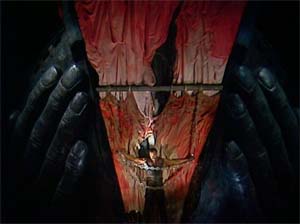 It’s a very strong first act musically and visually The Dutchman’s ship makes a spectacular entrance and the finger like timbers of the bow open up to show the Dutchman chained in a crucifixion pose. Simon Estes as the Dutchman is suitably elemental. His singing and acting have a frightening intensity without ever becoming unmusical. Matti Salminen’s Dahland is perfectly adequate and conveys the grasping bourgeois rather well.
Act 2, of course, opens in the Spinning Hall. Anny Schlemm’s Mary exemplifies the dull conventionality of the place. We are in the world of Strindberg or maybe Babette’s Feast. The intensity of Balslev’s performance cuts right through this. Johohoe! Truft ihr das Schiff im Meere an is as eerie as it is powerful. Against this obsession the rather dull Erik of Robert Schunk is doomed from the start. Things warm up with the arrival of Dahland and the Dutchman. Salminen is in very good voice with Mögst du mein Kind, den fremden Mann willkommen heißen. Senta is pinched looking or frightened almost throughout this scene.  There is great ambiguity while the Dutchman sings Wie aus der Ferne längst versangner Zeiten. The Dutchman of Senta’s imagination sings from the gorgeous fantasy hold of his ship while the shadowy figure who arrived with Dahland is still on stage. Senta is slow to buy into what is happening but she finally dissolves into a state that is more madness than delight.
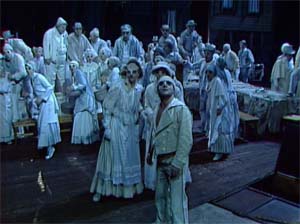 Act 3 opens with Senta watching her own wedding feast from the cage. The townspeople and Dahland’s crew are almost as unnatural as the Dutchman’s. It’s quite chilling and sinister all through until the Dutchman’s crew drive everyone off stage leaving Senta alone for her confrontation with Erik. Then we get the big scene where the Dutchman, chained up again in the infernal version of his ship, thinks that Senta has betrayed him and leaves her.
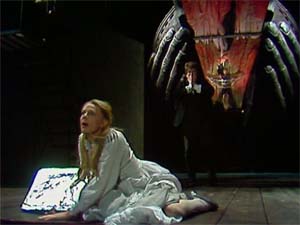 This is, obviously, crucial to the plot but it has never really made much sense to me in a normal interpretation. Here it does. This obsessed Senta needs to be “faithful unto death” not to have a happy ending. It’s equally apt that her suicide is just that. There is no hint of redemption for her or the Dutchman. It’s the end. The people turn their backs on her corpse leaving only Erik, in despair, still with her.
So dramatically it works as a piece held together by really intense performances by Balslev and Estes and, lest I forget, Woldemar Nelsson conducts and keeps things moving along briskly. At times the orchestral playing is quite thrilling and the chorus is excellent too.
A couple of other things about the production are worth pointing out. Although the booklet sets the scenes out in the conventional three acts it is actually played through (as I understand Wagner intended and as it was played at the COC a couple of years ago). Scene changes are dynamic and slick. There’s some real stage craft here. It’s also very dark, as I recall most 1970s productions being. This makes on stage detail hard to pick up and, I’m sure, affected the video direction.
This production was directed for video by Brian Large (surprise!) and it seems to have gone straight to video with no TV broadcast. That said it looks like it was directed for the “small screen” which one might expect in 1985. This is problematic given the crucial role of the spectating Senta, as most of the time she is out of shot. Large tries to compensate for this with superpositions, fades and dissolves and is fairly successful. All in all, I think he gives us as good a picture of what Kupfer put on stage as one could reasonably expect.
Picture quality is a bit soft grained as you might expect for the time and it’s 4:3. Sound options are PCM stereo or DTS 5.1 which is a post process of the original stereo capture. It’s very good indeed. There are English, French, German, Spanish and Chinese subtitle options. There’s nothing much in the way of bonus material but the booklet has a full track listing and an informative essay by Erich Rappl.
All in all I think this disc can be highly recommended. It’s a landmark production, well executed on stage and captured for DVD remarkably well for its era.
If you want a preview the whole thing is available in ten minute chunks on Youtube but the quality is a bit off putting.
There’s this part of me that thinks I ought to like Wagner. In some ways I do. The Rhinegold was one of the first operas I saw live when Goodall was conducting at ENO and I loved it. I like most of the Ring and I’m very fond of Der Fliegende Holländer but I also see the essential truth in the two great Wagner witticisms:
Anon to Evelyn Waugh – “What was Crete (i.e. the battle of) like?”
Waugh – “Like German opera; too loud and too long”
and…
Wagner lover – “There are some amazing moments in Wagner”
Wagner skeptic – “And there are some damn dull half hours in between”
This really comes to a head for me with Tristan und Isolde. If ever fifteen minutes of plot were compressed into five hours this is it. Essentially nothing much happens; very slowly; and very loud. I think it’s only ever performed because (a) it’s Wagner and (b) that chord. Five hours is an awful lot of bum numbing to experience one moment of musicological history. Maybe this is why directors try so hard to make it look like something is going on? This surely reached utter desperation point in the Met’s HD broadcast, when I thought I was watching a game of Tetris, though the current fugly Bayreuth production runs it close. I know I’m not the only one who has this problem as witness Julia Spinola’s essay Der Kunst der Langsamkeit. I just lack the ability to put my thoughts into German Higher Bollocks. Or maybe my Imperial wardrobe detector kit is more sensitive than hers.
I’m not giving up on Wagner. I like the music in Lohengrin for example and I’d really like to see the current Bayreuth production. Most operas are improved by rodents in my experience. I don’t know Tannhäuser or Parsifal at all well so there’s some exploring to do there. I think I’m done with Tristan though.
Once in a while an opera performance really blows you away and it becomes quite hard to write about, especially when the work is as long and dense as Die Walküre because even with a great performance one is in overload by the end. Yesterday’s broadcast from the Met was one of those experiences. Here’s what I think I saw!
 operaramblings