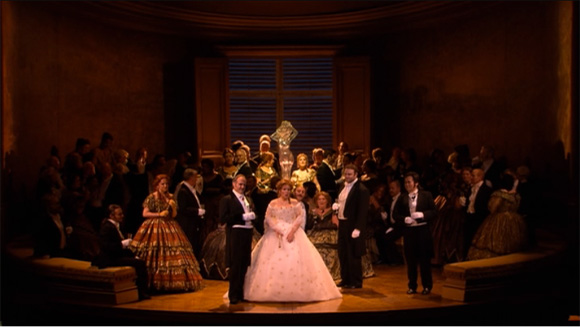
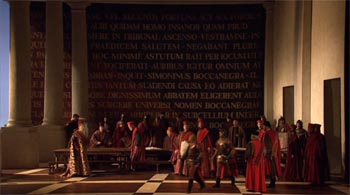
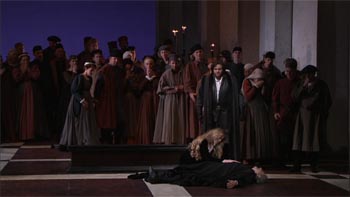
The 2007 recording of Verdi’s La Traviata from Milan’s Teattro alla Scala is extremely traditional but very satisfying. Liliana Cavani’s production is set in the mid 19th century with entirely conventional sets and costumes (with the obligatory cleavage) and nothing in the direction that adds up to an original concept or idea. Act 1 is set in a glitzy ballroom. Act 2 scene 1 takes us to a slightly odd sort of country house bedsit with billiard table In Act 2 scene 2 we are back with the glitz with actual gypsies and bare chested matadors. Act 3 is set in a suitably dark invalid’s bedroom. Angela Gheorghiu’s Violetta goes from ballgown to nightdress to ballgown to nightdress while maintaining Ange levels of, you guessed it, cleavage. The guys are all in evening dress or operetta dress uniforms. It’s all pretty and doesn’t distract from the music. Continue reading →
Verdi’s Il Trovatore notoriously has an episodic and highly improbable plot. It’s also famously difficult to cast. Creating a compelling production and staffing it with capable singers therefore presents a formidable double challenge. The current Canadian Opera Company production gets it half right. The problem is Charles Roubaud’s much travelled production. There’s not an idea in it. It’s not surprising that the director’s programme notes run to three short paragraphs. Roubaud sets each scene in a sort of grey box of towering walls. Unfortunately each grey box is just different enough that that the curtain comes down at the end of each scene and the stage crew spend what seems like an interminable amount of time setting up the next grey box. We just aren’t used anymore to sitting quietly through interminable scene changes. We expect slicker stagecraft and in a modern opera house there’s really no excuse for this 19th century approach. Within in each grey box the grey clad cast come and go and in between mostly stand around. Blocking is perfunctory, acting superfluous and old fashioned “park and bark” the order of the day. It’s the sort of production that might have passed muster thirty years ago but really doesn’t cut it in 2012. Continue reading →
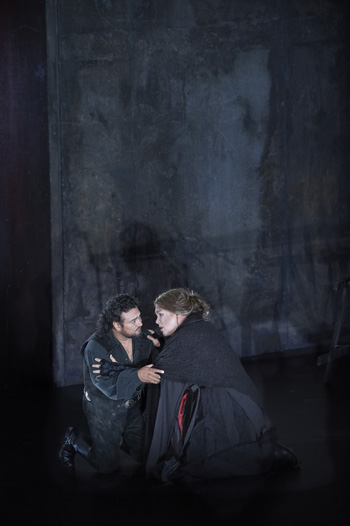
The first time I tried to watch Willy Decker’s 2004 production of Verdi’s Don Carlo at De Nederlandse Opera I failed to get past Rolando Villazón in doublet and hose. To anyone familiar with British TV comedy of a certain era the resemblance is just too close and I couldn’t get beyond the idea of Stephen Fry as Felipe II and Miranda Richardson as Elisabetta. This time around I watched the highly illuminating video introduction and read Wily Decker’s useful essay on his production concept before tackling the piece proper. I’m glad I did that and I’m glad I came back to this recording because it is very fine and it was very useful to have Decker and Chailly’s perspectives on the dramaturgy and the music.
Richard Eyre’s production of La Traviata at the Royal Opera House, filmed in 2009, is a pretty good example of how to do a traditional production. There’s nothing conceptual or thought provoking to it but the direction is careful and tells the story clearly and well. The designs are mid 19th century with crinolines and tail coats but with the odd imaginative touch and a welcome refusal to succumb to the “more stuff” syndrome that plagues so many Verdi and Puccini productions. Backed up by excellent music making it probably makes a near ideal introduction to the piece, even if it won’t entirely displace Willy Decker’s brilliant and disturbing Salzburg production in my affections.
So, another lip synched film from the 1970s. This time it’s Verdi’s Otello starring Jon Vickers and Mirella Freni. What makes this one a bit different is that Herbert von Karajan not only conducts but directs as well. It’s a curious piece with fantastic music making but no real production concept, continuity errors, some very dodgy acting and puzzling cinematography in places. It’s never dull though. Continue reading →
Mid period Verdi in a highly traditional La Scala production isn’t usually my cup of tea but I thought that if the usually excellent Opus Arte label thought the thing was worth a reissue it might be worth watching. With caveats, it was, even for someone who is as allergic to this kind of production as myself. Continue reading →
I’ve been wondering about whether to bother with the Decker production of La Traviata when it gets its MetHD broadcast in April since I own the Blu-ray of the original Salzburg 2005 production. So, it seemed like a good time to take another look at the disc.
I like this production more every time I see it. The overall concept of a Violetta who knows she is dying and is pretty consciously counting off the days works really well. The set is basically a curved wall with a clock and some sofas. There’s a lot of empty space and that’s entirely deliberate and serves effectively to reinforce Violetta’s alienation. The use of the chorus is interesting too. This is no jolly band of party goers. Rather, the chorus comes across as quite feral; a pack of wild dogs in evening dress. The character of the doctor does double duty too. He haunts the set almost throughout and from the very beginning. It’s hard not to think of him as Death though I don’t think Decker ever came clean on whether it’s supposed to be that explicit. When Violetta sings of “sterile pleasure” it’s quite clear what she means.
In Act 2, the country idyll is symbolised by flowery drapes over the sofas and, crucially, the clock. It’s the only time the clock is hidden. Violetta and Alfredo romp in flowery dressing gowns and underwear. The Germont senior arrives and as Violetta’s hopes dissolve she rips the flowery drapes away revealing both the clock and herself. The countdown has begun again. Back in Paris, the chorus is more cruel than ever playing out a vicious pantomime of Violetta before becoming a crowd of leering onlookers as Alfredo stuffs money into Violetta’s dress and mouth. The entry of Germont senior parallels actions of the doctor/Death earlier in the piece. There’s no break at the end of Act 2. The doctor very slowly forces the chorus off stage taking the clock and the pantomime Violetta with them to leave the stage completely bare. The rest of the action plays out with the characters widely spaced across this vast empty space.
It’s all very well thought through and consistent. There are many, many deft directorial touches (probably far more than we see on disc – see below) and the overall effect is very powerful.
It’s pretty much a dream cast. Netrebko in 2005 was just about perfect in every way for Violetta and she throws herself into the role with abandon. She’s not at all afraid to take physical risks and she sings really well. Her voice has power and brightness and her coloratura is spot on. She can also be lyrical and affecting when needed. Her interpretation is absolutely at one with Decker’s. Her “sempre libera” is quite chilling and there is real intensity in “Addio del passata”. Rolando Villazon’s Alfredo is a very good match. Salzburg caught him, too, at his very best and he doesn’t put a foot wrong. I’d go on at more length but this really is the Netrebko show! Thomas Hampson as Germont senior is a bit more of a conumdrum. Is he sincere or is his whole persona an elaborate bourgeois facade? Hampson doesn’t really tell us though he sings with his customary refinement and intelligence. Luigi Roni as the doctor deserves a special mention too. He only has a few lines to sing but his overall presence is huge. Carlo Rizzi conducts a polished performance from the Wiener Philharmoniker.
So where’s the fly in the ointment? Surprise! It’s the video direction of Brian Large. Emptiness and space are central to this production and Large can’t bear to give us space. We do get just enough framing shots to allow us, with a bit of imagination, to figure out what the director is doing but mostly it’s relentless close ups. He produces a particularly pointless example of switching back and forth between close ups in “Che e cio?” when he seems to think he’s filming Wimbledon. It doesn’t help that the framing shots we do get are, unaccountably, taken from high stage left. So grrr (and not the word I have written on my notepad because my mother may read this).
Technically the disc is very good. The picture is 1080i HD (maybe just a hint of ghosting on low light level shots) and the sound is very vivid DTS HD Master Audio 5.1 (LPCM stereo optional). Subtitles are IT, FR, EN, ES, DE, IT and CH. The documentation is a bit more generous than usual with a track listing and a synopsis in EN, FR and DE. There’s a useful and entertaining “making of” documentary which suggests that directing Villazon and Netrebko is easier and a lot more fun than directing Hampson! (Some people are perhaps just too smart).
So after all that how do I feel about seeing the Met production? If I could see it live I’d be there in a moment. Can I bear to see it butchered by another inept video director? I don’t know. It should be a good vehicle for Natalie Dessay though.
Pretty much all of this production is available on YouTube if that’s your thing. Here’s an excerpt.
Simon Boccanegra was the work that persuaded me that maybe I did like Verdi after all. It’s a terrific score and if the plot isn’t without it’s artificialities it’s full of strong characters and strong emotions which Verdi brings to life with fabulous orchestral and vocal writing.
The most recent DVD version to appear is of the 2010 Royal Opera House production that was broadcast live on the BBC. It features Placido Domingo in his baritone incarnation in the title role. There’s a strong supporting cast with Ferrucio Furlanetto as his arch enemy, Fiesco; Jonathan Summers as the villain, Paolo; Joseph Calleja as the young rebel, Gabriele Adorno and Marina Polpavskaya as Boccanegra’s “lost” daughter, Amelia/Maria. The singing and acting are generally very strong. Placido is, of course, terrific. What more can one say? Furlanetto is a strong foil; excellent in both the prologue and the crucial final scenes. Summers is more than adequate though I might have hoped for more of a frisson when he curses himself. The real star for me is Calleja. He has a gorgeous voice and can float out a lovely pianissimo. His big aria early in the second act is particularly good but he is excellent all through the piece. The one weak link is Poplavskaya’s Amelia. It’s not bad. She acts well and looks the part but one really wishes for more beauty of tone. Pieczonka, in the Met HD broadcast, was much closer to the required vocal quality. Ensemble work throughout is excellent and there are some big set pieces! Antonio Pappano conducts brilliantly. He gets really good playing from the orchestra which is pretty crucial as there are some cruelly exposed woodwind and brass lines. He manages drama and urgency while still giving the singers room to do their thing when they need it. All in all, this is musically very satisfying.
The production, by Elijah Moshinsky, is pretty conventional. It’s a period setting with simple designs that suggest renaissance paintings. There are a few nice touches like the graffiti on the walls in the exterior scenes but mostly the look is just undistracting. There’s nothing beyond the text in the way the story is told either. Blocking is fairly basic and there’s a fair bit of “park and bark”. One senses that Moshinsky’s efforts have gone into character development rather than in trying to make any bold statement.
Sue Judd directed for TV and video and it’s a conventional TV view with too many close ups. She needs to watch some of François Roussillon’s recent work. We also get little chats from Pappano between scenes. These probably work OK first time through but I think would get pretty tedious on repeat viewing. There are short bonus features on WorshippingWorking with Placido Domingo and Rehearsals with Elijah Moshinsky. The technical quality is very good. It was filmed in HD and the picture is clear and detailed. The DTS 5.1 sound is really excellent; detailed, very spacious and coping very well with the more congested passages. There is also LPCM stereo. This really deserves a Blu-ray release but it’s on EMI who so far seem not to have gone that route(1). There are English, French, Spanish, German and Italian subtitles. The documentation is missing from my library copy but apparently contains a track listing, synopsis and “notes”.
This is definitely worth a look and it will be very interesting to do a detailed “compare and contrast” if I can get my hands on the Sony DVD release of the 2010 Met HD broadcast with Domingo, Morris, Giodarno and Pieczonka.
fn1. EMI was recently sold to Universal; parent of Deutsche Grammophon, and Decca so I suppose anything is possible.
Last night I went back to the Four Seasons Centre to take another look at Christopher Alden’s Rigoletto. I was up in Ring 5 this time so quite a different viewpoint and it was the opening night cast singing. I now have a better understanding, I think, of what Alden is driving at and some of the stage action that was just puzzling first time around made more sense. Certainly the role played by Giovanna (Megan Latham) makes much more sense seen as the count’s procuress. The interpretation of Sparafucile is also interesting; part commedia perhaps and reminiscent of the quack in L’Elisir d’Amore with a sinister twist. If we take as valid Alden’s assertion that Rigoletto’s separation of personal and public life is a delusion then having all the action played out in “public” makes a certain kind of sense, though then I have to ask why, uniquely, the scene where Gilda confesses to her father what we (and he) already know, that she has been debauched by the duke, has to be between the two of them is a bit of a mystery. So, all in all, I still think it’s an interesting and very beautiful but not quite “of a whole” production. I much prefer that the COC take some chances even if not everything comes off 100% and I shall look forward to Mr. Alden’s next production here.
Musically there wasn’t a lot to choose between this cast and the one I saw on Friday. Quinn Kelsey is a very powerful Rigoletto and he was a little more restrained in the acting department than Lester Lynch. All in all a very fine performance. Dmitri Pittas was solid as the duke but I think David Lomeli has a more Italianate sound. Ekaterina Sadovnikova is a rather different Gilda to Simone Osborne. Her voice is lighter coloured and perhaps more classically suited to this role and there were none of the top end insecurities that some commented on on opening night. She did seem a bit underpowered in the duets with Kelsey but was fine singing solo. Once again I was pleased/surprised by how good the sound is up in the nosebleeds.
Bottom line, I still think this is a production worth seeing. The house wasn’t full either night I went and, in particular, there were plenty of seats last night in Ring 5. I got a second row dead centre seat as a “rush” ($22) and there were still OK seats available for that price half an hour before curtain.
Last night was the second performance of the COC’s new Rigoletto and the first featuring the alternate leading role trio of Lester Lynch (Rigoletto), David Lomeli (Duke of Mantua) and Simone Osborne (Gilda). The rest of the cast was as on opening night.
Musically this was a really splendid evening. Everybody sang really well. I like Lester Lynch’s idiomatic playing of the title role and he managed to combine a not inappropriate amount of scenery chewing with being thoroughly musical. Lomeli lived up to the “dragged from obscurity by Placido Domingo” hype. I think there is a true Italian tenor emerging here. He nailed his arias with lovely ringing high notes and plenty of swagger. Osborne, on role debut, was lovely. Caro nome was one of the highlights of the evening and ,in general, she sounded very secure across some pretty tough music. The chemistry between the three was pretty good although the production maybe put more emotional distance between Gilda and Rigoletto than is sometimes the case. In any event the voices blended well and seemed well balanced. Among the other roles I was particularly impressed by Kendall Gladden’s Maddalena. She has a really smoky mezzo that created a pleasing contrast with the brighter voices. She’s a pretty fine actor too so it’s easy to see why she gets cast as Carmen! I also liked Philip Ens’ Sparafucile. He was a sinister presence and a genuine bass with a thoroughly solid lower register. All in all, the casting managed to combine very good individual singers into an ensemble that had a really good balance of tone/timbre. The orchestra and chorus were at their usual high standard and Johannes Debus kept things together very nicely and didn’t distract from the singing and I do think this is very much a singers opera.
The production and design (Christopher Alden and Michael Levine) was very decorative. All the action plays out in a lavishly panelled and furnished “gaming room” looking something like the smoking room at one of the better London clubs in the mid/late 19th century. It does duty for the duke’s court, Rigoletto’s home and Sparafucile’s inn. In a sense this creates a kind of unity; all of these spaces are misogynistic theatres of corrupt power and delusion. On the other hand it requires the audience to suspend disbelief more often and more willingly than usual. It’s an odd kind of secret that can be sung mezzoforte in front of the people it’s supposed to be secret from! The male dominated Victorian aesthetic seems to produce a kind of emotional coolness too. We never quite get enough emotional charge in the Gilda/Rigoletto dynamic to fully feel his loss (i.e. I didn’t cry at the end). The final scene though is splendidly and very effectively done.(*)
So summing up, I enjoyed the show. Musically it is first rate. The production was interesting but I don’t think the concept was quite able to carry the piece emotionally. It’s not a disaster and there’s nothing to shock the traditionalist. Maybe if I had seen Rigoletto a million times before I’d be more positive. Go see the show and judge for yourself!
The production runs until October 22nd and there is a choice of the cast we saw or Quinn Kelsey, Dmitri Pittas and Ekaterina Sadovnikova as Rigoletto, the duke and Gilda.

 Continue reading