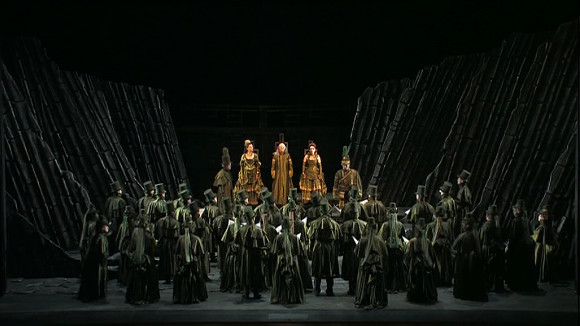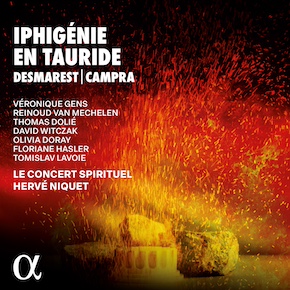
Euripides’ Iphigenia at Tauris formed the basis for an opera almost a century before the more famous one by Gluck. Henri Desmarets; one of the more notable successors to Lully at Versailles/Paris began work on an Iphigenia opera to a libretto by Joseph-François Duché de Vancy in the 1690s but work was interrupted by Desmarets being exiled from France for marrying a minor without her father’s permission. Eventually the Académie Royale de la Musique entrusted the task of completing the opera to André Campra who teamed up with Antoine Danchet as librettist. The end result was a tragédie lyrique in five acts and a prologue that premiered in 1704 to some success. An even more successful revival in 1711 led to multiple productions across France and abroad before it was effectively replaced by the Gluck work in 1779. Continue reading
Tag Archives: van mechelen
Does anybody do dance like Opéra de Paris?
The title of this review of a 2022 recording of Rameau’s Platée is prompted by the fact that I’ve rarely seen this much high quality dance included in an opera production. It’s really spectacular. But back to basics. Platée is a comic opera of 1745. The production filmed in 2022 is by Laurent Pelly and was making its fifth run at the Palais Garnier. There’s an earlier video release of the 2002 run.

Titon et l’Aurore
Jean-Joseph Cassanéa de Mondonville’s Titon et l’Aurore is another member of that rather long list of operas that were well received in their day and then totally disappeared from the rep. It’s interesting as an example of what was happening on the French opera stage between the retirement of Rameau and the revolution (it premiered in 1753) and because it played an important role in the “querelle des bouffons”.

Brueghelland
ETA 6th December 2019:
Rewatching Le Grand Macabre after four years has rather changed my opinion. It still seems weird and sometimes hard to watch but I think I see a certain logic in it now that completely escaped me before. So the End of the World is approaching and all the Powers that Be can do is squabble, exchange scatological insults and get very, very drunk while the one sane (if rather weird) character (Gepopo) can’t find a language to communicate the enormity of what’s happening to them. Sound vaguely familiar? (Coincidentally, I’m writing this on the day that Andrew Scheer said that the Federal Government should give more heroin to the addicts in Alberta because otherwise they’ll get in a snit). Of course, in Ligeti’s version Death gets so drunk that he screws up terminating the space-time continuum but we probably won’t be so lucky. So yes the fart jokes and the raccoon on bins orchestra is still there but it now seems to me in service of something rather more profound than I previously gave it credit for. Also, Hannigan is not just brilliant vocally. It’s also, even by her standards, an amazing physical performance. (Original review under the cut).

Le Roi d’Ys
It’s perhaps surprising that Lalo’s Le Roi d’Ys isn’t performed much more often than it is. Most people probably only know it for the tenor aria Vainement, ma bien-aimée which crops up from time to time in recitals and competitions. Sure, it’s not strikingly original. The plot is a love triangle with overlays of revenge and divine retribution and the music is, with the exception of the rather fine overture, a bit on the rumpty tumpty side. But, let’s face it, there are plenty of standard repertoire works with implausible romantic plots and banal, if tuneful, music. I think there’s a large section of the opera audience that would very much enjoy this piece.