I was talking to Leslie Barcza of barczablog at a concert yesterday. He asked me what I was most looking forward to in the upcoming season and I was a bit stumped for an answer because there’s lots of good stuff in Toronto this season but nothing that really sets my pulse racing. Finally I answered with the TSO’s Dream of Gerontius, which, it turns out, is not exactly high on Lesley’s bucket list. This led to a brief discussion about how origins affect our reactions; that is until the actual concert interrupted our talk.
Tag Archives: strauss
Historic Ariadne
Opera videos of performances before 1980 are quite rare and are mostly films. Recordings of live performances are extremely uncommon and often quite interesting. A couple have just been rereleased on DVD. The one reviewed here is an Ariadne auf Naxos from the 1965 Salzburg Festival (the other is a recording, in German, of Don Giovanni with Fischer-Dieskau – watch this space). It’s an old ORF TV broadcast with a grainy 4:3 black and white picture and less than stellar mono sound but it does provide an idea of what audiences saw and heard fifty years ago.
Natalie Dessay showcase
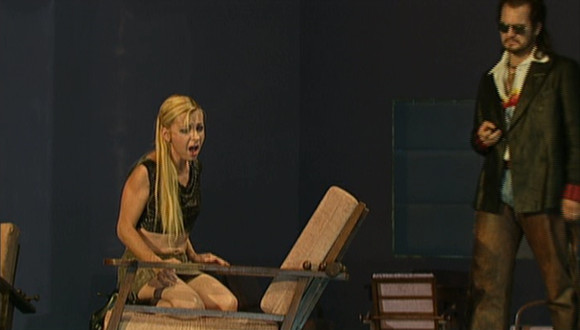
Le miracle d’une voix is a compilation of scenes from various recordings in which Natalie Dessay featured made between 1993 and 2003. It’s especially interesting in that a couple of pieces feature more than once. There are three Les oiseaux dans les charmilles; Olymia’s aria from Les contes d’Hoffmann and two Grossmächtigen Prinzessin from Ariadne auf Naxos. Thrse demonstarte what I have always believed to be Dessay’s greatest strength; her ability to recreate a character to fit in a particular production. The two Zerbunetta arias illustrate this perfectly. In the first, a Salzburg production from 2001, Zerbinetta is a depressed, heavy drinking, prostitute who celebrates a kind of deeply sad sisterhood with Ariadne before being dragged off by a very sleazy Russell Braun. In the second, from the Palais Garnier in 2003, she’s a bubble headed tourist in bikini and wrap who pesters poor Ariadne all around what looks like a Mediterranean building site. They are completely different characterisations but both highly effective. The same is true of the three Olympias who range from very conventional doll to inmate in some sort of asylum or home.
Dessay is a spectacular Zerbinetta
A recording featuring Deb Voigt and Natalie Dessay, both high on my list of singers I’d like to party with, obviously has to be seen. They feature in a 2003 recording of Ariadne auf Naxos from the Met. It’s a Moshinsky production, directed for this run by Laurie Feldman. It’s pretty traditional in most respects though there are some interesting touches in the second act. We are squarely in the house of the richest man in Vienna c. 1750. No Konzept here. In fact, the first act is traditional too in that the acting is broad, going on coarse grained. Dessay brings a touch of distinction, managing to effectively portray the more vulnerable side of Zerbinetta. Voigt too is very fine, and very much with the overall mood, as a completely over the top stroppy diva. She’s definitely playing for laughs. Susanne Mentzner’s Composer and Wolgang Brendel’s Music Master are both quite competent but suffer a bit from the pantomime acting the director appears to want.
Midnight Marschallin
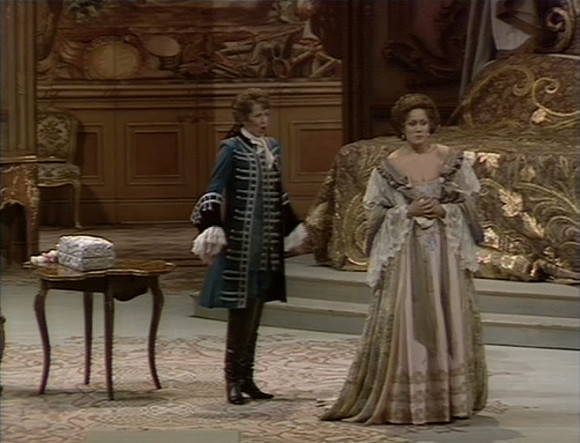
In 1985 the Royal Opera House staged film director john Schlesinger’s production of Der Rosenkavalier to mark the 25th anniversary of Sir Georg Solti’s house debut. It’s an essentially traditional production. We are in 1740s Vienna and both costumes and set are highly elaborate. The opening scene stars one of the largest beds ever seen on an opera stage. That said, it’s well put together. The chemistry between the principals is good and the nonsense at the beginning of Act 3 is deftly handled. There are a number of small touches that help set the tone too. For example, at the beginning of Act 2 fake books are being installed in the Faninal “library”.
Where gay hussars are found
OK I’m not going to pretend that Johann Strauss’ Der Zigeunerbaron is profound or anything but it is kind of fun, especially when given the no holds barred Mörbisch Seefestspiele treatment. It’s a tale of mistaken identity and romance with some silly humour thrown in and lots of gypsies (complete with obligatory anvil chorus) and a hidden treasure. Heinz Marecek’s 2000 production is old fashioned spectacular with scads of dancers, galloping hussars and rather outlandish costumes all set on the large Mörbisch island stage and complete with a noisy and spectacular firework display at the start of Act 3. There are bonus pigs.
First, the sound quality
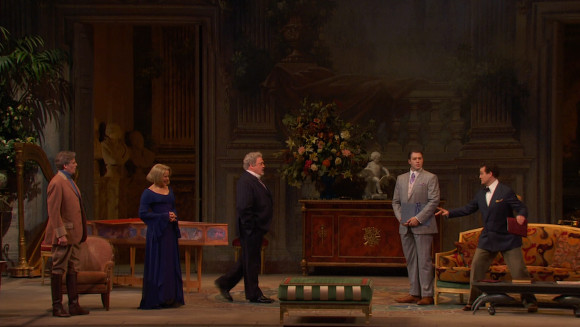
The MetHD broadcast of Strauss’ Capriccio has been issued on Blu-ray. I enjoyed the original broadcast but found watching it again on disk rather unsatisfying. The main problem is the production. It’s a John Cox effort from 1998. The period is updated from ancien régime France to just after WW1, apparently to make the people more contemporary while allowing an opulent, old style Met “all the things” production. Peter McClintock’s direction of the revival emphasizes the most obvious comedy (the ballerina falling over with her legs in the air, for example) while doing little or nothing to bring out the sheer cleverness of this opera, about an opera, within an opera. It all seems very heavy handed, in fact the word that popped into my head several times was “vulgar”.
Kleiber’s Rosenkavalier
Carlos Kleiber didn’t record much despite enjoying something of a cult following as a conductor. In 1994, shortly before his death, he conducted four performances of Der Rosenkavalier at the Wiener Staatsoper; the first of which was recorded. It’s clearly Kleiber’s night. His appearances at the start of each act are greeted with cheers and wild applause. One can only guess at the reception he got afterwards because the curtain calls don’t make it onto the recording. And, yes, it is a masterly conducting performance with fine support for the singers, beautifully shaped lines and an infectious sense of fun.
Lunchtime with Tracy Dahl
I’ve attended many very good concerts in the Richard Bradshaw Amphitheatre but I’m not sure I’ve ever attended one as intense as Tracy Dahl and Liz Upchurch’s Songs from the Heart recital today. Tracy really is a rather extraordinary artist. She is the antithesis of the lieder singer who stands demurely by the piano and Schuberts mellifluously. She throws every fibre of her being into the performance. It’s not campily histrionic but voice, facial expression and gesture are all used to the full whether she’s hiccupping a drunken Harlequin or sibilantly suggesting a slithery singing snake.
Static Elektra
For the performances of Elektra at the 2010 Baden-Baden festival the Powers that Be chose to revive Herbert Wernicke’s 1997 Munich production with Bettina Göschl directing. The production concept seems to have been inspired by classical Greek drama. Sets and costumes are very simple, even austere, and the singers often address the audience directly. On stage this probably worked quite well as the overall effects are visually striking and the relative lack of interaction between the characters is perhaps appropriate for a work that is so much about alienation.