In an age of co-productions many opera productions are seen in multiple houses. Some of them we get to see in multiple guises. For example I’ve seen Tcherniakov’s Don Giovanni on DVD and will be seeing it live later this season in Toronto. Spmething that’s been fermenting in my brain for a while now is why the same production can get a drastically different reception in different places. The piece that first made me think about this was Chris Alden’s Die Fledermaus. This was generally well received in Toronto (more perhaps by my friends and acquaintances than the print media but that’s par for the course) but universally panned in London when it played at ENO. Bryan’s interesting comments about the Carsen Falstaff kicked off the train of thought again and made me want to put some tentative thoughts into writing.
Tag Archives: schade
The COC’s 2014/15 season announced
Yesterday evening saw the announcement of the line up for the COC’s 2014/15 season. The usual rather prosaic press conference was replaced with a glitzy reception and main stage show featuring Brent Bambury of the COC interviewing Alexander Neef, Johannes Debus and others plus piano accompanied performances by Simone Osborne, Russel Braun, Robert Gleadow, Charlotte Burrage and Aviva Fortunata.
There were few surprises, in itself no surprise given the number of official and unofficial “leaks” this time around. There are three productions new to Toronto, all COC copros, and three revivals so it’s an “all COC” season with no rentals or other imports. Here’s what’s coming up:
Renée and her frocks
John Cox’s production of Massenet’s Thaïs at the Metropolitan Opera is probably most remembered for the rather extraordinary collection of Christian Lacroix frocks that Met perennial Renée Fleming gets to wear. It’s rather more than that. In fact it’s a pretty good example of what the Met does best. It’s sumptuous and spectacular and has a pretty much ideal cast which, together, go a long way toward making this curious piece rather enjoyable.
Schade rocks
Today’s summer second thought is the 2004 Salzburg festival production of Purcell’s King Arthur. I really enjoyed this first time around and I think it stands up extremely well to repeat viewing. I pretty much stand by my original review but certain aspects of the production did stand out on repeat viewing. The first thing that struck me is how these English 17th century works are very much a blend of the vulgar and the sublime (one could argue that that is the defining characteristic of English culture; from Chaucer to Trooping the Colour). This production, like Jonathan Kent’s The Fairy Queen, successfully blends the two elements. There’s a really good example at the very end where Michael Schade’s panty strewn rock star “Harvest Home” is followed by a gorgeous and dignifieed “Fairest Isle from Barabara Bonney but there’s lots more; much of reinforced by the sort of special effects that a Restoration audience would have loved. There’s also some real depth in how it’s done. First up I found the Merlin dressed as banker’s wife episode very funny but just that. On rewatching I realised that much more is going on as the scene segs into Merlin explaining to Arthur that everything around him is an illusion.
Summer second thoughts
The heat and humidity of a Toronto summer aren’t especially conducive to dealing with most of what’s in my DVD review pile right now (Wagner chiefly!) and the live music pickings are slim as, Toronto Summer Music Festival aside, music has departed for the land of moose and loon. I thought, therefore, that I might take another look at some old favourites and see how they shape up to a second look. I thought I’d focus on works where I have seen many subsequent productions or, perhaps, on works once seen only on DVD but which I had more recently been able to see live.
‘Tis the season
Opera/concert season is pretty much done in the big smoke though there is the Toronto Summer Music Festival (see below). Attention moves to various more rural venues and to some seriously eclectic programming. Out in Northumberland County there’s the Westben Festival with concerts in a barn ranging fro Irish trad to Richard Margison. The highlight, for me, here would be a recital by Suzy Leblanc and Julius Drake featuring French mélodies, Strauss lieder and English songs by Christos Hatzis. That one is on July 30. Westben also has the UBC Opera Ensemble doing Carmen and, for those so inclined, a programme of Broadway tunes from the ever reliable Virginia Hatfield, Brett Polegato and James Levesque. No word on whether Brett’s cat is also performing.
Stratford Summer Music has three concerts by the Vienna Boys Choir, one including Michael Schade. There is also the Bicycle Opera Project and a celebration of R. Murray Schafer’s 80th birthday.
Meanwhile, back in the smoke there is the Toronto Summer Music Festival which kicks off on July 16th with the Trio Pennetier Pasquier Pidoux in an all French programme. The highlights for me are the Gryphon Trio with Bob Pomakov on the 18th and Philippe Sly with Julius Drake on the 23rd.
Ex Alden semper aliquot novis
Last night saw the final performance of the COC’s run of La clemenza di Tito. I had seen the Ensemble Studio performance a couple of weeks ago and really enjoyed it but had some questions and reservations about the production. Last night many of those issues were resolved. It seemed more closely directed and the characterizations were more fully rehearsed. A good example of this would be Michael Schade’s intensely neurotic Tito which was central to the concept. Many things make sense if one sees Tito as being in love with an idea of himself. In this context his betrayal by Sesto is particularly hurtful because it implies that his closest confidante isn’t buying it and his “clemency” is necessary to restore his faith in his own self-projection. This Tito gives Robert Gleadow’s Publio space and reason to be more than the dutiful, rather thick plod. He’s the one who has seen through Tito but must “play the game”. His final, rather sharp, exchanges with Vitellia suggest a genuine capacity for malevolence. This is, after all, an Imperial Court, where by definition life is dangerous and nothing what it seems.
Sister swap
Richard Strauss’ Arabella is a bit of a peculiarity. The music is top notch Strauss and the libretto is by von Hofmannsthal so it ought to be quite superb. It doesn’t quite get there though. It’s hard not to think that if von Hofmannsthal had lived a little longer he would have tightened up the libretto. Act 1 works fine but Acts 2 and 3 seem rather contrived and could definitely use a few cuts. I’m not sure that the whole Fiakermilli thing works either. It’s almost as if Prince Orlofsky’s party mislaid Johann and found Richard by accident. That said there is some very beautiful music. Aber der Richtige, wenn’s einem gibt is going straight onto my list of top soprano duets.
COC’s Fledermaus succeeds on several levels
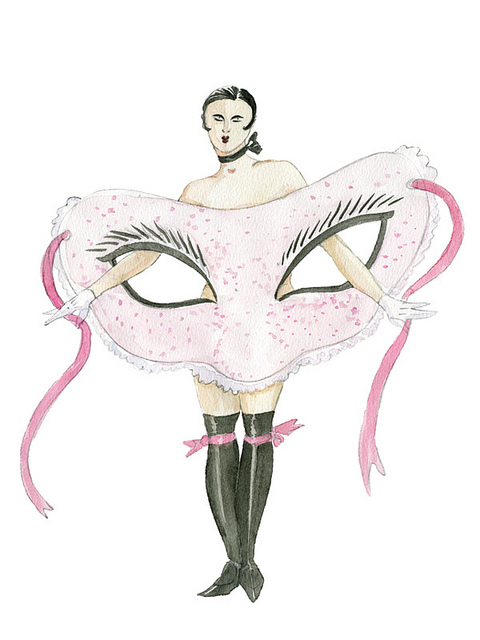
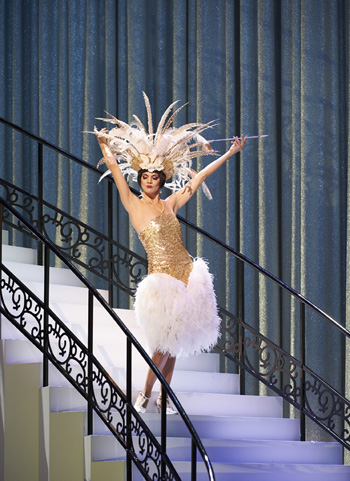
Christopher Alden’s recent productions in Toronto; Rigoletto and Der Fliegender Holländer, were controversial, rather cerebral affairs that delighted his fans but tended to puzzle, and even infuriate, the more conservative critics and opera goers. His Die Fledermaus, which opened last night at the Four Seasons Centre, has something for everybody. There are two main threads uniting the three acts. The first is the piece as an allegory of Austrian bourgeois society from an insecure pre WW1 period through a period of unbridled hedonism in the 1920s to the beginnings of Fascism. The second is a much more explicit depiction of Falke as the ringmaster of the whole circus. He goes from manipulative Freudian psychiatrist in Act 1 to Orlofsky’s confidante in Act 2 to, bat costumed, sitting astride the giant watch that hangs above the stage; the only character aloof from the takeover of the drama by the sinisterly Fascistic Frosch. All this is strung together by prefiguring later elements in earlier scenes. In Act 1 the party goers from Act 2 invade the scene via the fractured wall of Rosalinde’s bedroom as Gabriel imagines the delights to come. A silent but frenetic Frosch appears on stage at various points in the first two acts although his identity isn’t apparent until the coup de theâtre that carries us into Act 3. Additionally Alden does not shy away from bat imagery, including it’s darker overtones. There are bat shadows on the backdrop during the overture, Falke first appears as a Dracula look alike, the ‘ballet’ are batgirls and we close out with Falke, again dressed as a bat, overseeing the denouement. There’s a lot going on and I shall be very happy to see this again and delve deeper (a recurrent theme with Alden productions). Continue reading
Sneak preview of Die Fledermaus
There’s an event on in Toronto this weekend called “CultureDays”. The COC’s contribution last night was an open orchestra dress rehearsal of Christopher Alden’s new production of Die Fledermaus preceded by a talk in the Richard Bradshaw Auditorium by set designer Allen Moyer and costume designer Constance Hoffman moderated by the CBC’s Brent Bambury. The event was “first come, first served” and restricted to 500 tickets so we decided to be early. Doors opened at 1815 for a 1830 talk so the plan was to meet the lemur at the opera house at 1700, grab a bite to eat and then join the line-up. I got there early as I was through at work and preferred to sit in the sunshine at the Four Seasons Centre rather than at my desk so I got there around 1615. There was already a line up! By the time the lemur showed up just before 1700 there was quite a line up so we changed plan and the lemur went off to fetch burritos to eat in the line. Just as well as they ended up turning people away. Continue reading