Dido on film

Long before I got my hands on the Royal Opera House/Royal Ballet Dido and Aeneas, the film version from 1995, directed by Peter Manuira and with Maria Ewing in the title role, was my go to version. How does it stack up today?

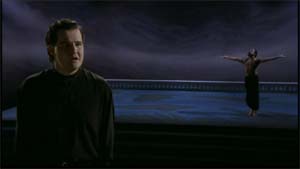
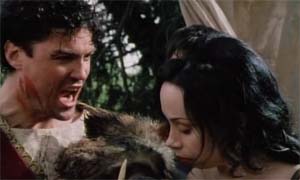
Some things that strike me.  It’s very naturalistic. It seems to be set in and around a Tudor mansion and the costumes are vaguely that way too. The interludes that are normally danced are filled in with “busy” scenes that try to inject some feeling but aren’t nearly as effective as Wayne McGregor’s dancers. The hunt scene has dogs and spears and a real boar’s head (which Aeneas touchingly present to Dido in her bath). There is a lot of fire including a full blown pyre at the end. For all that it doesn’t seem any more “true” than Wayne McGregor’s much sparer vision. It’s also very emotionally restrained. It’s not really until the final confrontation between Aeneas and Dido that any real emotion intrudes and even then it’s quite restrained This is actually very effective and Maria Ewing is truly affecting in the final couple of scenes. Ewing is good throughout both in the singing and acting department and her looks help (OK I know not everyone goes for Ewing but I think she’s gorgeous!). Karl Daymond is fine as Aeneas. We get a sort of composite Belinda/Second Woman set up with some of Belinda’s music given to the Second Woman and them doubling up on other bits. While Rebecca Evans and Patricia Rosario are fine there really isn’t enough musical or emotional contrast between them and Ewing. Richard Hickox conducts the Collegium Musicum and it’s all a bit low key in common with much else. It’s worth watching for Ewing’s performance in the final act but is otherwise a bit of a snooze.

Technically it’s very 1995. The 16:9 picture is hard letterboxed in a 4:3 frame and it’s pretty soft grained. Sound is adequate LPCM stereo. There are English, French and German subtitles.

Let the triumph of love and of beauty be shown

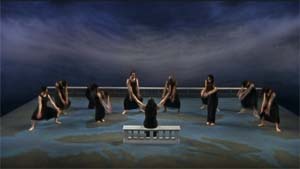
One of the trickiest things about opera productions; baroque opera anyway, is what to do about the dance elements. Time was when opera and ballet were joined at the hip but not so much nowadays beyond sharing premises. In 2009 the Royal Opera House made the bold decision to have choreographer Wayne McGregor direct the combined forces of the Royal Opera and the Royal Ballet in a production of Henry Purcell’s pocket masterpiece Dido and Aeneas. The result was broadcast by the BBC and subsequently released on DVD and Blu-Ray by Opus Arte. It’s a fascinating and rewarding production.

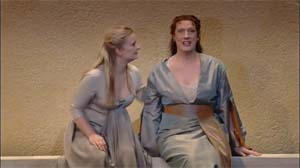
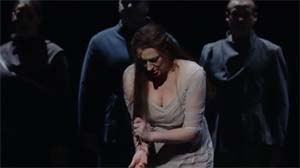
Sets and costumes are very spare. Aeneas and the chorus are in greatcoats and wide trousers. The ladies are in unfussy gowns. The dancers are in singlets and booty shorts (both sexes). Carefully detailed direction of the singers and their gestures, bold choreography and imaginative lighting carry the visual side of the production. The use of top quality dancers and a top notch choreographer allows the dance elements to realise their full potential (and not a castanet in sight!). The result is visually stunning.

Now add a superb singing cast. Lucy Crowe almost steals the show as Belinda. She’s fresh and vivacious and her clean sound is just right for Purcell. But it is “almost” because we have Sarah Connolly’s monumental Dido to set against it.(1) She is one of the great Didos. I have heard Kirkby, Te Kanawa, Ewing and Baker in the role and even Flagstad but none exceed the combination of searing intensity and pathos that Connolly brings to the role. She is superb. Other elements of the singing are also admirable. Lucas Meachem is a hunky Aeneas and manages the tricky low notes better than most. The sorceress and witches; Sara Fulgoni with Eri Nakamura and Pumeza Matshikiza playing Siamese twins, don’t do the camped up distorted thing that is so often inflicted on the role. Fulgoni sings with quite a lot of vibrato which is sufficient to create some musical distance between her and the non infernal characters. The minor roles are all pretty good too. The regular Covent Garden orchestra is replaced by the Orchestra of the Age of Enlightenment under Christopher Hogwood. This is a move that other large houses might think about for earlier repertoire.

All this goodness builds to a searing climax in which Dido slits her wrists with the “tushes far exceeding those that Venus’ huntsman slew” and dies while a haunting projection of a horse plays back of stage. All in all it’s an hour of magic.

Video direction is much better than average. Close ups are minimised and we get to see the choreography in its broadest sense. The picture is superb 16:9 anamorphic (1080i on the Blu-Ray) and sound options are PCM stereo and DTS 5.1 (PCM 2.0 and PCM 5.1 on Blu-Ray). There are English, French, Spanish, German and Italian subtitle options.

Highly recommended.

(1) I do think the balance of voice types between Belinda and Dido is important. It’s like Carmen and Micaëla. If the voices are too similar much texture is lost. Crowe and Connolly are an ideal combination.

How to do Purcell

A while ago I had the misfortune to watch a thoroughly misconceived version of Purcell’s King Arthur. I have now had a chance to watch a version from the 2004 Salzburg Festival and it’s a lot better! This production by Jürgen Flimm takes Purcell and Dryden’s work and treats it respectfully but not solemnly. As originally intended, it’s given as a series of scenes spoken by actors interspersed by songs which are sung by five singers who change role as needed. The dialogue is in German but the singing is in English which seems a bit odd at first to an English speaker but one soon gets used to it. Flimm uses Dryden’s text for the most part but interpolates some scenes, notably where Merlin, disguised as an investment banker’s wife, enters via the auditorium and delivers a diatribe about Regietheater and how Salzburg has gone all to Hell. It’s just like being at a typical COC Opera 101. It’s staged in the appropriately baroque Felsenreitschule and the set mirrored the arcades of the building with a brightly painted wooden arcade structure set behind the stage. The orchestra is in a sunken pit in the middle of the stage so the action takes place all around them. There is clearly some heavy duty projection equipment behind the set because the production uses a wide range of, often spectacular, lighting effects.

1.sacrifice


Continue reading

The Most Ghastlie Murther of Mr. Henry Purcell

Purcell’s semi-operas are notoriously difficult to recreate for the stage though it can be done, and brilliantly, as the recent The Fairy Queen at Glyndebourne showed. M. Hervé Niquet and his collaborators (co-perpetrators might be a better term) in Montpellier take the Purcell/Dryden piece King Arthur and provide an object lesson in how not to do it. Starting with a campy explanation of how he couldn’t inflict five hours of John Dryden on us, M. Niquet inflicts upon us a travesty each five minutes of which seem to last longer than five hours of Dryden, or even Racine. The objective, we are told, was to create a narrative to link the Purcell numbers and create something coherent. Except the “plot” (more or less non-existent) which M. Niquet has cooked up with the help of a hitherto unknown to me french comedy duo, Shirley and Dino, doesn’t actually do that. It’s not helped by the fact that no differentiation is made between British and Saxon characters but that’s really minor compared with the overall lameness of it. Most of the linking action is camped up. It’s supposed to be Pythonesque apparently but this lot of Frenchmen are about as convincing as Pythons as the Pythons are as Frenchmen. All the action, except Purcell’s songs, is in French which also seems odd. The Purcell is sung in English, though with the exception of the solid and idiomatic bass, Joao Fernandez, it’s not always obvious. The other singers really aren’t adequate in any department; shrill, forced and unidiomatic to a man/woman, though being forced to camp it up all the time doesn’t help. I couldn’t watch it all. I got half way through Act 2 then fast forwarded to Act 5. I wish I hadn’t. The suffering that is inflicted on that gorgeous song “Fairest Isle, all isles excelling” is just the final straw.

Searching desperately for positives besides Joao Fernandez I would say that the band, Le Concert Spirituel, is very good indeed. Everything else is almost enough to make one forget how good the music Purcell wrote for King Arthur actually is.

Watch if you dare…